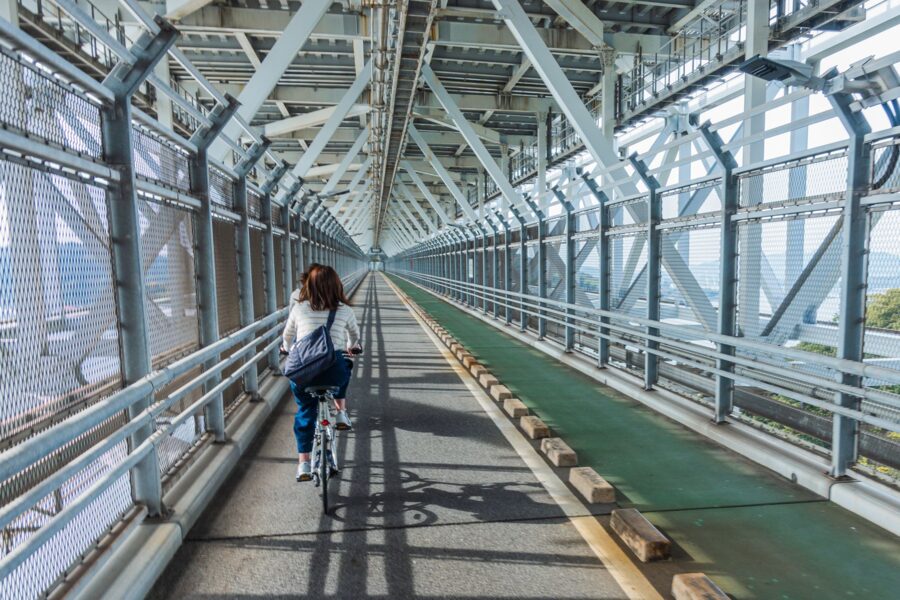
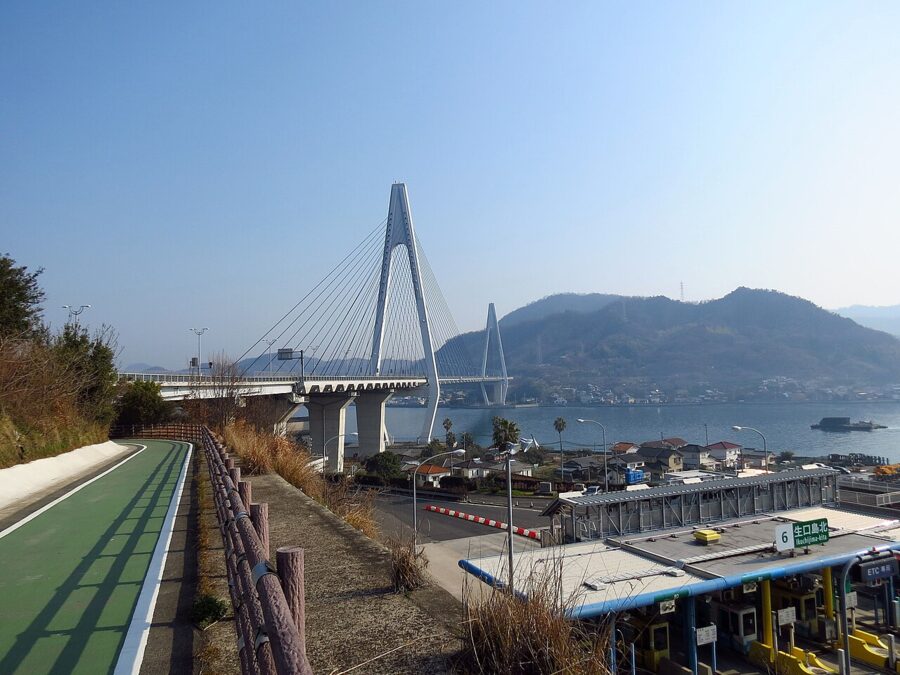
The cycle lane on the Innoshima Bridge does not run beside the traffic. It runs underneath it, inside the steel truss, 58 metres above the Mekari Strait, with the expressway rumbling overhead and the sea showing through the mesh on both sides. For 1,270 metres you ride in a long grey tunnel of girders, sharing the lane with the odd moped, and then you drop down a ramp into Ohama and the island begins.
The first thing worth stopping for is a short ride from the bottom of that ramp: a small shop by the bridge park that makes hassaku daifuku, opens at 08:30 and shuts when the day’s batch has gone. Leave Onomichi after breakfast and you reach it mid-morning, buy one, and can be across Innoshima and onto the next bridge within the hour.
That is a perfectly good way to do it. But Innoshima is also the island of the Innoshima Murakami pirates, of a hill lined with some 700 stone Buddhist figures, of the winter citrus now sold all over Japan and of the shipyards that paid for the island’s last hundred years. The decision this island asks of you is simple: one hour or half a day.
In this guide10
- Where Innoshima sits on the route
- Arriving over the Innoshima Bridge
- Crossing the island: the signed route and the hill choices
- Innoshima Suigun Castle and the Murakami pirates
- Shirataki-yama and its views
- The Flower Center and the pyrethrum fields
- Hassaku and hassaku daifuku
- Habu, the shipyards and the east side
- The Ikuchi Bridge and the ferries from Innoshima
- Where to stay and eat
Where Innoshima sits on the route
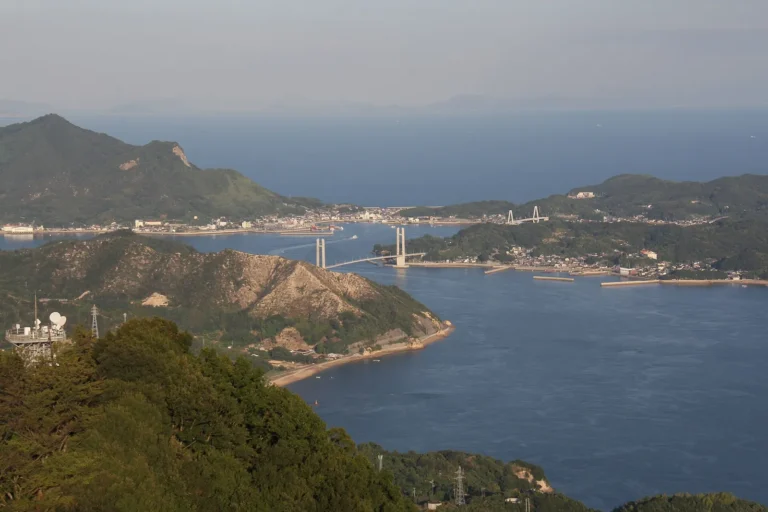
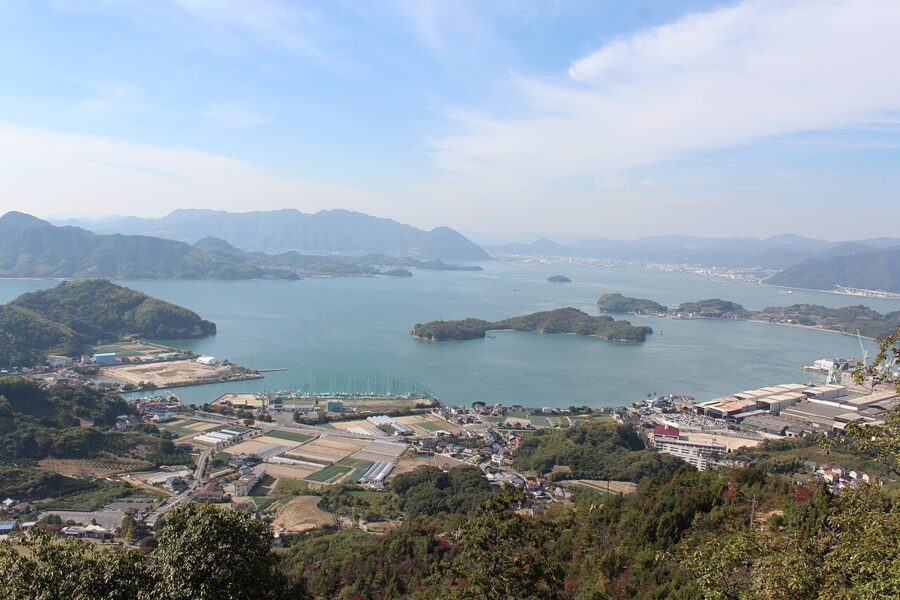
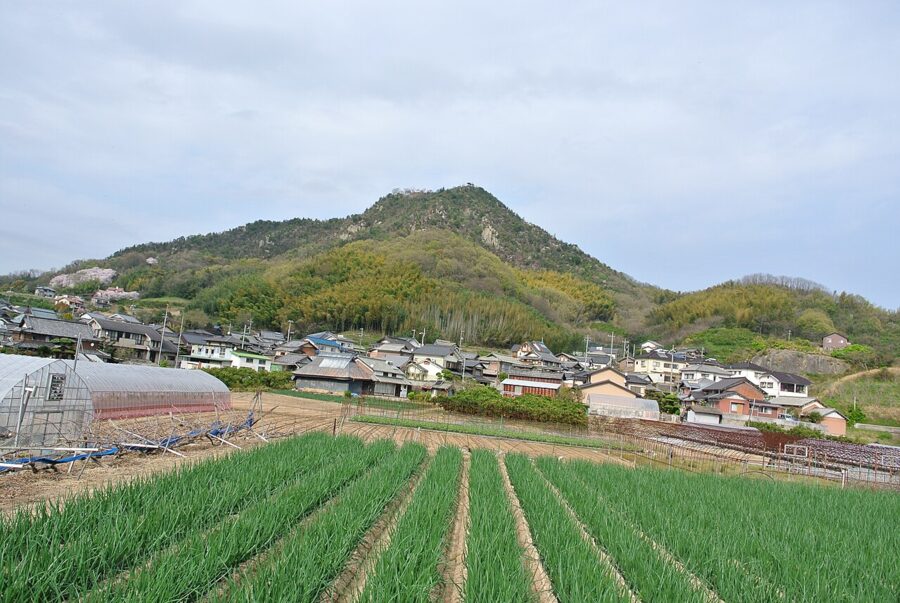
Innoshima (因島) is the second island south of Onomichi on the Shimanami Kaido, after Mukaishima. The Innoshima Bridge brings you in at Ohama on the north-east tip; the Ikuchi Bridge takes you out from Taguma on the west side, across a narrow strait to Ikuchijima and Setoda. Until 2006 it was its own city, and the island still has the feel of a working town rather than a resort: a port, a hospital, shipyards and a high street at Habu in the south-east, citrus terraces and onion fields everywhere else.
On the signed cycling route you see only the western half. The blue line keeps to the flatter side of the island and gets you from one bridge to the other in roughly 12 km (7.5 miles), which is the length of the tourism association’s own west-side course from Amenity Park to the Ikuchi Bridge. Allow under an hour of riding for that, plus whatever you stop for. Habu, the castle, the east coast and the hills are all off the line, and that is where the half-day goes.
You can also skip the first island: boats from Onomichi call at Shigei on the north-west coast, and a high-speed boat runs from Mihara to Habu (details below); both are handy ways of getting to the Shimanami Kaido from the Shinkansen.
Arriving over the Innoshima Bridge
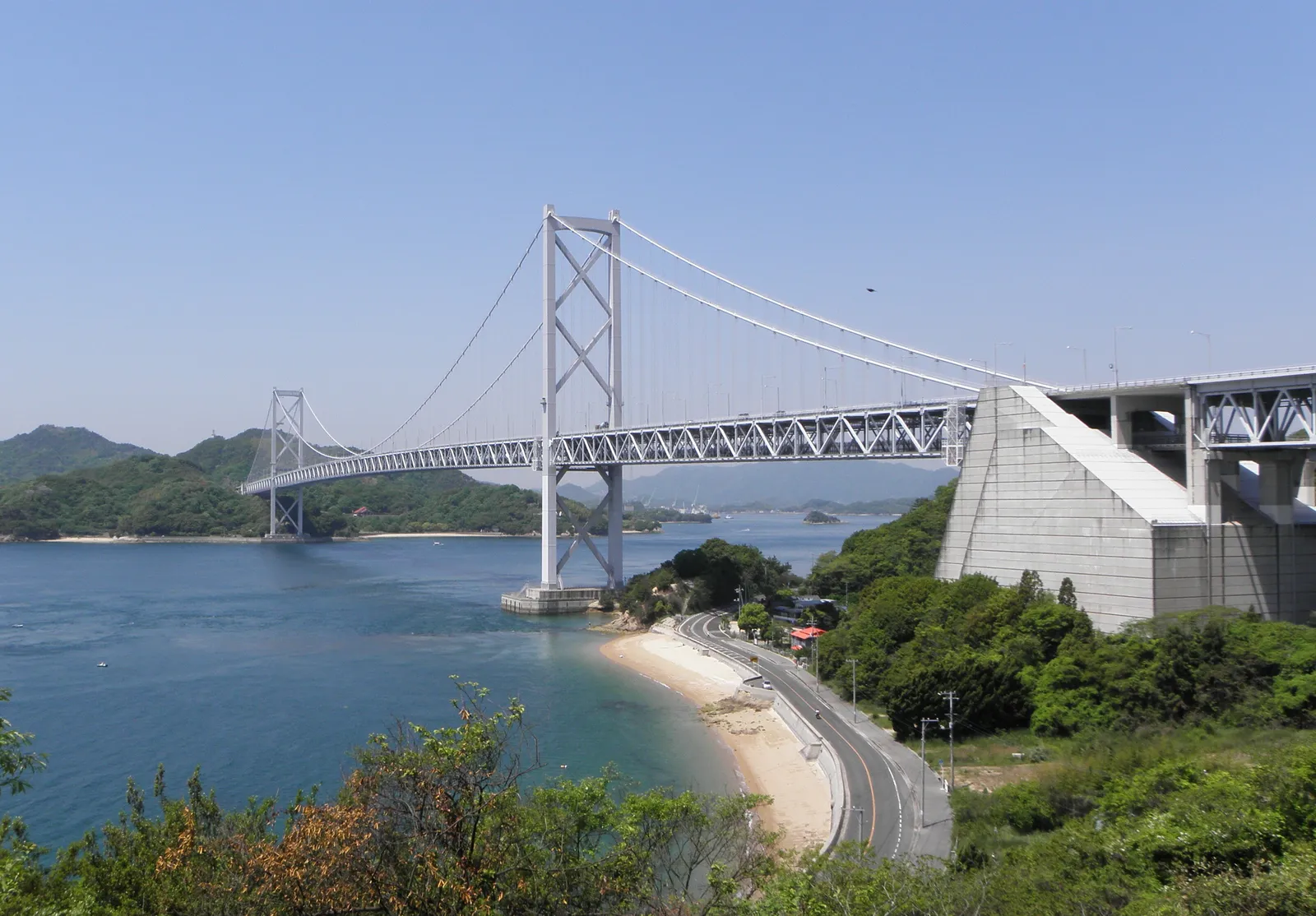
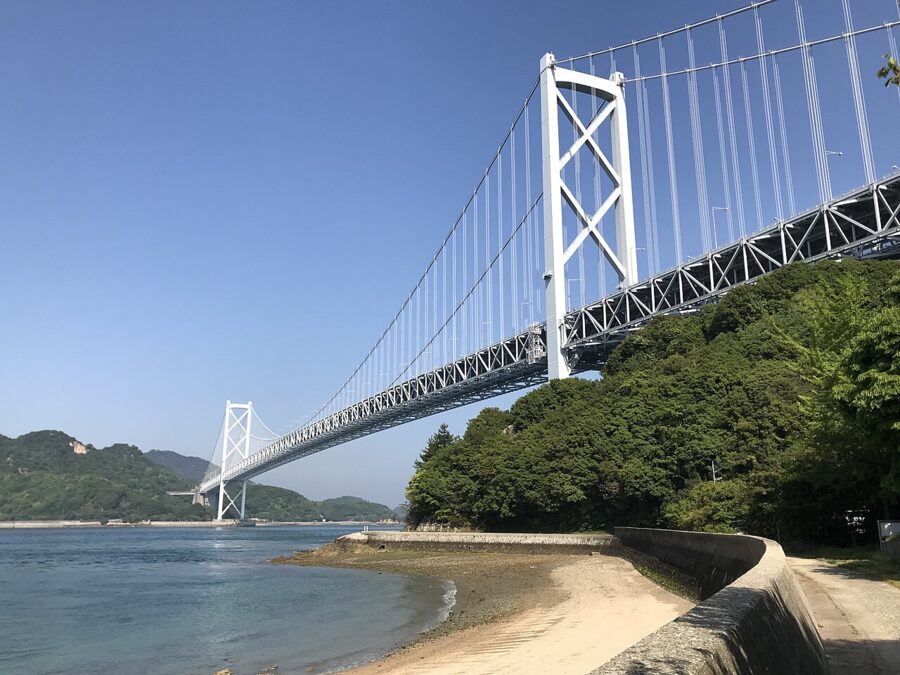
The Innoshima Bridge opened in December 1983, the first of the Honshu-Shikoku suspension bridges to be completed. Its central span of 770 metres was the longest in Japan when it was finished, and its towers stand 145 metres above sea level. Look at it from the beach and you see why it carries two roads: the deck is a deep steel truss rather than a slim girder, with room inside it for a second level.
That second deck is yours. Cyclists enter on the Mukaishima side at Tachibana and ride inside the truss to Ohama, on a deck 58 metres above the sea that bicycles share with mopeds. Bicycles cross free: the “Shimanami Cycling Free” scheme that waives the cycle tolls on the route’s bridges has been extended to 31 March 2028. Mopeds still pay.
One practical point: the cycle and footpath decks close in strong winds and typhoons, like those on every bridge on the route. If the morning forecast is rough, check the closures before you set off from Onomichi rather than finding out at the ramp.
Ohama: the lighthouse and the bridge park
Before you ride on, the north tip of the island is worth ten minutes. Below the bridge, Innoshima Bridge Memorial Park has a sandy beach facing Mukaishima, and just past it on Cape Ohama stands the white Ohamasaki Lighthouse. The wooden building beside it, with three small towers on the roof, was built in 1910 as a tidal signal station for ships fighting the fast current of the Mekari Strait, and became an Important Cultural Property in 2024. Neither building is open, but the view from the shore is the point.
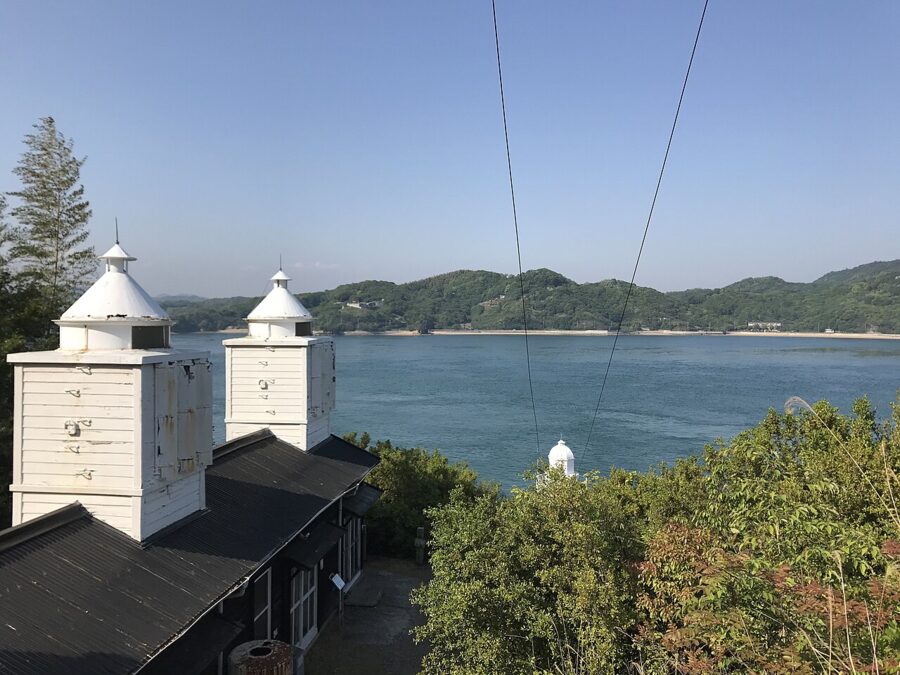
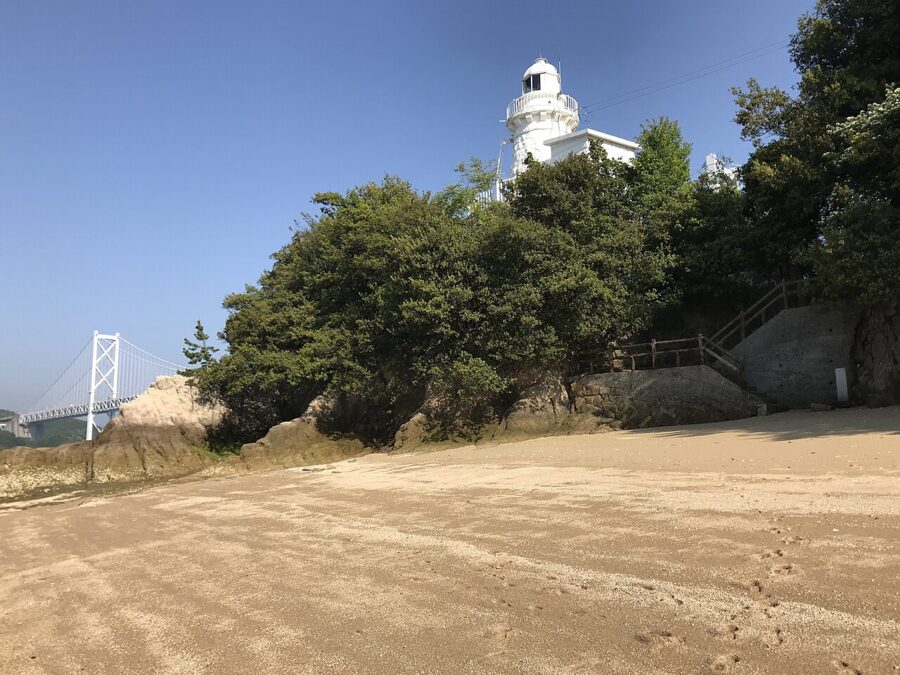
Crossing the island: the signed route and the hill choices
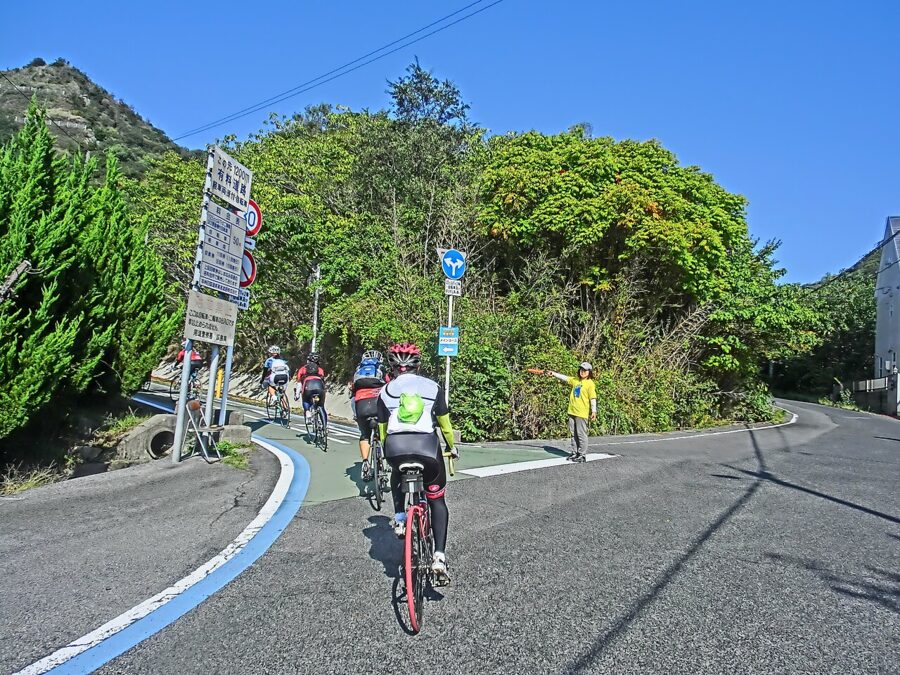
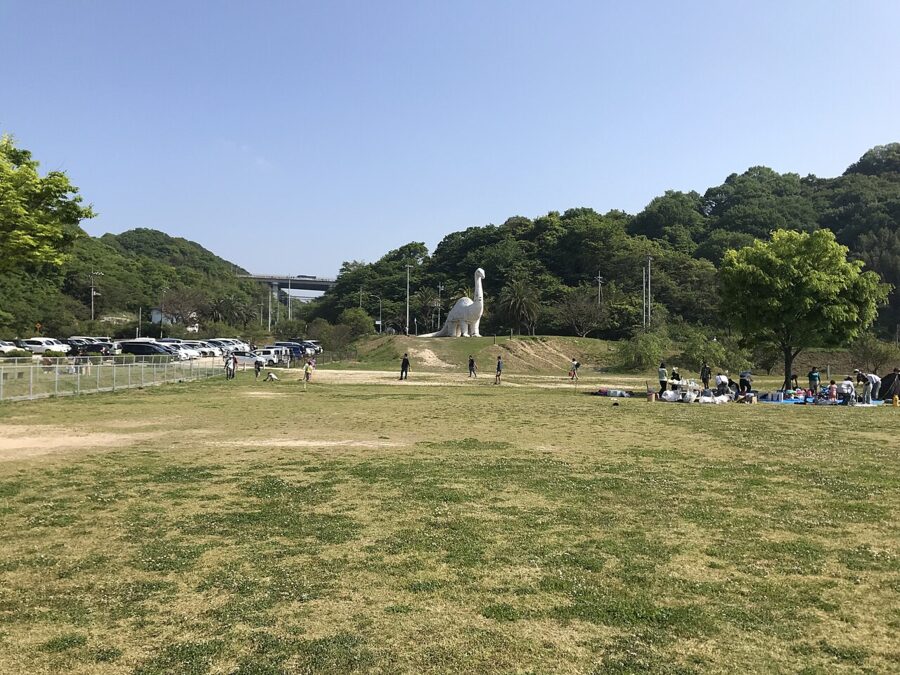
From Ohama the blue line runs west past Innoshima Amenity Park, a big lawn with toilets, a children’s play area and a dinosaur, and the beach at Shimanami Beach. It then turns inland through Shigei, past the gate of the Flower Center and the turning for Shirataki-yama, over one small rise by the sports park, and down through Nakanosho and Taguma to the Ikuchi Bridge ramp. It is the gentle way across, and on a weekday it is quiet. Through Taguma the road narrows and the traffic picks up, so ride in single file.
The tourism association’s cycling courses lay out the alternatives plainly. The east-side course is about 24 km (15 miles): Ohamasaki Lighthouse, then the Suigun Skyline, a road the association itself files under “gekisaka” (brutal slope), then Jizobana at Mitsunosho and round to the Ikuchi Bridge. The skyline starts climbing almost at once, and the first reward is the view over the Innoshima Bridge from Kaji-no-hana, one of the island’s eight named viewpoints. A third course of about 16 km (10 miles) links Shirataki-yama, the bicycle shrine at Oyama Shrine and Innoshima Park above Habu, which makes it the course for anyone who wants the views and does not mind the climbs.
My advice: if you are riding the whole route in a day, take the blue line and stop at the castle only if you started early. If your Shimanami Kaido itinerary has a night on Innoshima or Ikuchijima, the east side and Habu are the better half of the island, and an e-bike makes the climbs reasonable.
Renting on the island
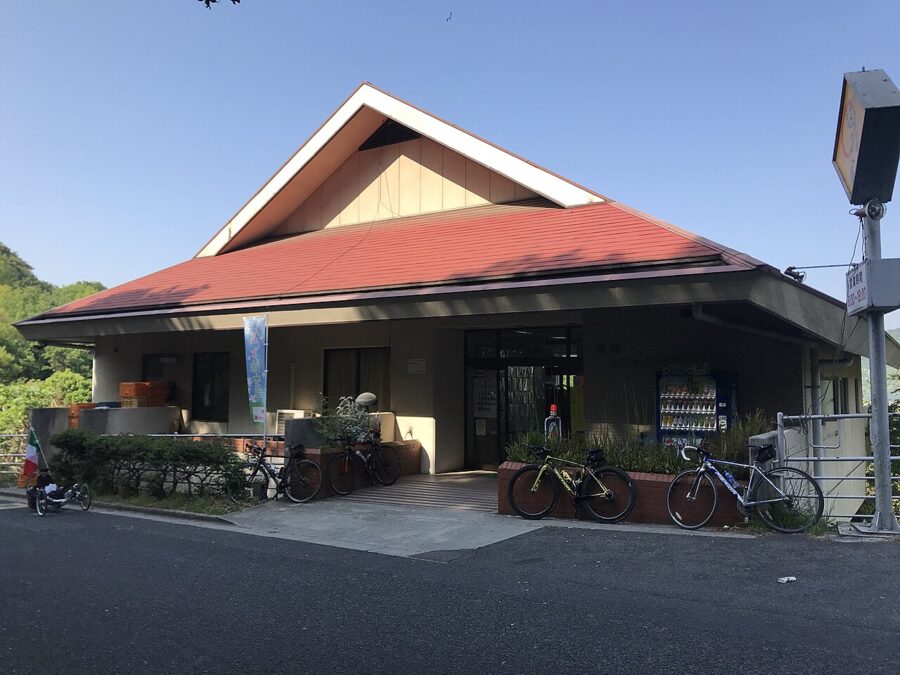
The Shimanami Japan terminal for Innoshima is at Habu port, in the municipal central car park (尾道市営中央駐車場), and its cross bikes and city bikes can be returned at any terminal on the route. Shimanami Japan’s rates are ¥3,000 (about US$20) a day for an adult bike and ¥4,000 for an electric-assist bike, as of 2026. Private shops, one-way rules and booking are part of Shimanami Kaido bike rental.
The island’s own office in the same building runs the Innoshima electric-assist rental, made for the hill choices above: ¥2,000 for up to four hours, ¥500 for each extra half hour and a ¥3,000 deposit, refunded on return. It covers Innoshima, Ikuchijima and the Kamijima islands, but the bike must come back to Habu, between 08:30 and 19:00 (17:00 from November to March).
Innoshima Suigun Castle and the Murakami pirates
Through the 15th and 16th centuries the narrow channels of the Geiyo islands were controlled by the Murakami, the family the Portuguese Jesuit Luis Frois called the greatest pirates in Japan. There were three branches, based on Noshima and Kurushima off Imabari and here on Innoshima. “Pirate” undersells them: in ordinary times they ran the sea lanes, collecting tolls from passing ships, piloting them through the currents and trading, and in war they fought as the navy of whichever lord they had allied with. The Murakami pirate heritage was listed as Japan Heritage in 2016.
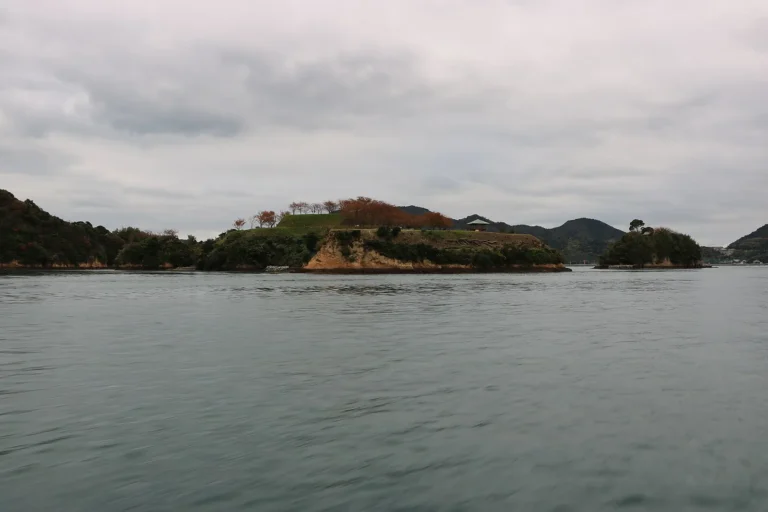
The Innoshima branch peaked under its sixth head, Murakami Yoshimitsu, an ally of the Kobayakawa clan, who moved his base onto Innoshima in 1567. His places are scattered across the island, mostly as wooded hilltops: castle sites, a lookout on Shirataki-yama and a sea checkpoint at Mikasaki on the south-east cape.
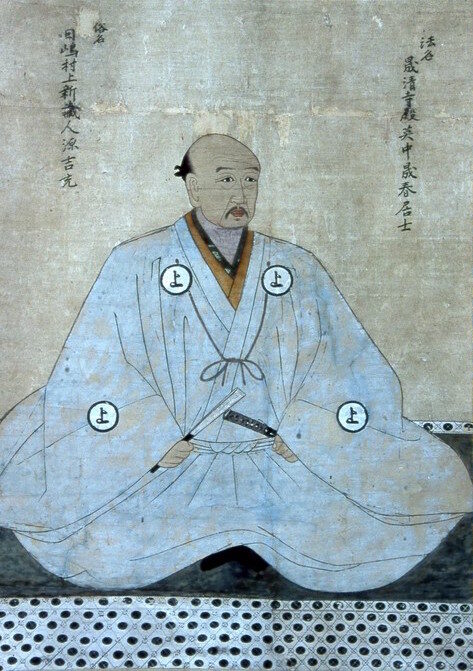
The Innoshima Suigun Castle is not a castle the Murakami built. It is a museum in castle form, built in 1983 under the supervision of the historian Naramoto Tatsuya, on a hill in Nakanosho in the middle of the island. The keep holds the collection: armour given to Yoshimitsu’s family by Kobayakawa Takakage, three scrolls of Murakami family documents from the medieval period (both Hiroshima Prefecture important cultural properties), and an order of 1333 from Prince Moriyoshi addressed to the Murakami.
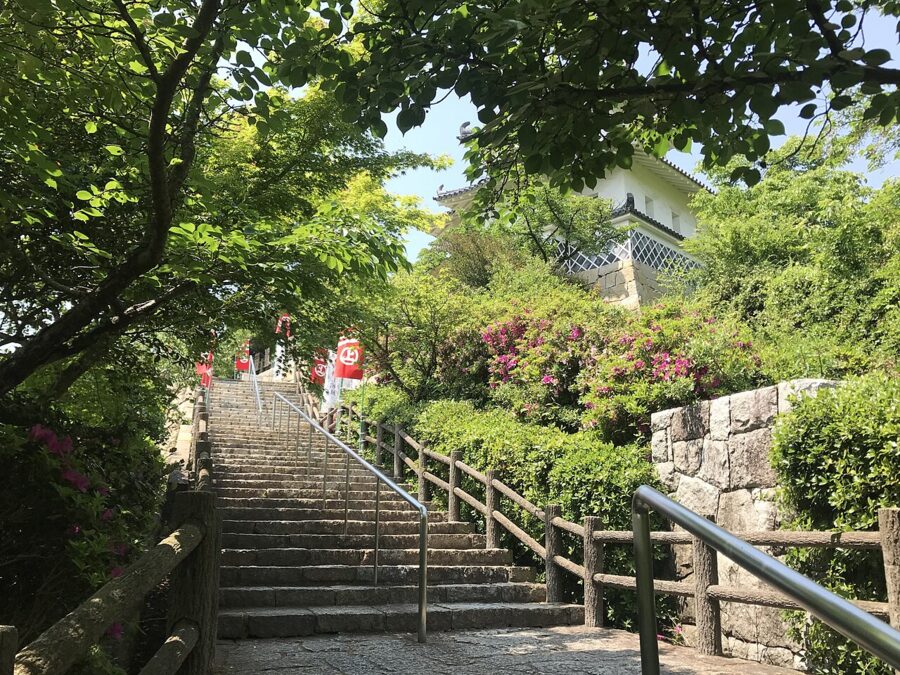
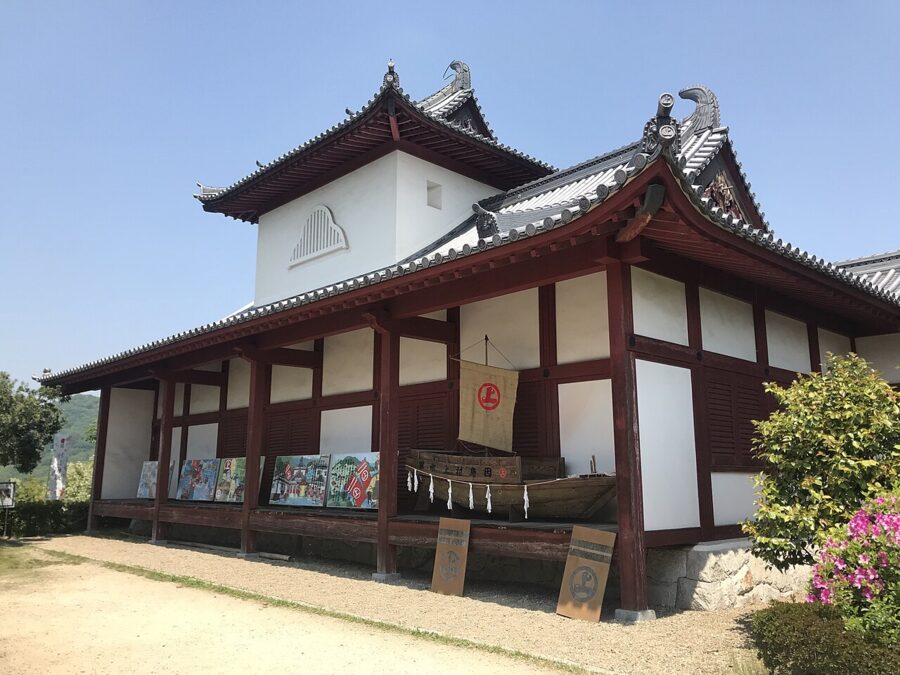
Practicalities, as of November 2026:
- Hours: 09:30 to 17:00, last entry 16:30 (10:00 to 15:00 on 2 and 3 January).
- Closed: Thursdays (open if Thursday is a public holiday) and 29 December to 1 January.
- Admission: ¥330 (about US$2) for adults, ¥160 for primary and junior high school pupils; during special exhibitions the adult fee rises to ¥500. The 2026 exhibition for the tenth anniversary of the Japan Heritage listing closed on 25 November, so the standard fee applies again.
- Parking: free, 50 spaces.
From the signed route, turn off where the blue line meets prefectural road 367 near the Innoshima North interchange; the castle is about 2 km from the interchange. If you have time for one more stop nearby, the Honinbo Shusaku Go memorial in Toura, a short ride east, keeps the restored birthplace of the 19th-century Go master who never lost a castle game. It opens 10:00 to 17:00, closes on Tuesdays and charges adults ¥310.
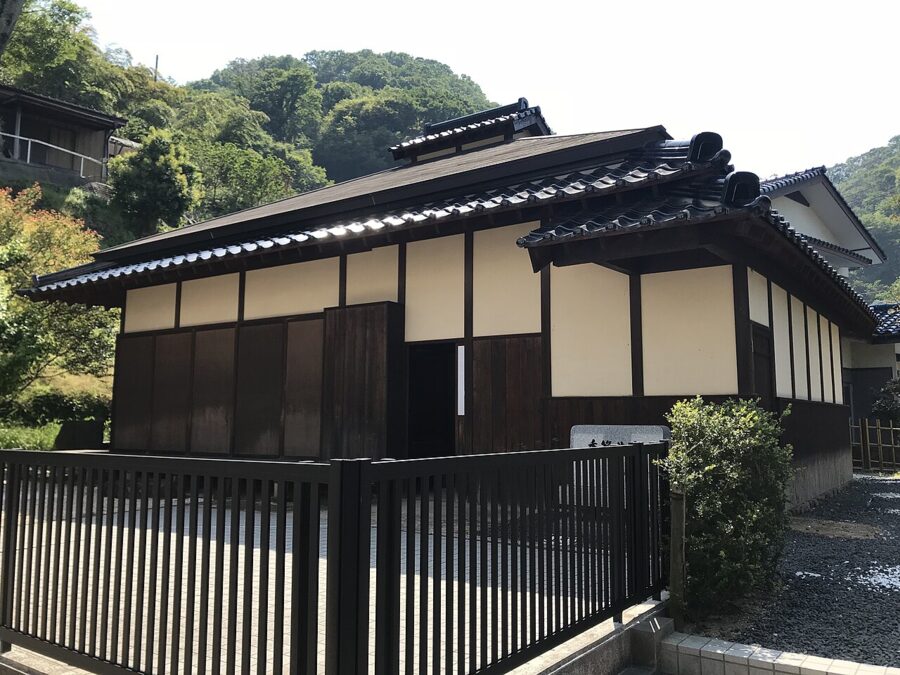
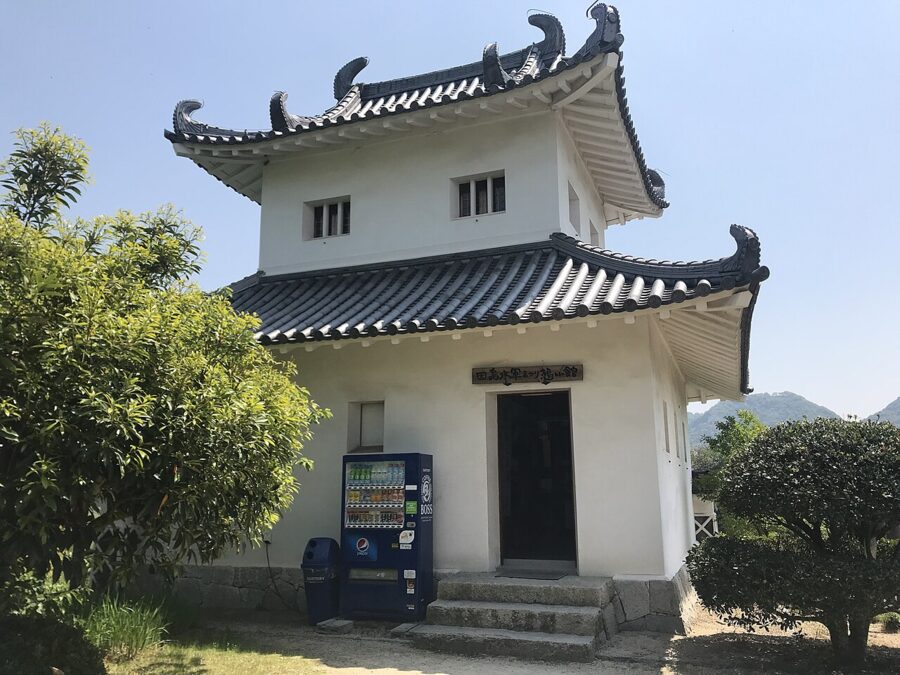
If your dates are flexible, the Innoshima Suigun Matsuri is the island’s big summer event. In 2026 it was split in two: the sea festival with races between kobaya, the Murakami’s small fighting boats, on 30 August, and the fire festival with torches, drums and fireworks on 20 September.
Shirataki-yama and its views
Shirataki-yama is only 226 metres high, but it stands on its own above Shigei with the sea on three sides, and the observation deck on top looks all the way round, over the islands of the Geiyo group to the mainland at Mihara. The poet Yoshii Isamu caught it in one line: where there is an island there is sea, where there is sea there is an island. There is no charge to visit Shirataki-yama and its rakan.
The stone figures set it apart from every other viewpoint on the route. Murakami Yoshimitsu is said to have built a Kannon hall on the summit in 1569 as a lookout over the Mekari Strait. In 1827 Kashiwabara Denroku, a Shigei merchant who had founded a small faith drawing on Shinto, Confucianism, Buddhism and the then-forbidden Christianity, began carving rakan, the disciples of the Buddha, with stonemasons from Onomichi; the work was finished in 1830. Denroku never saw it complete: he was poisoned in 1828, the tourism association says, by a Hiroshima domain afraid his following would turn into an uprising.
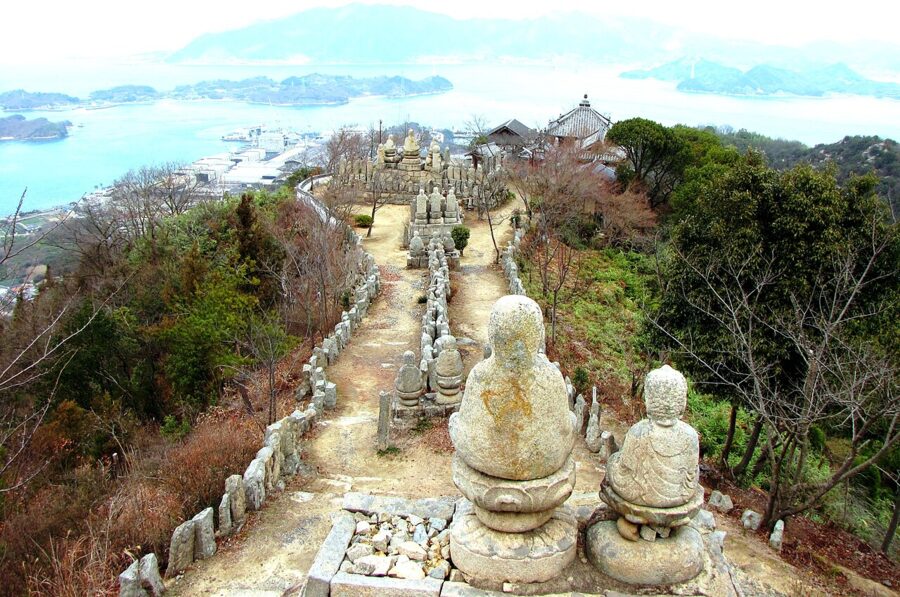
There are two ways up. The quick one is the Shirataki Flower Line, a narrow road that climbs from near the Flower Center to the car park at the eighth station; from there it is 218 metres and about ten minutes’ walk to the summit. The other is the old approach from the front car park, 618 metres and about half an hour on foot through the gate and up past the figures. On a bike, the Flower Line means gaining most of the hill’s height in a short distance; it is worth it on a clear morning and a waste of legs in haze.
The Flower Center and the pyrethrum fields
The Innoshima Flower Center sits right on the signed route in Shigei, which is the main reason to stop: free entry, flower beds, a big lawn, flushing toilets and 100 free parking spaces. It is open 09:00 to 17:00 and closed on Tuesdays (Wednesday if Tuesday is a holiday) and from 29 December to 3 January. The large greenhouse is currently closed to visitors, so do not plan around it.
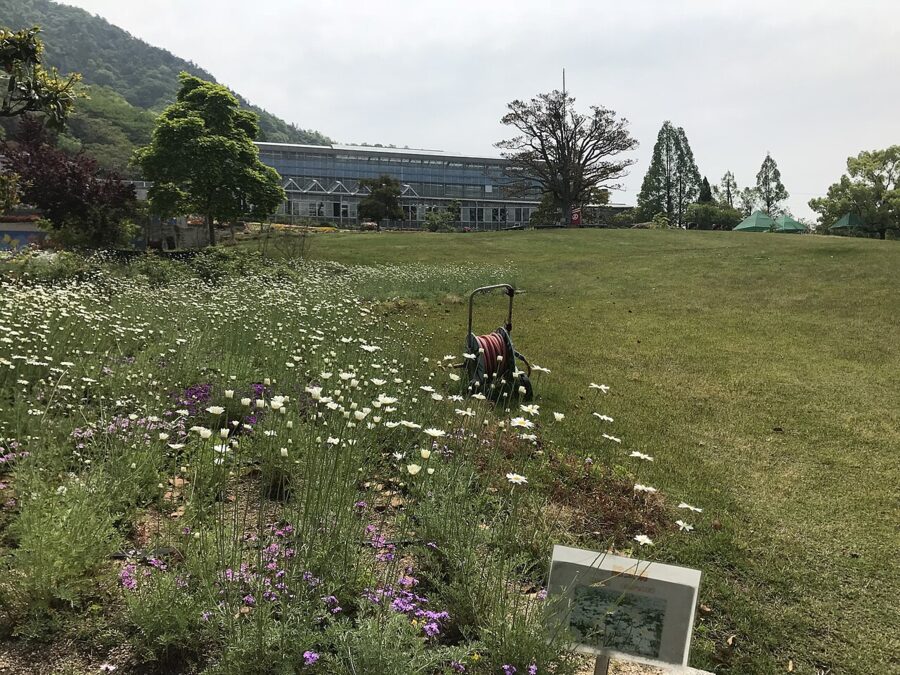
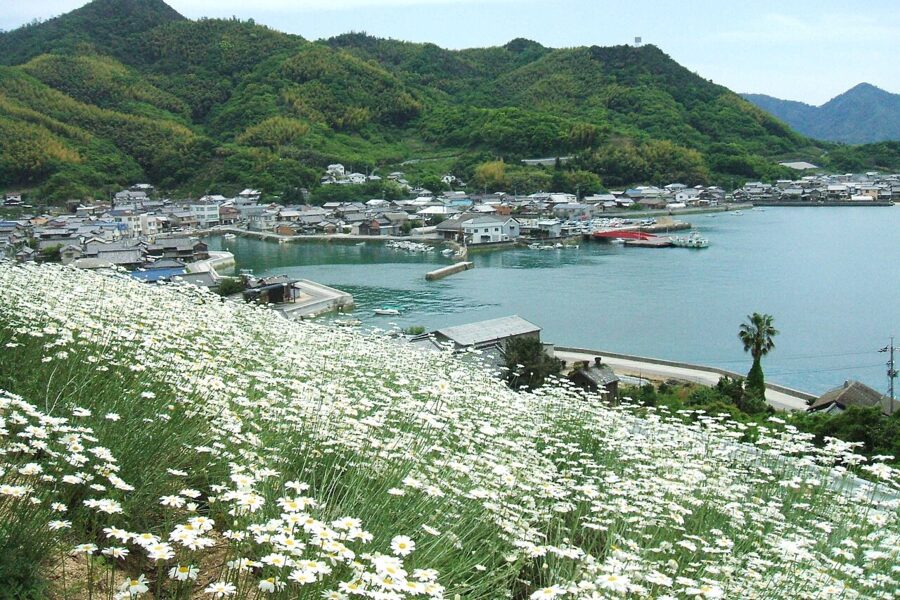
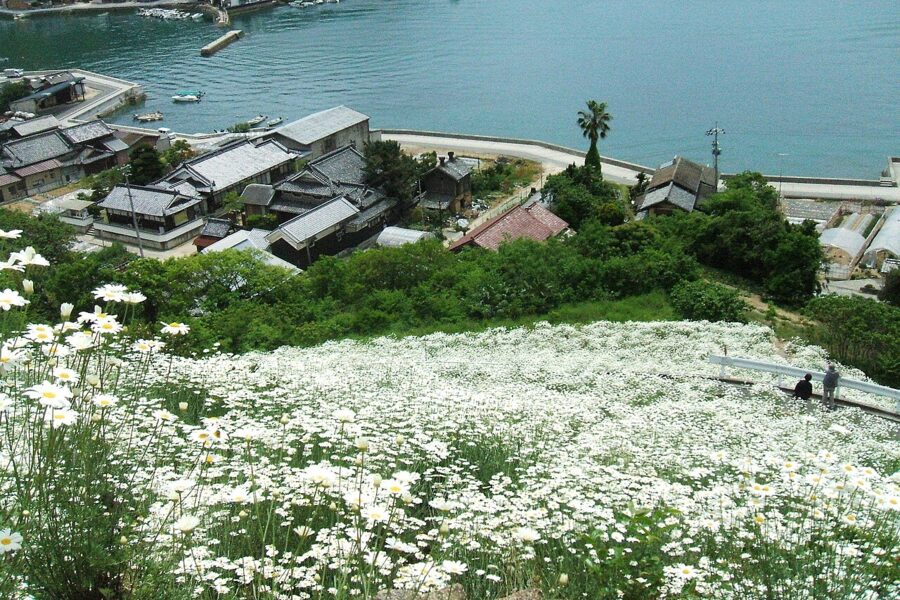
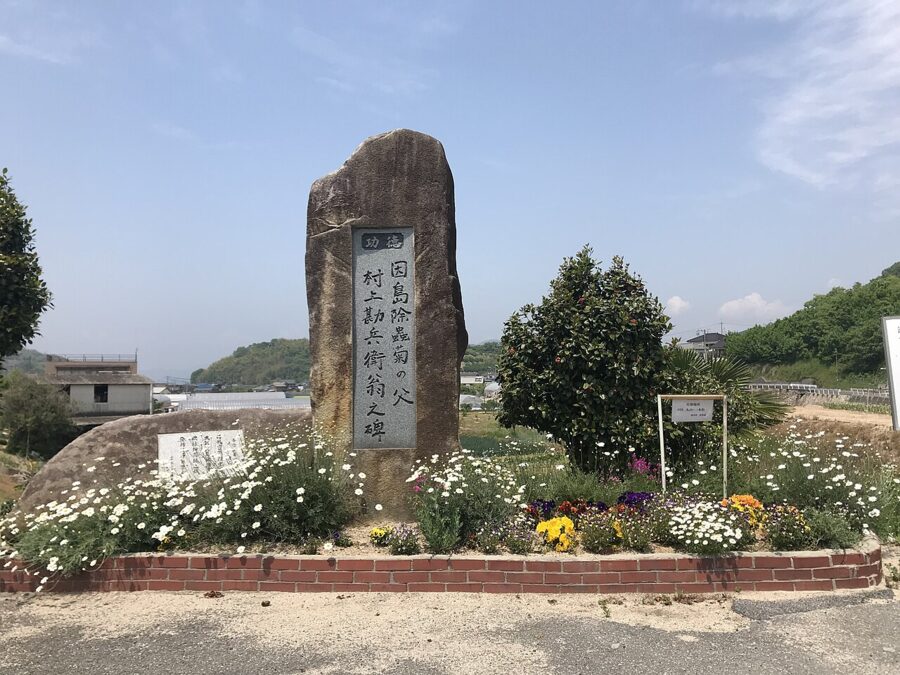
Late April to early May is when the Flower Center earns a longer stop, because that is when the pyrethrum flowers. Innoshima once grew this white daisy on a large scale for insecticide and mosquito coils, and in May the island’s terraces turned white with it. Chemical insecticides ended the trade, but the pyrethrum is still planted for show on five plots, including a 7-are field next to the Flower Center and the old terraced field at Magami, above Shigei West Port. The Magami field was dug up and replanted recently to improve the soil, so expect fewer plants there than in past years.
Hassaku and hassaku daifuku
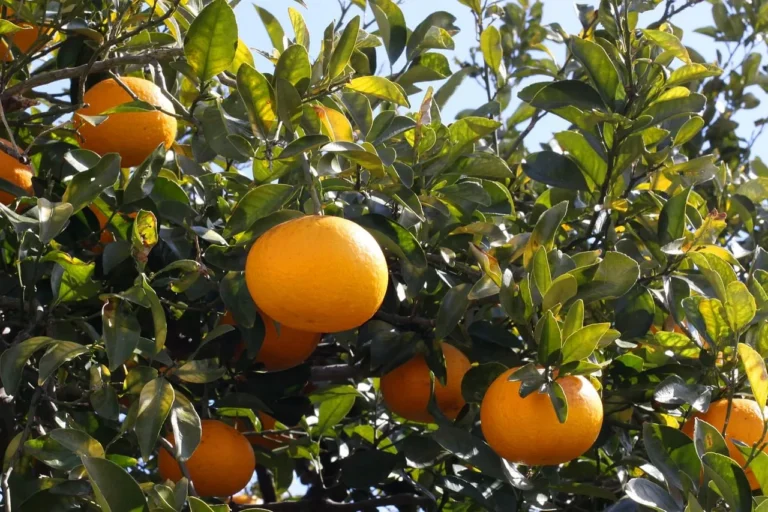
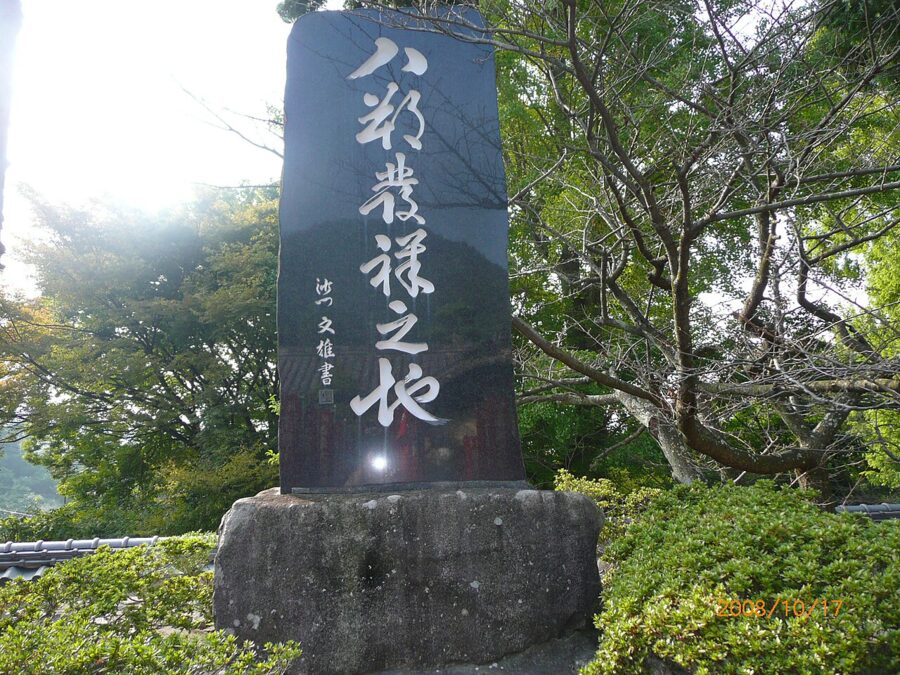
Hassaku, the large, slightly bitter winter citrus sold all over Japan, began on Innoshima. According to the island’s own account of the hassaku, two trees grew around 1860 from seeds thrown away in a field belonging to the family of the priest of Jodoji temple in Taguma. The fruit turned out to be good, people kept eating it, and in 1886 it was given its name, from hassaku, the first day of the eighth month in the old calendar, when it was said to be ready. Growers’ co-operatives later spread it across Japan.
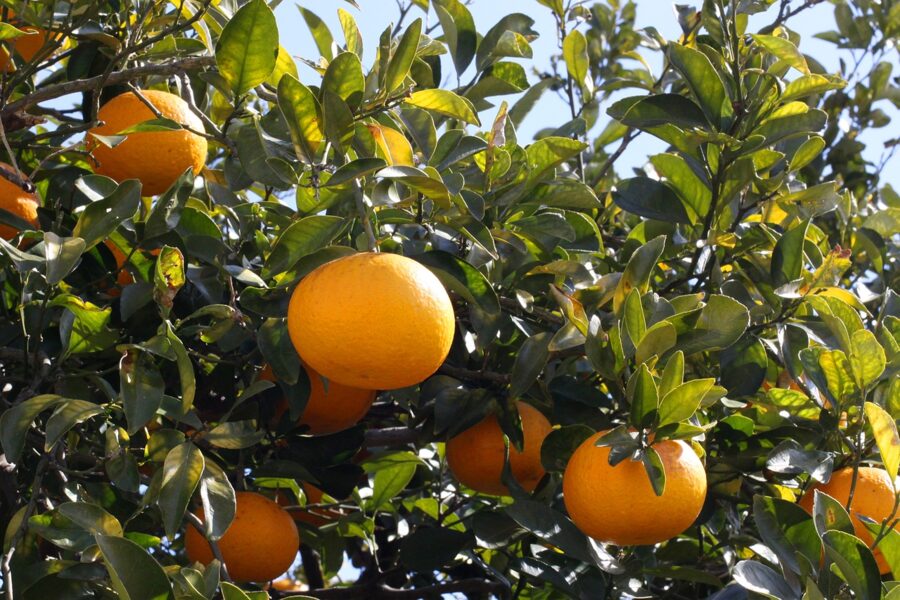
The daifuku came much later. According to the confectioner itself, Kashihara Shin’ichi, who made mikan mochi on Innoshima, created hassaku daifuku to mark the opening of the Innoshima Bridge in 1983: a segment of fresh hassaku and white bean paste wrapped in soft rice cake. His shop moved to Hiroshima city in 2013 and sells the “original” there, so the daifuku you buy on the island today comes from other makers.
The one most riders mean is Hassakuya, at 246-1 Ohama, inside the Innoshima Bridge park and about five minutes by bike from the cycle ramp. It opens at 08:30 and closes when it sells out, and its days off have been Monday and Tuesday. There is a small eat-in corner with a view of the bridge. The filling depends on the fruit, so outside the citrus months check what is on before making a special trip, and on spring weekends the earlier you arrive the better.
Habu, the shipyards and the east side
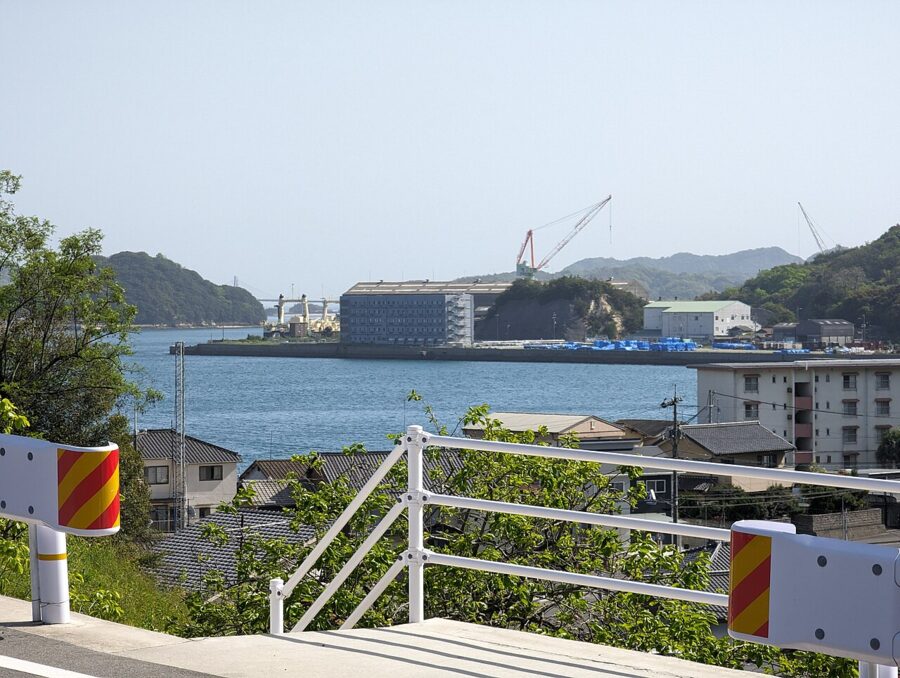
Habu, the port and old city centre on the south-east shore, is the town the signed route misses, and it is where Innoshima’s money came from for most of the last century: shipbuilding. The big yard along this shore was Hitachi Zosen’s Innoshima works for decades, and the island’s own okonomiyaki, the inoko, comes from those years. Inoko is cooked with udon noodles in it, the tourism association says, because a shipyard worker needed something that would last him through a shift. In the boom years of the late 1950s and early 1960s the island had around fifty okonomiyaki counters, some with hotplates cut from yard scrap.
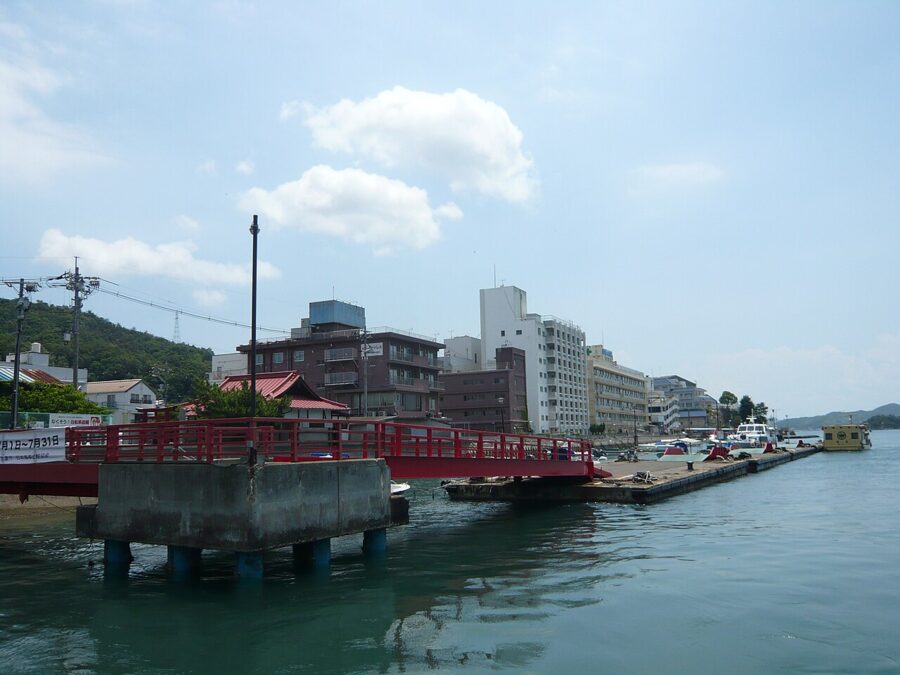
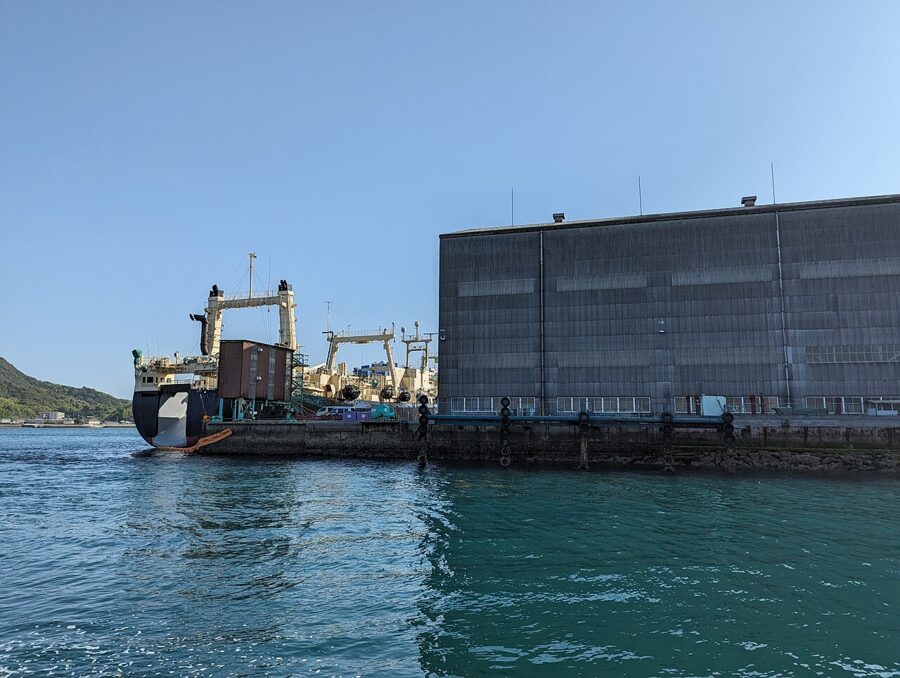
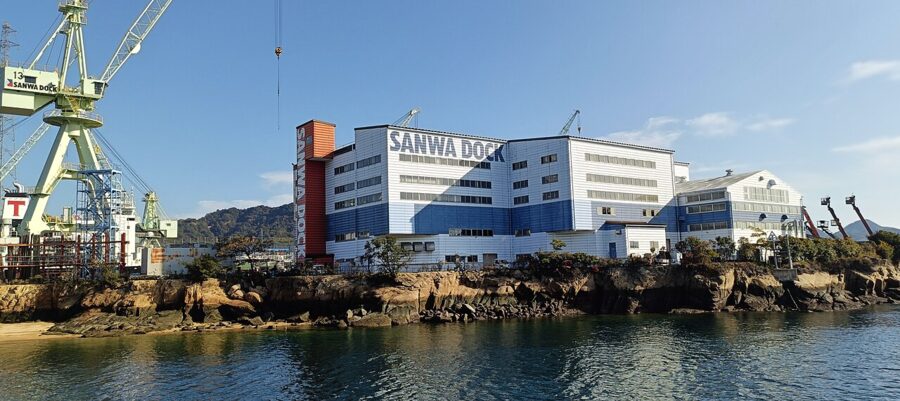
The best view of all this is from Innoshima Park on Tengu-yama, 207 metres above Habu, a national park special zone since 1957. Footpaths climb through cherry, maple and azalea to lookouts over the dry docks, the town and the islands to the south, with the Shikoku mountains on a clear day.
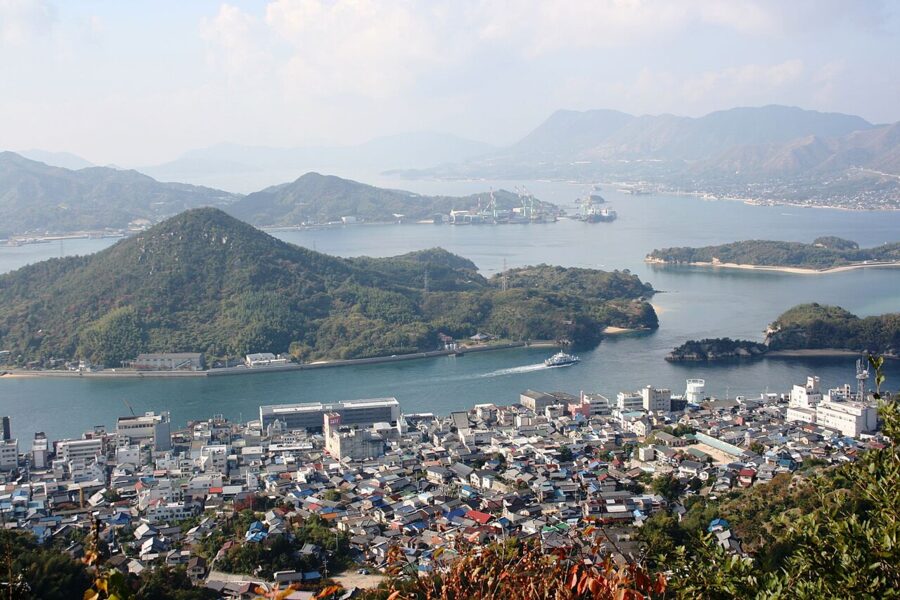
Two more stops make the east side worth the climbs. At Oyama Shrine in Habu, the Watashi shrine is dedicated to a god of travel and safe crossings and has become the route’s bicycle shrine, with bike racks inside the grounds, bicycle-shaped votive plaques and three torii to walk through for safety, against theft and for good connections. And on the cape south of Mitsunosho, Jizobana is a Jizo carved into a rock on the shore that you can reach only for half an hour to an hour either side of low tide. Check the tide table before you go, watch your footing on the wet rock, and do not try it after dark: there are no lights.
The Ikuchi Bridge and the ferries from Innoshima
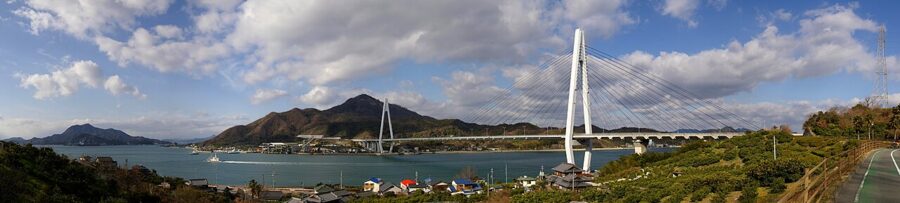
The Ikuchi Bridge is the way most people leave. Opened in 1991, it is a cable-stayed bridge 790 metres long with a central span of 490 metres, among the longest cable-stayed bridges in the world when it opened. The cycle ramp starts in Taguma, near a convenience store that makes a good last stop, and the crossing is short; on the far side you are on Ikuchijima, with Setoda and its lemon groves across the island. The deck is 35 metres above the sea, against 58 for the Innoshima Bridge’s cycle deck, so the ramp up is shorter too.
Innoshima is also well connected by sea, which makes it a good place to start, finish or bail out. As of November 2026:
| Route | Operator | Time | Fare (adult) | Notes |
|---|---|---|---|---|
| Shigei East (Innoshima) to Onomichi, or on to Setoda | Setouchi Cruising | about 20 min to Onomichi | ¥800 each way; bike ¥500 | Several sailings a day on the Onomichi to Setoda line; check the current timetable |
| Habu to Mihara (via Ikina, Innoshima Mall pier, Shigei and Sagishima) | Habu Shosen | about 40 min | ¥1,500; bike ¥300 | 12 high-speed sailings a day; Mihara port is five minutes’ walk from the Shinkansen station |
| Kanayama (Innoshima) to Akasaki (Ikuchijima) | Sanko Kisen | 4 min | ¥80; bike with rider ¥130 | Every 20 minutes on weekdays; no sailings at weekends or on public holidays |
| Habu to Imabari (via the Kamijima islands) | Geiyo Kisen | about 80 min | ¥1,780 | Four sailings a day each way; bikes carried on most, with limits on some sailings |
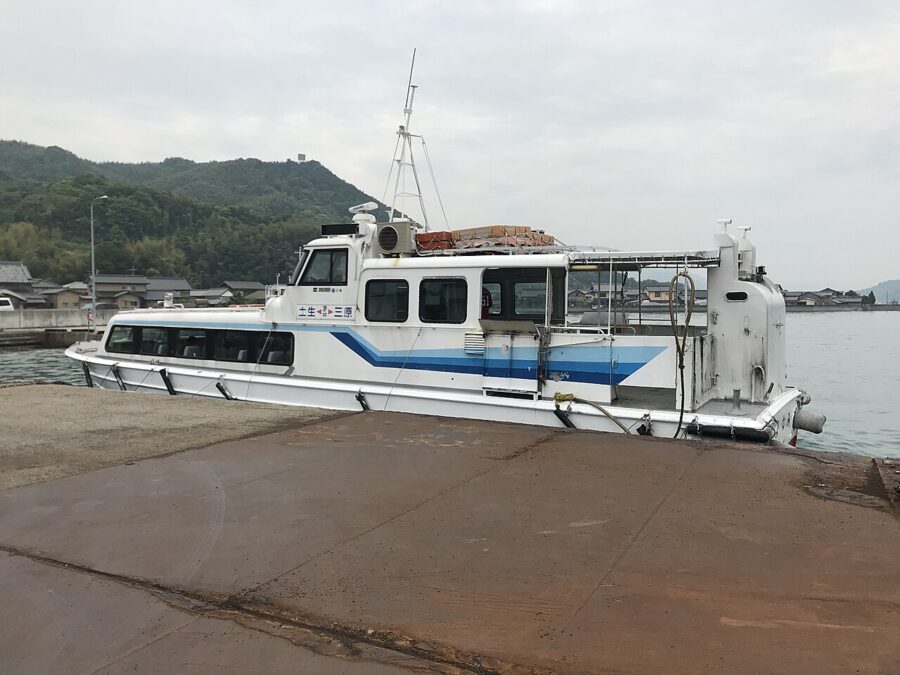
The Habu to Imabari boat is the useful one if you run out of time: about 80 minutes against a day’s riding. At weekends in October and November 2026 JR West also ran a trial linking Onomichi and Imabari by boat, using the regular Onomichi to Setoda boats, which call at Shigei, and new connections south of Setoda; the trial ended on 29 November, and no return has been announced. On land, Innoshima Unyu’s island buses run from Habu to the main districts on a timetable revised in September 2025.
Where to stay and eat
Innoshima makes sense as a base if you want to ride the islands in two easy days, or to see the east side without rushing. Habu has most of the beds and the only real choice of food in the evening. Three places stand out, all open and taking bookings in 2026:
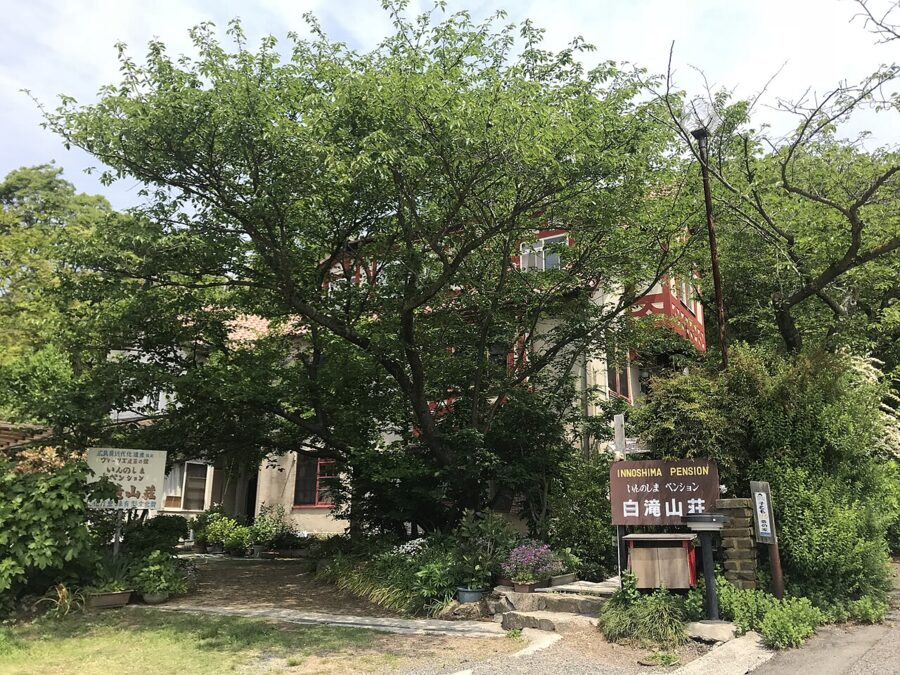
- Innoshima Pension Shirataki Sanso, in Shigei below Shirataki-yama and a few minutes from the signed route, is a Western-style house that the owners present as a Vories building. From September 2026 a night with breakfast is ¥9,240 per adult, and with breakfast and dinner from ¥13,640.
- Hotel Innoshima, formerly the Innoshima Lodge, is up in Innoshima Park on Tengu-yama above Habu, with the view to match; the tourism association lists half-board from ¥12,650.
- Nautique Shiroyama is a small auberge in Habu with two restaurants; half-board starts at ¥19,800 in the association’s listing. Its online booking was paused for a couple of weeks from 6 November 2026, so check or book by phone.
Since 1 April 2026 Hiroshima Prefecture has charged an accommodation tax of ¥200 per person per night on stays costing ¥6,000 or more before tax, paid at the hotel. The tourism association also lists smaller inns, minshuku and a one-group guesthouse in Habu and Mitsunosho.
For food, Hassakuya at Ohama covers the morning. In Habu, look for inoko: the counters are small, some with only six seats, and many close in the early evening or one weekday, so lunch is the safer bet. In Shigei, the HAKKO Park of a local fermentation company has a free garden and a café serving lunch from 11:00 to 14:00, but only on Mondays, Tuesdays, Thursdays and Fridays; at weekends, the convenience stores near the Ikuchi Bridge are the reliable option.
The plan that works for most people is the one the island suggests at the bottom of the bridge ramp. Buy the daifuku at 08:30, eat it on the beach by the lighthouse, and if the morning is clear, turn up the Flower Line to the rakan before you ride on to the Ikuchi Bridge.