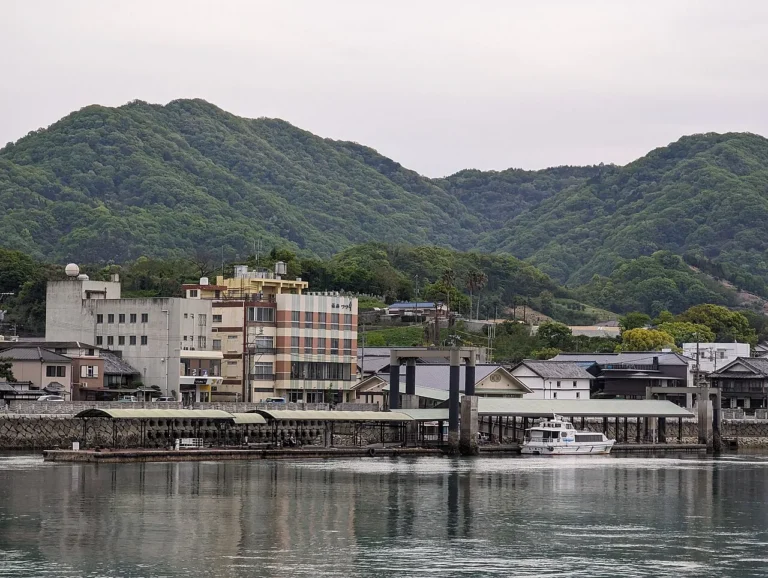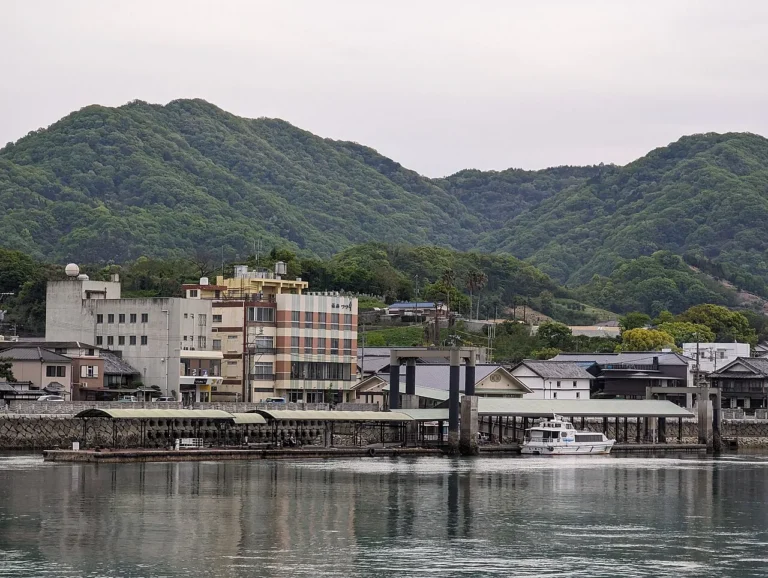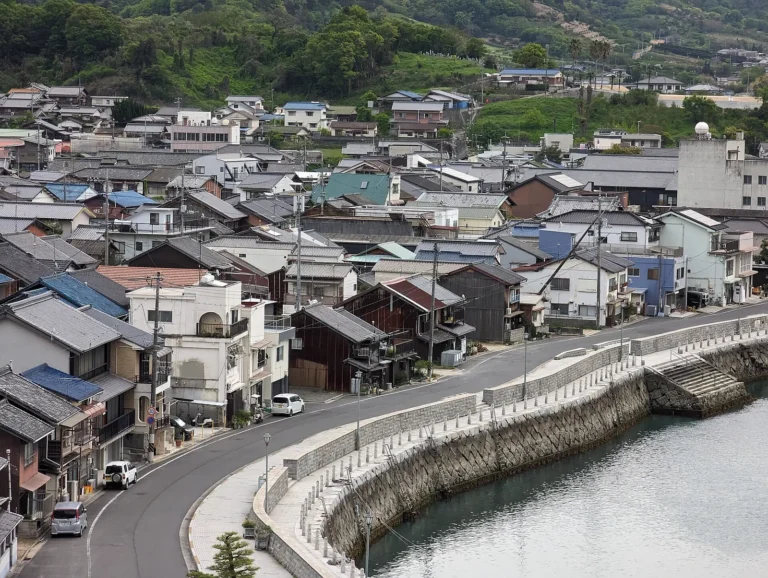
Kosanji lets its last visitors in at 16:30, and the last boat from Setoda to Onomichi leaves the pier at 17:00. Most of the mistakes made on Ikuchijima happen between those two times: a rider reaches the temple gate at four o’clock with a bike to hand back, a boat to catch and a temple that needs two hours, and sees a third of it at a trot.
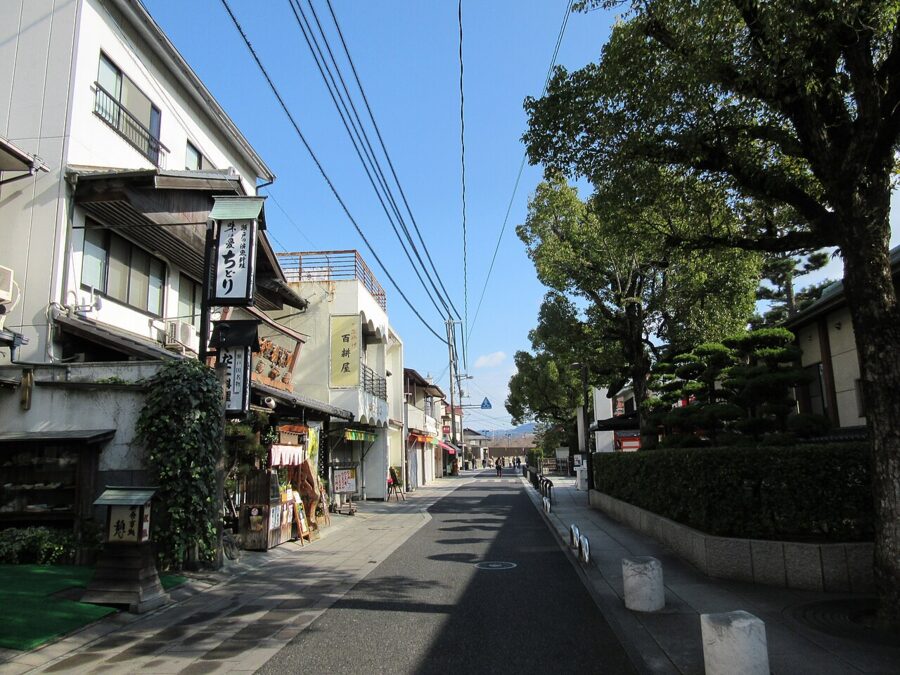
It deserves better planning than that. At the end of a quiet street of shops in Setoda, an Osaka welding engineer spent the last thirty-five years of his life building copies of Japan’s most famous temple buildings in memory of his mother, then dug a tunnel to hell underneath them. A generation later, a sculptor from the hills inland covered the slope above with white marble from Carrara.
So give Kosanji the early afternoon, not the last hour. Riding through to Imabari, that means lunch in Setoda and the temple straight after. Taking the boat home, it means being at the gate by two, with the marble saved for last, when the sun has dropped behind it.
In this guide9
- Who built Kosanji, and why it is called the mother's temple
- Three terraces and one straight line
- The Senbutsudo: a thousand Buddhas and the way to hell
- The Hill of Hope (Miraishin no Oka)
- The museum, the Kongokan and Choseikaku
- Hours, tickets and the 2026 prices
- How long to give it, and in what order
- Kosanji on a riding day
- When to go
Who built Kosanji, and why it is called the mother’s temple
Kosanji (耕三寺, read Kōsanji) belongs to the Honganji branch of Jodo Shinshu, the True Pure Land school of Buddhism, and it was built by one man. Kosanji Kozo was born Kanemoto Fukumatsu in Kobe in December 1891 and started primary school on Ikuchijima, the island he would later call home. His father died in 1904, when the boy was twelve, and his mother brought him up alone.
At sixteen he went to work as an apprentice oxygen welder in Osaka, at a company the French gas firm Air Liquide had set up to teach the new technique in Japan. He learned under its French engineers, and in 1921 invented a way of welding steel pipe of large diameter. By 1926 he ran his own pipe works in Osaka, making everything from sewer mains to ships’ tubing, and holding a string of patents.
In 1927 he began building a villa in Setoda for his mother, Yatsu: Choseikaku, which took five years and the best timber money could buy. She died in June 1934, aged 69.
Eleven months later he was ordained a Jodo Shinshu priest, taking the name Kozo, and that October he vowed to raise a temple around her villa. The first hall was finished in 1938. That year he became priest of a small temple in Yamanashi; he had its registration moved to Setoda in 1939 and renamed it Kosanji in 1942.
He kept building until he died in October 1970, aged 78, and changed his own surname to the temple’s in 1956. The temple still calls itself “the mother’s temple” (母の寺), and quotes his wish that visitors praise their mothers rather than his buildings. Kosanji has no parish families to support it, so the whole precinct is run as a registered museum and paid for by admissions.
Three terraces and one straight line
The grounds climb in three terraces, and every building is placed on or mirrored across a single north–south line, with the gate at the bottom and the main hall at the top. The temple calls this the Kosanji layout and claims nothing like it anywhere else in the country. The symmetry is plain from the foot of the steps.
Almost every building copies a famous original, but none is a straight copy. Kozo kept the outline and proportions of each model and then changed whatever he liked: more colour, more carving, steel where the original had wood, and floor plans rearranged to make halls into galleries. Fifteen of them were registered as national tangible cultural properties in 2003, young as they are. The temple’s own building guide (in Japanese) names each model:
| Building at Kosanji | Modelled on | What Kozo changed |
|---|---|---|
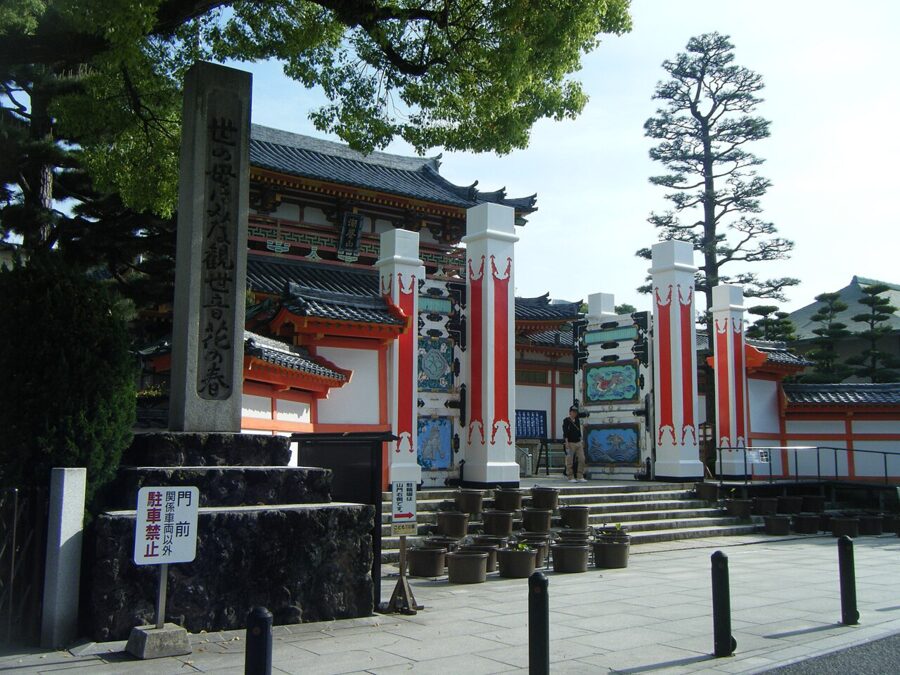
| Sanmon, the main gate | The style of the Shishinden gates at the Kyoto Imperial Palace | Built largely of steel and painted vermilion; dragons, waves and guardian lions in relief on the doors |
| Chumon, the inner gate | The two-storey gate of Horyuji’s western precinct, Nara | Free, post-war carving on the swelling columns |
| Rakando, the corridors | The corridors of Horyuji | Turned into halls for 500 arhat statues |
| Reihaido, the worship hall | The west gate of Kiyomizudera, Kyoto | A gate made into a hall, with a Kannon inside |
| Bell and drum towers | The belfry of Shin-Yakushiji, Nara | Close to the drawings, with brighter colour |
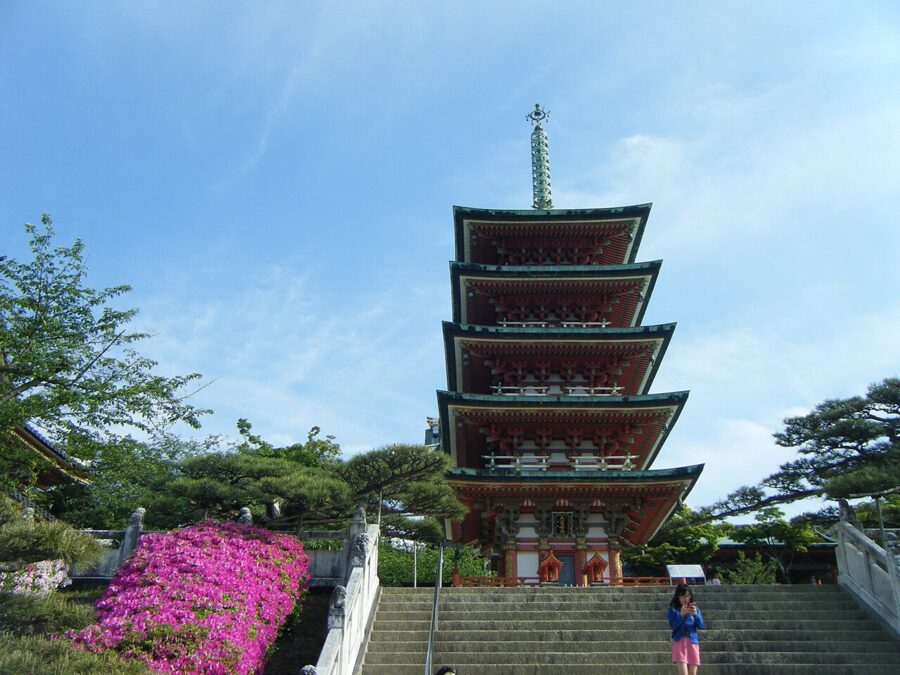
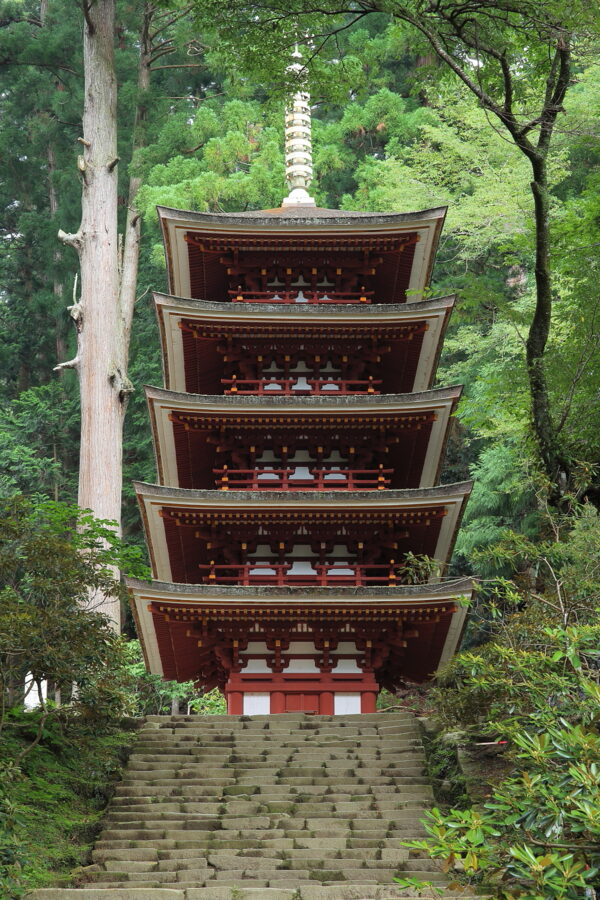
| Five-storey pagoda | The pagoda of Muroji, Nara | A steel-pipe central pillar |
| Hohozo and Sohozo | The main hall of Shitennoji, Osaka | Interiors rebuilt as museum galleries |
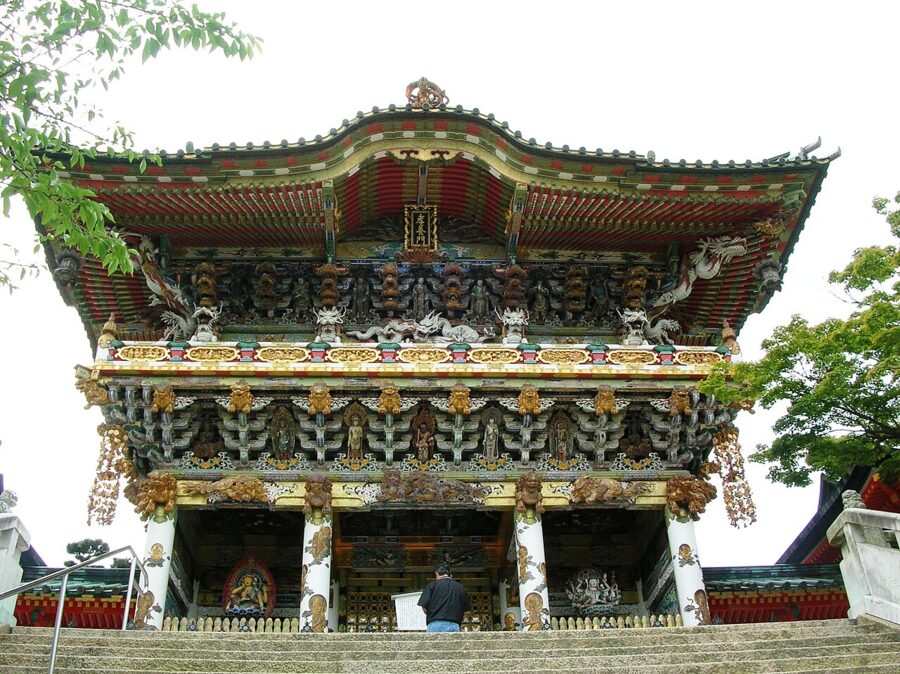
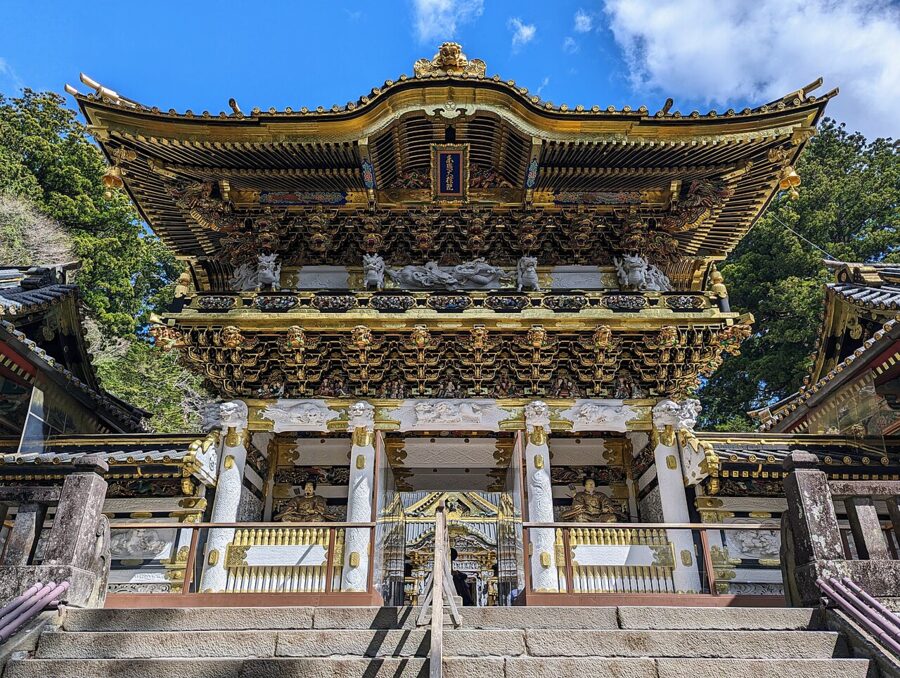
| Koyomon, the upper gate | The Yomeimon at Nikko Toshogu | Built from the Yomeimon’s measured drawings; richer carving and colour |
| Hondo, the main hall | The Phoenix Hall of Byodoin, Uji | Brighter colour; a white marble terrace in front |
| Shishinden and Shingyoden | The Amida Hall of Hokaiji, Kyoto | A matched pair, plain, facing each other |
| Tahoto pagoda | The Tahoto of Ishiyamadera, Otsu | Carved frog-leg struts in place of plain posts; turned 45 degrees |
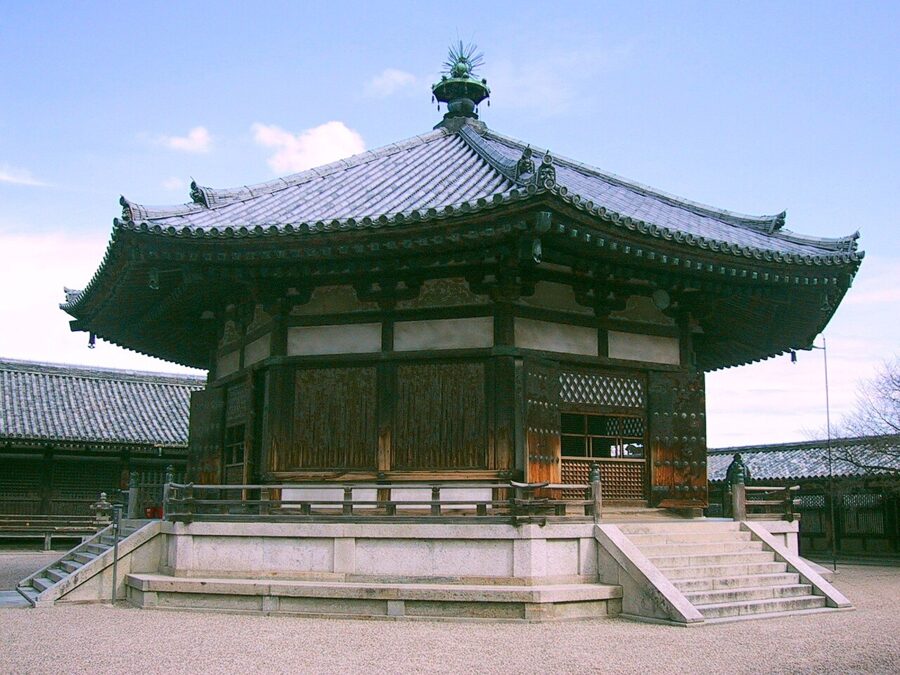
| Octagonal hall (Seitokudo) | The Yumedono at Horyuji, Nara | Half size, with the inner posts removed |
The lower terrace: a steel gate and five hundred arhats
The Sanmon at the street is the first sign that this is an engineer’s temple. It follows the style of a palace gate in Kyoto, but most of it is steel under the vermilion, and the rails and door frames are worked so finely that you would take them for wood. Inside, the Rakando corridors run left and right from the inner gate, lined with 500 arhat statues carved between 1937 and 1948; Kozo carved some himself, alongside sculptors from Nara.
The Butsuhozo, also on the lower terrace, was the first building finished, in 1938, and is the plainest, built before Kozo’s taste for decoration took over.
The middle terrace: the pagoda
Stone steps rise beside the worship hall to the five-storey pagoda, which the temple calls the Daijibo-to, the pagoda of the great compassionate mother. The copy of Muroji’s pagoda is fairly faithful in outline. Inside it, the central pillar that every Japanese pagoda hangs from is a steel pipe, put up in 1952, the one detail here that only a pipe maker would think of. The pagoda was finished in December 1955.
The upper terrace: Nikko’s gate and the Phoenix Hall
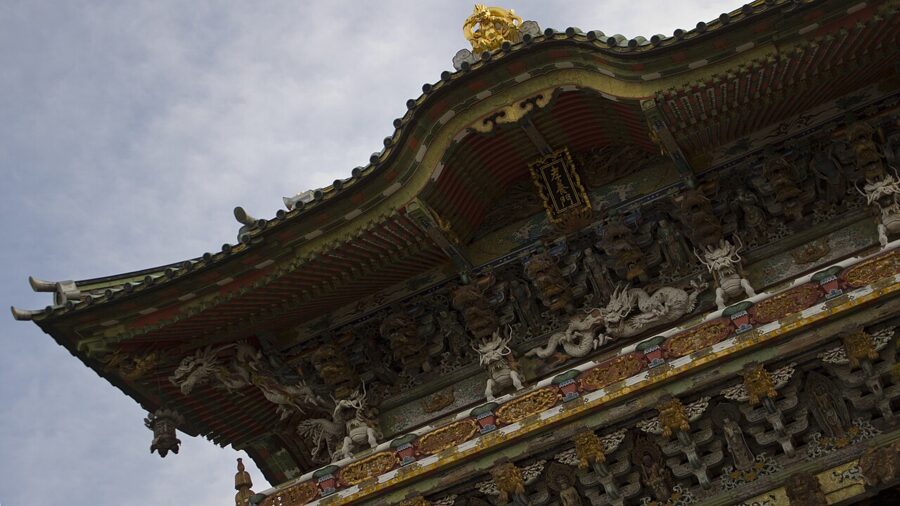
The Koyomon, the Gate of Filial Devotion, is the building that earned Kosanji its nickname, “Nikko of the West”. Kozo vowed to build it in 1953, obtained the one set of measured drawings of the Yomeimon at Nikko that the Ministry of Education held, and spent ten years on it, finishing in April 1964. It is the only building here made from its model’s own drawings, so the proportions match exactly.
The differences are all in the surface. The lower columns carry reliefs of Amida’s host descending to welcome the dead, painted in gold and silver, and the brackets are covered in floral scrolls in graded colour. The temple calls it the most opulent building in Japan, and once you have looked up at the eaves for a while you stop arguing.
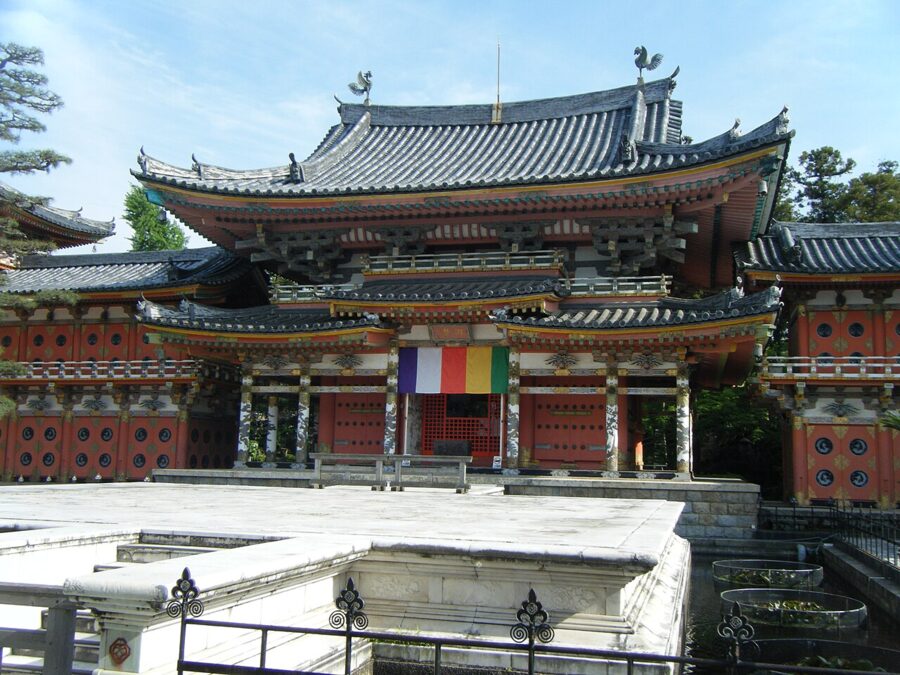
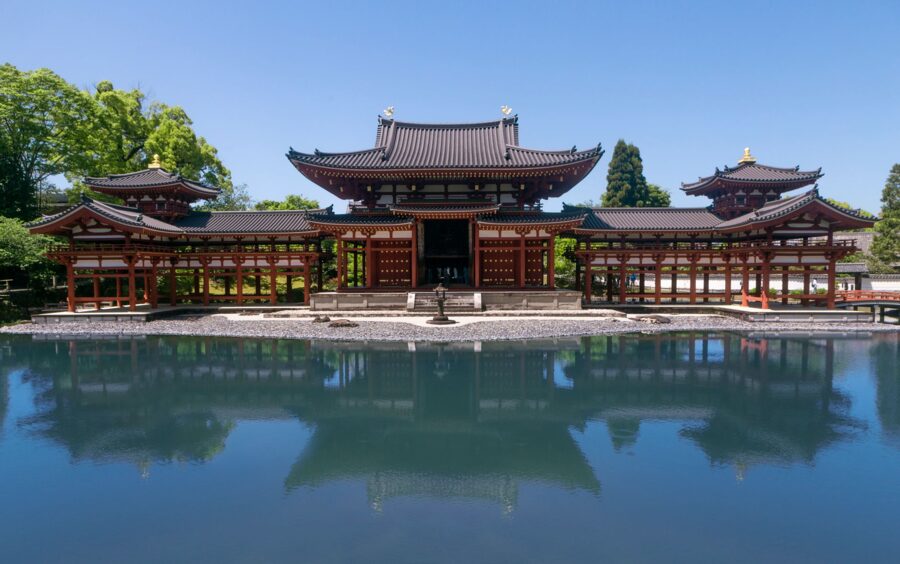
Through the gate, the main hall copies the Phoenix Hall of Byodoin at Uji: a central hall with a wing to each side and a tail corridor behind, in the style of the late Heian court. Where the original sits quietly over its pond, Kozo’s version is painted in full colour and stands behind a great terrace of white marble, about 14 m square, with auspicious birds and flowers carved along its base. Work began in 1940 and the painting was finished in 1949.
The Tahoto, the octagonal hall and the Kuse Kannon
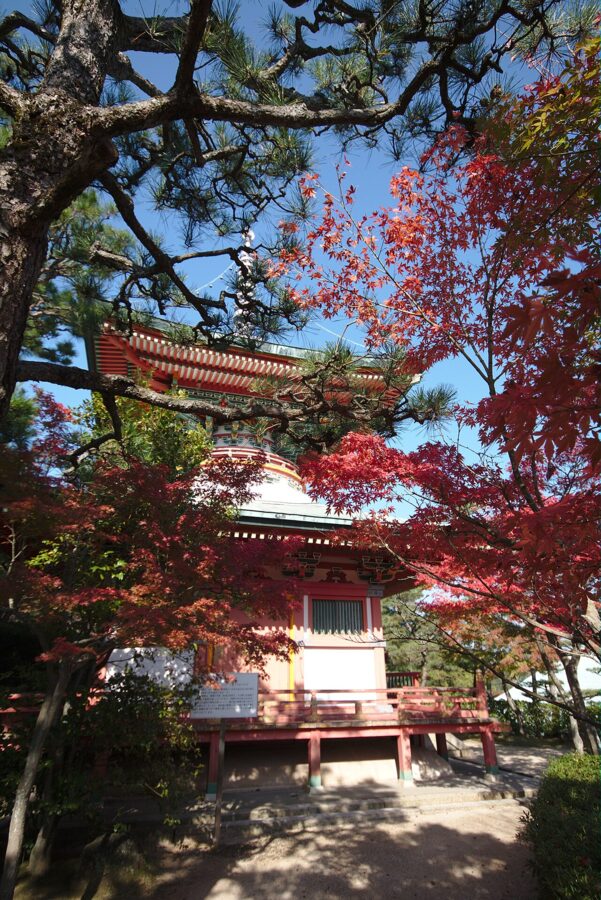
Either side of the main hall, the two-storey Tahoto pagoda and the octagonal Seitokudo stand turned 45 degrees to the temple’s central line. The temple says no other temple in Japan sets buildings this way. The Tahoto follows the national treasure pagoda at Ishiyamadera near Lake Biwa; the octagonal hall is a half-size Yumedono, the hall at Horyuji on the site said to be Prince Shotoku’s residence, and inside is a painting of Shotoku at fourteen, praying for his father.
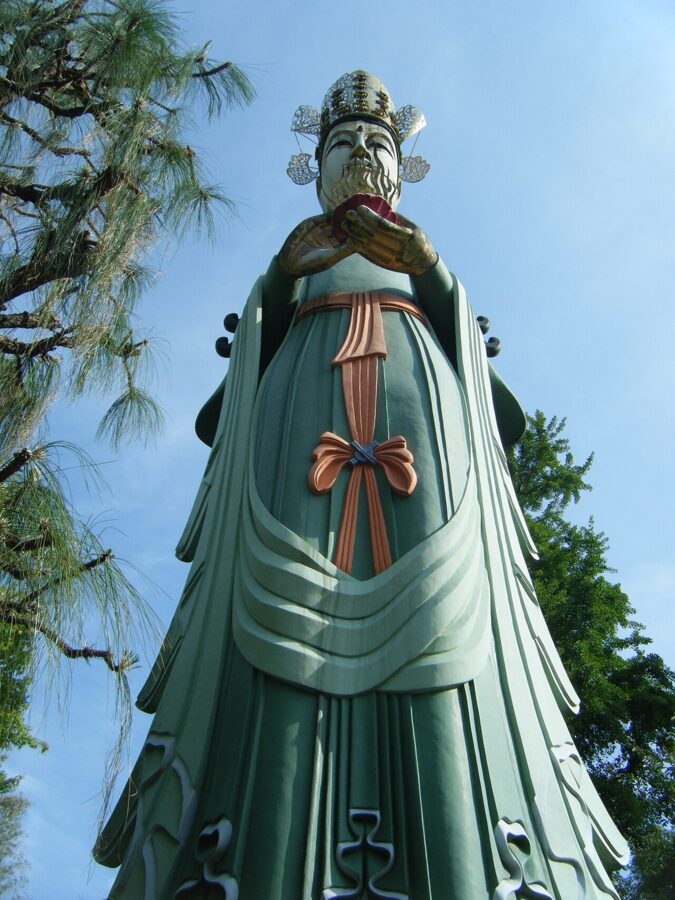
Behind the octagonal hall stands the Kuse Kannon, finished in October 1965 and copied from the secret Kannon kept inside the Yumedono. The figure alone is 10 m tall, and with its crown and base it reaches 15 m. There was no precedent for making a statue this way: a steel frame on a reinforced-concrete footing, filled out with concrete and plaster and then painted. Kozo, then in his seventies, directed the ironwork himself.
Two quieter buildings sit apart from the axis. The Ginryukaku, a silver-painted pavilion over a pond behind the Shingyoden, has a dragon painted on its round ceiling and was built to be used as a tea room. The small Chasodo in the south-east corner, finished in 1966, was the last building of all.
The Senbutsudo: a thousand Buddhas and the way to hell
The cave is the part of Kosanji that people describe to each other afterwards. The Senbutsudo Jigokukyo (千佛洞地獄峡), the Thousand Buddha Cave and Gorge of Hell, was dug between 1955 and 1964: a tunnel about 350 m long, reaching some 15 m below the upper terrace, its rock walls built from Mount Fuji lava and burnt stone from Mount Asama set in reinforced concrete.
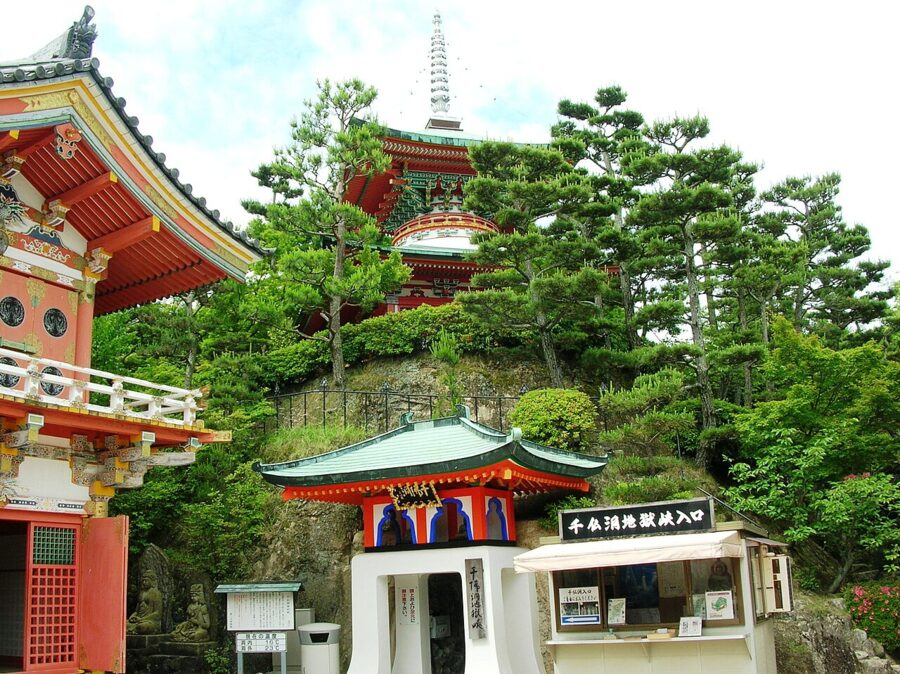
Its purpose is teaching. The Senbutsudo sets out the Ojoyoshu, the tenth-century guide to rebirth by the monk Genshin, which founded the Pure Land imagery of hell and of Amida’s western heaven. Dozens of framed pictures hang along the walls, carved and painted scene by scene through the ten realms of existence, from the punishments of the hells up to the Pure Land.
Between the paintings sit about a thousand stone Buddhas, the work of the Imabari stone carvers Umakoshi Mitsuo and his son Shohachi, and in the middle the tunnel opens into three chambers about 10 m high, one with a waterfall. It is dim, damp and narrow in places, and the hell scenes are graphic enough that small children may not enjoy them. The cave closes at 16:50, ten minutes before the gate, and has steps at both ends, so it is not open to wheelchairs.
Plan on 20 to 30 minutes underground. It is the one part of the visit that is good on a wet day, and the one part I would not skip.
The Hill of Hope (Miraishin no Oka)
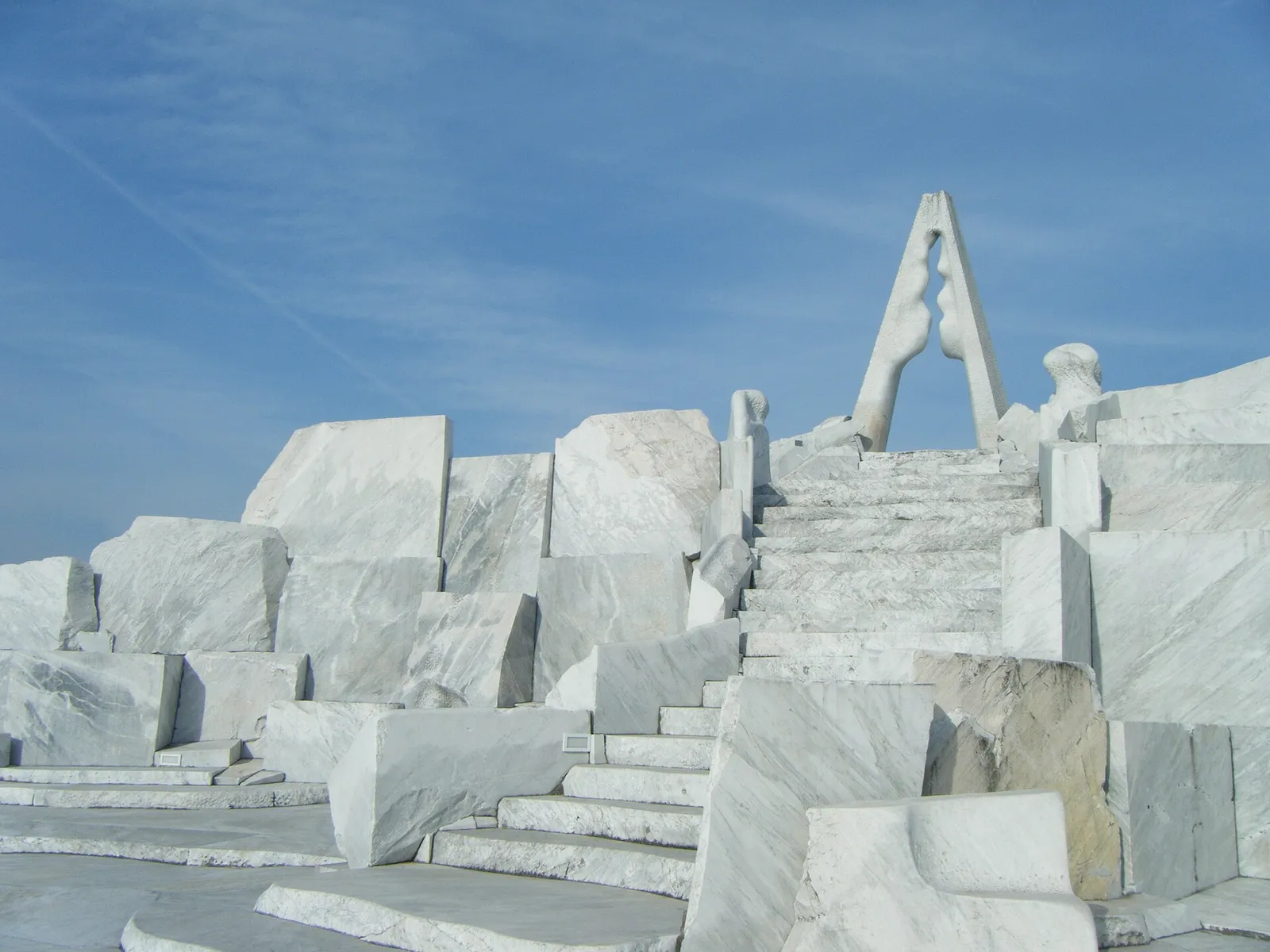
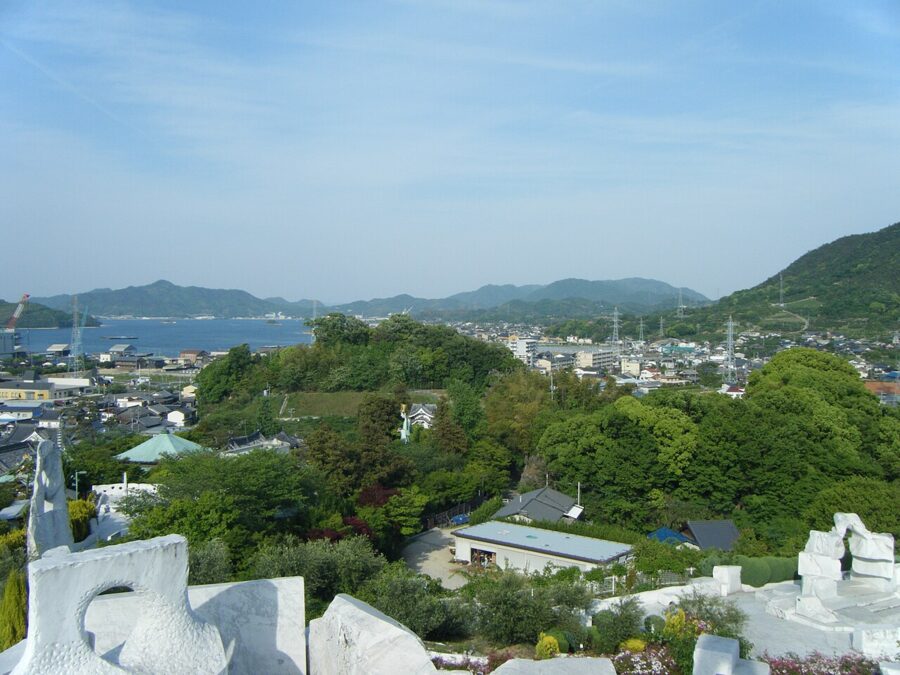
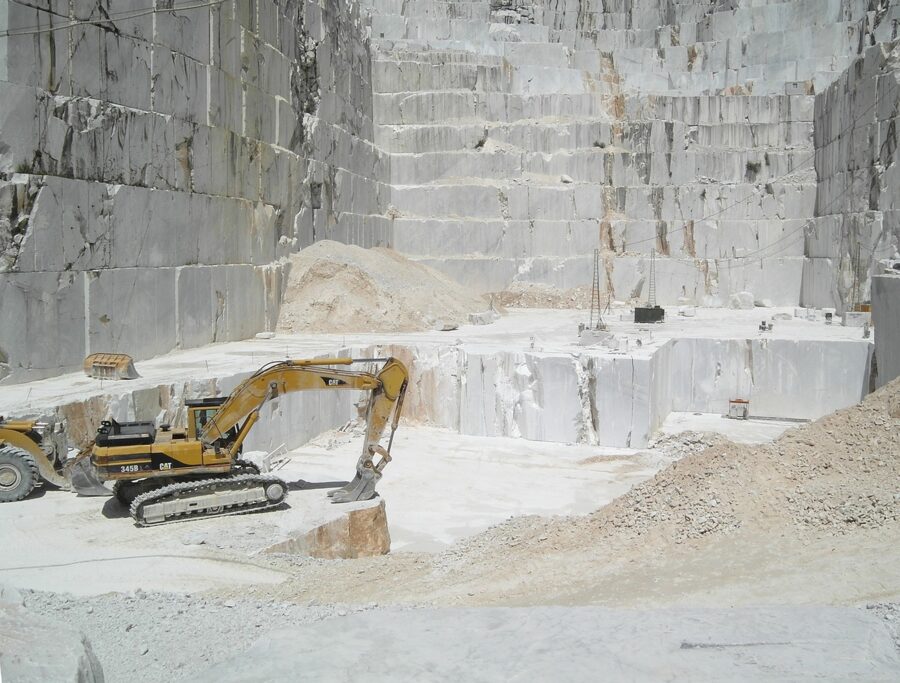
Above and behind the temple, the Hill of Hope (未来心の丘, Miraishin no Oka) is a garden of white marble covering about 5,000 square metres. Every piece of stone was quarried at Carrara in Italy, where the sculptor kept his studio, and shipped to Japan by container. The temple puts the total at around 3,000 tonnes.
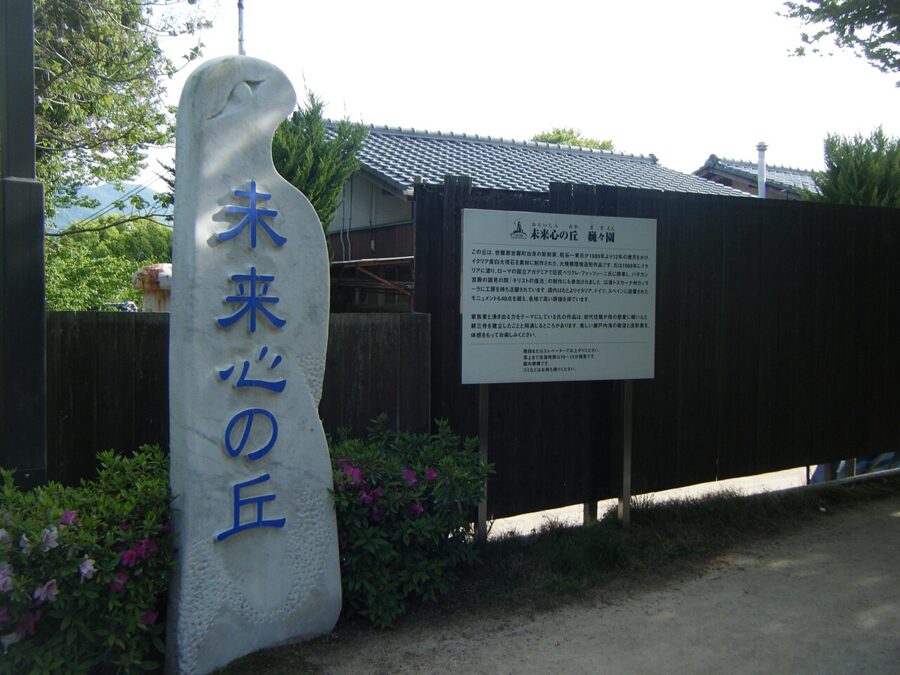
The sculptor, Kuetani Itto, was born in 1942 at Utsudo in Sera, in the hills north of Mihara, and trained in Rome from 1969 under the sculptor Pericle Fazzini. He began the hill in 1988, and the first stage opened in October 2000. In 2005 it took first prize in the urban category of the Marble Architectural Awards in Carrara.
Twelve guardians in marble
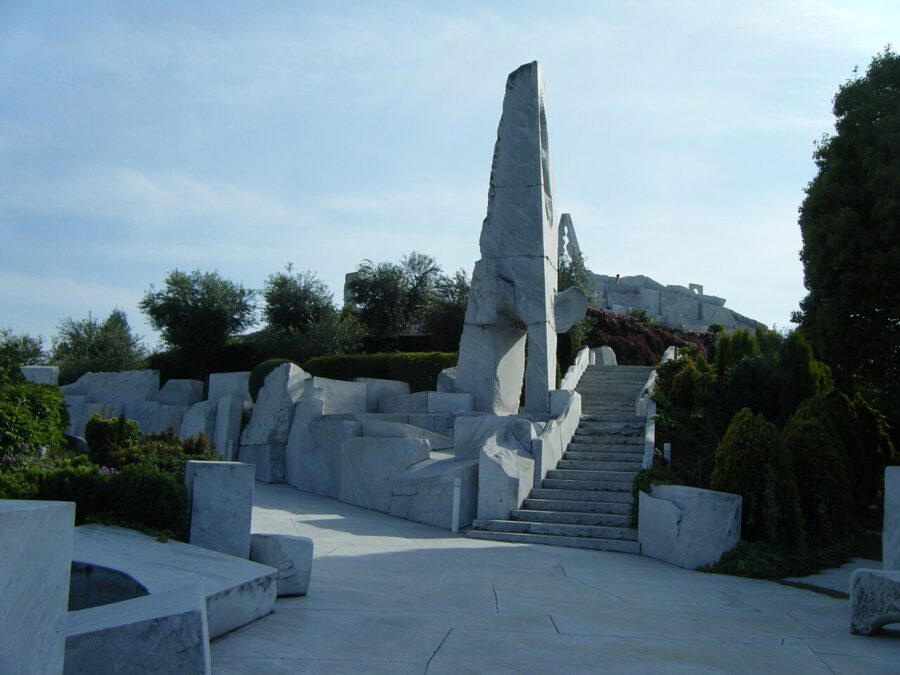
The temple’s page on the hill explains the shapes. Each monument stands for one of the twelve guardian deities of esoteric Buddhism. The pointed Tower of Light stands for the light of the sun god; the White Lion Tower carries the mount of the guardian of the south-west, with a small lion slide the temple warns you to take carefully.
The rest are smaller and more playful. There is a turtle stage for singing on, folding screens of the wind god on which you are meant to pick out the four seasons, a sky cat looking up at the moon, and a garden of two demons. From the White Elephant garden the label points out the site of an outpost castle of the Kobayakawa clan, and the southern rampart faces a peak once used for signal fires.
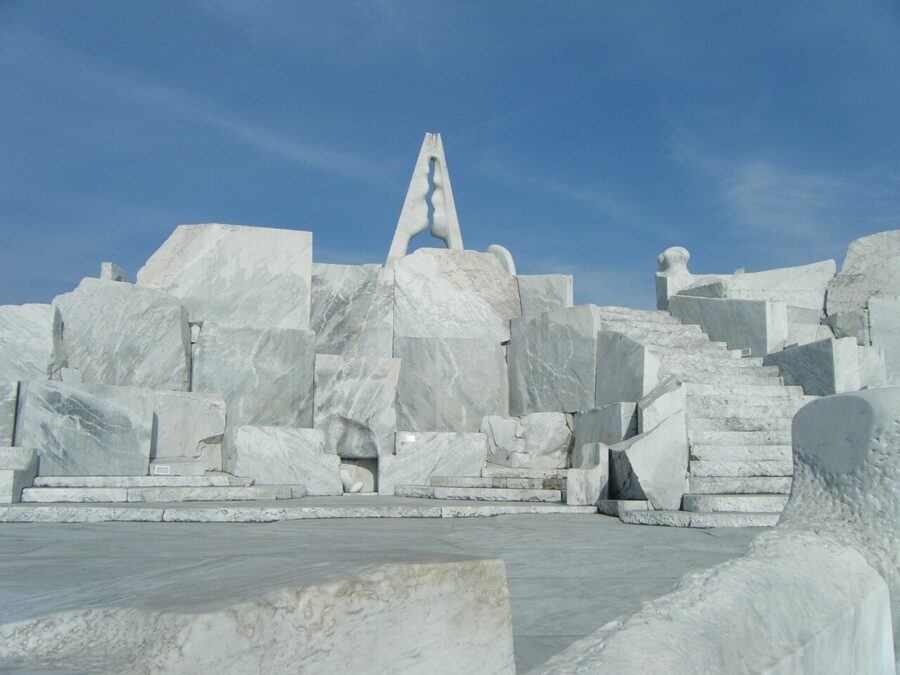
You are meant to touch all of it, sit on it and climb it; that was Kuetani’s wish. The catch is the light. On a sunny day the white stone throws the sun back at you, and in July and August the hill has almost no shade, so bring sunglasses and, in summer, go up after about 15:00. On a grey day the stone goes soft and the colour drains out of everything except the sea.
Cafe Cuore and the shop
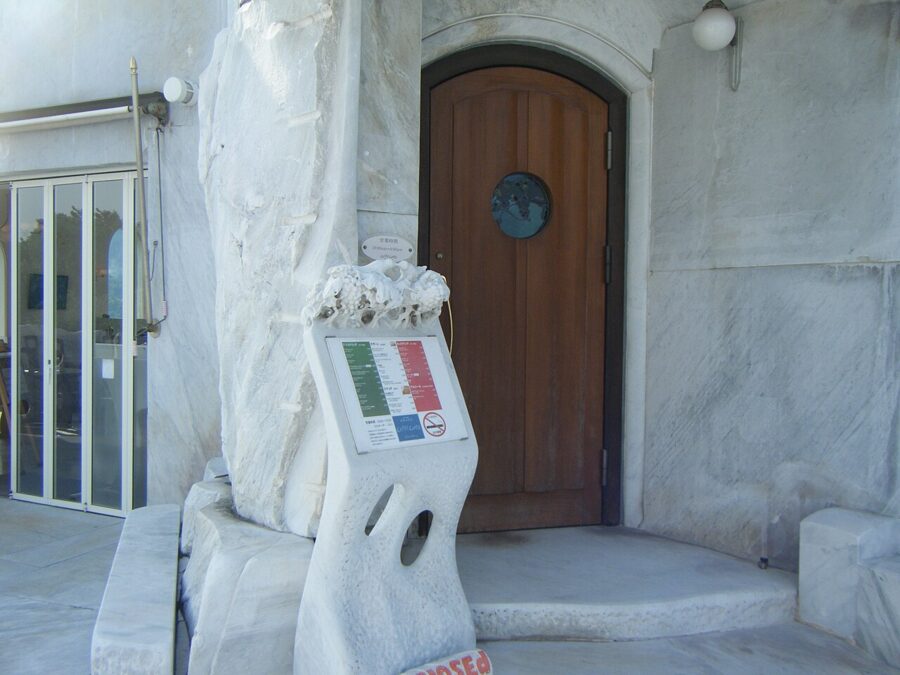
Cafe Cuore sits in the marble near the top, and Kuetani designed it down to the name, the tables and the chairs, with grapes and a Venus carved in the stone. It serves coffee and soft drinks from 10:00 to 16:30, last orders 16:00. The temple’s Byakurenge shop and gallery (10:00–17:00) sells postcards, the hill’s catalogue and a miso made with yuzu, small fish and sea bream, alongside work by Kuetani and by potters and glass artists connected with the museum.
The museum, the Kongokan and Choseikaku
Kosanji has been a registered museum since 1952 and opened as one in March 1953, with Kozo’s son as its first director. The collection grew from the furnishings bought for his mother’s villa and is strongest in Buddhist art, tea utensils and modern Japanese painting. It includes Important Cultural Properties such as a seated Amida with a jewelled crown by the Kamakura sculptor Kaikei, inscribed 1201, and the Ki no Tsurayuki portrait cut from the Satake set of the Thirty-Six Poets scrolls.
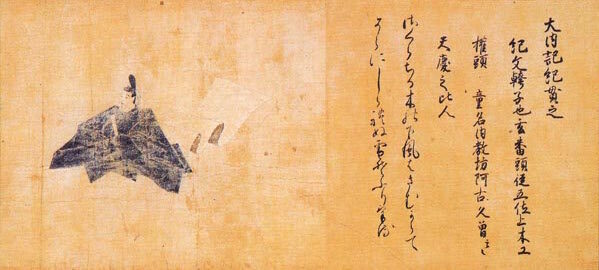
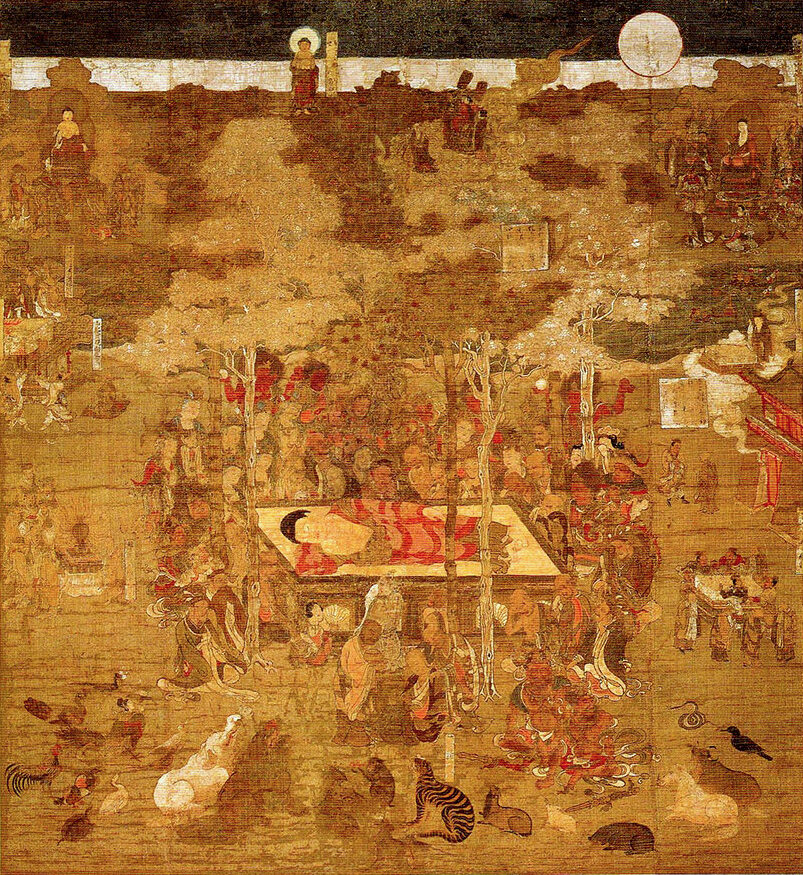
The main gallery is the Kongokan, a concrete treasure hall opened in 1968 and renamed in 1996 after Kozo’s posthumous title, Kongo-in. Its ground floor shows Buddhist sculpture all year, including the Kaikei Amida, and the upper floor and the two halls beside the pagoda change their shows. As of November 2026 they show tea utensils for the museum’s 73rd year and modern Japanese painting from the collection.
If you only have time for one room, make it the Kongokan’s ground floor. Kaikei needs no caption.
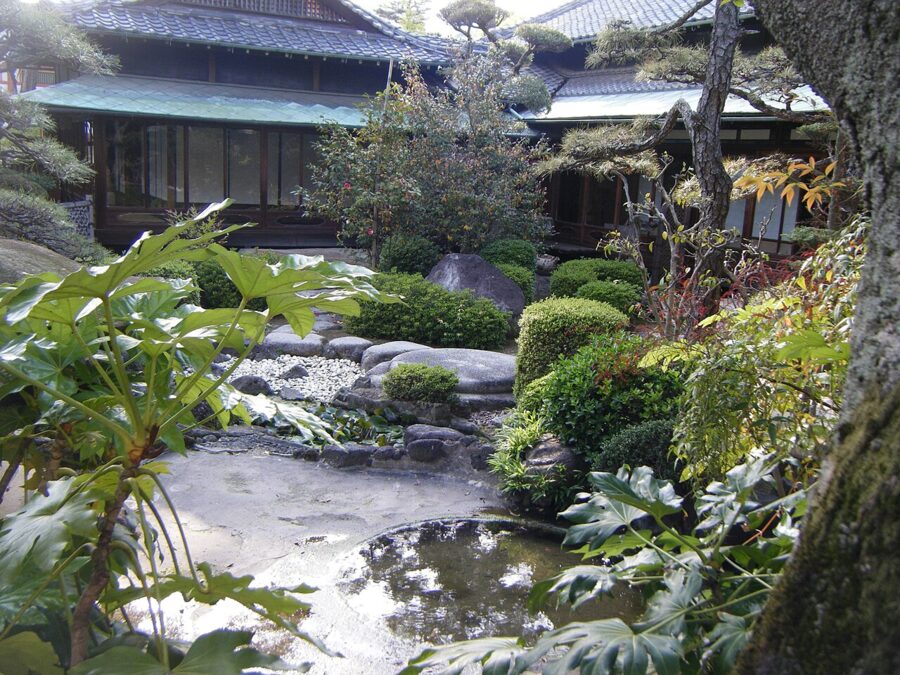
Choseikaku is the house that came first, and it costs extra. Begun in 1927, it joins a Japanese house of the finest timbers to a two-storey Western wing with stained glass, a carriage porch and white plaster, and the sliding doors were painted by Kawakami Setsui, a prize-winning painter of the Kyoto school. The detail that stays with people is the plan: the old lady’s room is far grander than the reception room for guests, and the family altar room is so large it juts out from the house. After his mother died Kozo turned part of it into a hall with a family altar.
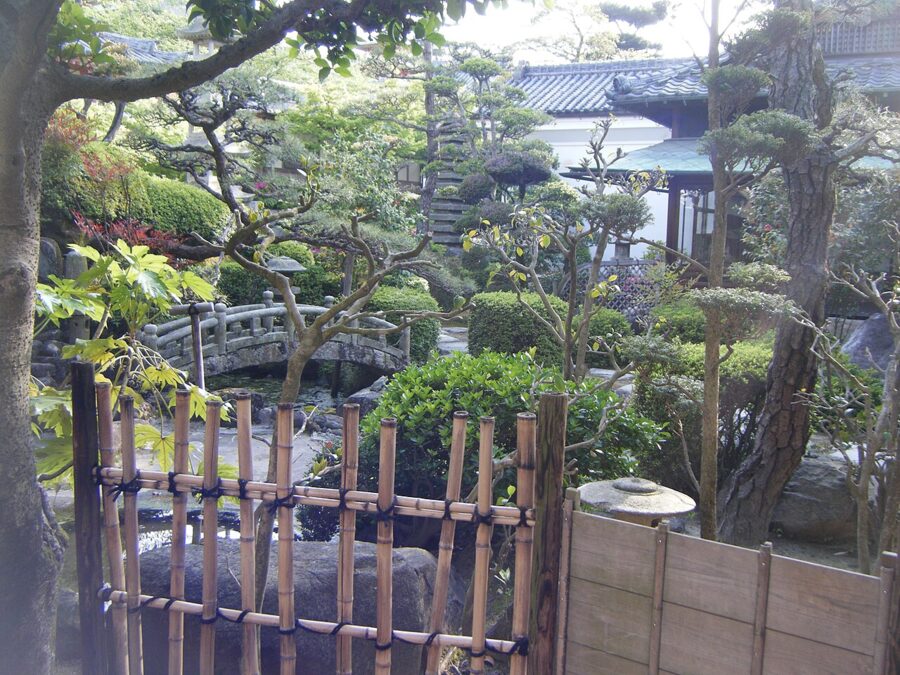
It opens from 10:00 to 16:00 and costs ¥500 (about US$3), paid at the door, on top of the main ticket. It has steps and is not open to wheelchairs. If you like houses more than temples, it is the best ¥500 on the island.
Hours, tickets and the 2026 prices
Kosanji raised its prices on 1 April 2026, the first rise since 2015, citing the cost of running and repairing the buildings. Adult admission went from ¥1,400 to ¥1,800 and the Choseikaku charge from ¥200 to ¥500, so any guide still quoting the old figures is out of date. These are the current prices and hours, as of November 2026:
| Kosanji Temple Museum | As of 2026 |
|---|---|
| Opening hours | 09:00–17:00, last entry 16:30; open every day of the year |
| Senbutsudo cave | 09:00–16:50 |
| Choseikaku | 10:00–16:00; ¥500 extra, paid there (pre-school children free) |
| Cafe Cuore | 10:00–16:30, last orders 16:00 |
| Adults | ¥1,800 (about US$12); groups of 20 or more ¥1,600 (about US$11) |
| University and high school students | ¥1,200 (about US$8), with student ID; groups ¥1,000 |
| Junior high school age and under | Free |
| Onomichi residents | ¥1,000, with proof of address (new in 2026) |
| Disability certificate holders | Free, with one companion |
| Payment | Cash, credit cards and e-money at the ticket desk, shop and cafe |
The main ticket covers the temple grounds, the cave, the Hill of Hope and the Kongokan. Two discounts are easy to use. An adult with a child of junior high age or younger pays the group rate, which the temple calls its filial discount; and if you show a ticket from the Hirayama Ikuo Museum of Art down the road, you also pay the group rate. Tickets can also be bought ahead on the temple’s online ticket page.
For locals and repeat visitors there is an annual pass: ¥3,000 (about US$20) for one person, ¥5,500 for two and ¥12,000 for up to five, valid for a year from purchase. Two visits pay for it.
Is it worth ¥1,800? Yes, if you give it the time. The ticket buys a temple, a cave, a museum and the marble, and taken in an hour none of them is worth the money.
How long to give it, and in what order
An hour and a half covers the buildings, the cave and the Hill of Hope at a steady walk. Two and a half hours lets you add the Kongokan, Choseikaku and a coffee on the marble without watching the clock. With less than an hour, skip the galleries and go straight up through the Koyomon to the cave and the hill.
The order that works is the one the grounds were built for: up the axis through the lower and middle terraces, the main hall at the top, then the cave from the Shishinden to the Kuse Kannon, and the Hill of Hope last. Choseikaku, by the lower terrace, fits at the start if you arrive after 10:00 or at the end if you leave before 16:00. The photography rules are simple: personal photographs are fine everywhere outdoors, but no drones, no tripods, flash or video inside the galleries, and no costume shoots.
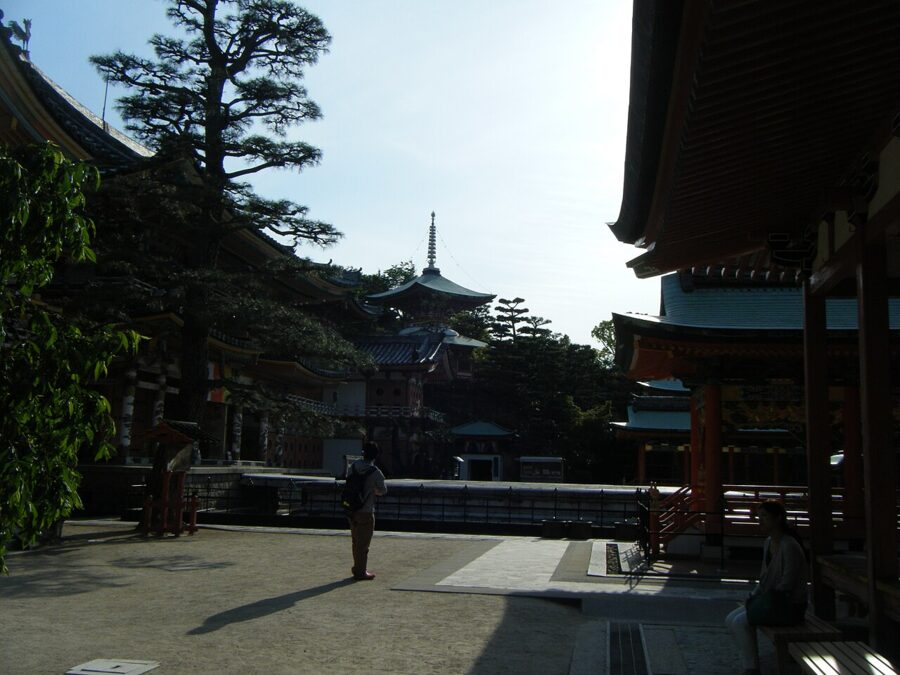
Ramps reach every terrace of the grounds, marked in red on the temple’s map, and the desk lends three wheelchairs, two of them power-assisted. The hall interiors, the cave, Choseikaku and the Kongokan all have steps at their entrances.
Kosanji on a riding day
Kosanji is in Setoda (瀬戸田), the port town on the north shore of Ikuchijima, about 30 km (19 miles) from Onomichi by the cycling route and about 40 km (25 miles) from Imabari. That puts it close to halfway along the Shimanami Kaido and makes it the natural long stop of a one-day ride; on a one-day Shimanami Kaido itinerary, it is the place to spend the middle of the day.
From the rental terminal and the pier
The Setoda tourist information office (瀬戸田町観光案内所), one of Shimanami Japan’s rental terminals, is by the Kosanji bus stop, a couple of minutes’ walk from the temple gate. It opens 09:00–17:00 and takes back bikes from any terminal on the route at no extra charge, which makes the most useful plan on the island very simple: ride out from Onomichi, hand the bike in here, see the temple, and take the boat home.
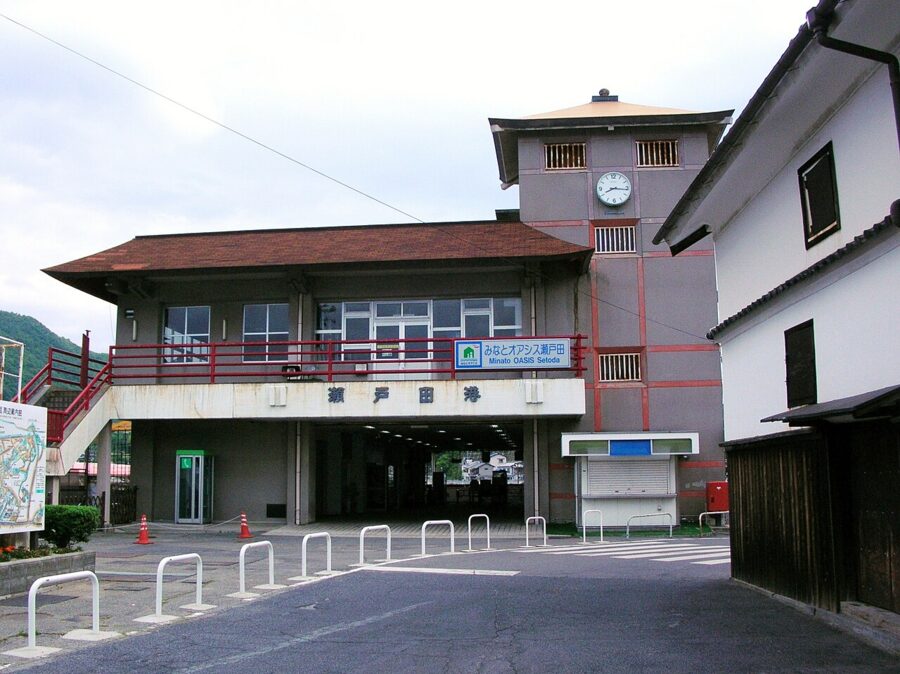
Setoda Port is at the other end of the shopping street, about ten minutes’ walk from the gate. Setouchi Cruising’s boats to Onomichi take about 45 minutes and leave Setoda at 07:50, 10:00, 11:25, 13:25, 15:00 and 17:00 on the current timetable, for ¥1,500 (about US$10), plus ¥500 for a bike, as of 2026. If you leave the temple at 16:30, the 17:00 boat is comfortable; leave at 16:50 and it is not.
Miss it and you are not stranded: passenger boats to Mihara run until after 20:00, and Mihara has a station on the Shinkansen. It is the latest of the Shimanami Kaido luggage and ferries options from the middle of the route.
Riding on to Imabari is the harder fit. Rental bikes may not be ridden after dark, and from Setoda it is still about 40 km over the Tatara Bridge, Omishima, Hakatajima and Oshima. Either see Kosanji in the morning and leave Setoda by about 13:00, or split the ride with a night in Setoda, where Setoda has the most beds of anywhere in where to stay on the Shimanami Kaido. An assisted bike, booked through Shimanami Kaido bike rental, buys back most of the afternoon.
By car, bus and taxi
Drivers leave the expressway at Ikuchijima Kita or Ikuchijima Minami, each about 13 minutes from the temple according to the temple’s access page. There are two free car parks: one for about 40 cars, two minutes’ walk away, and a second for about 40 more, five minutes away. A taxi from Onomichi Station takes about 40 minutes. The Shimanami Liner highway buses stop at Setoda on the expressway, not in town, so the boat is the easier way in without a bike.
When to go
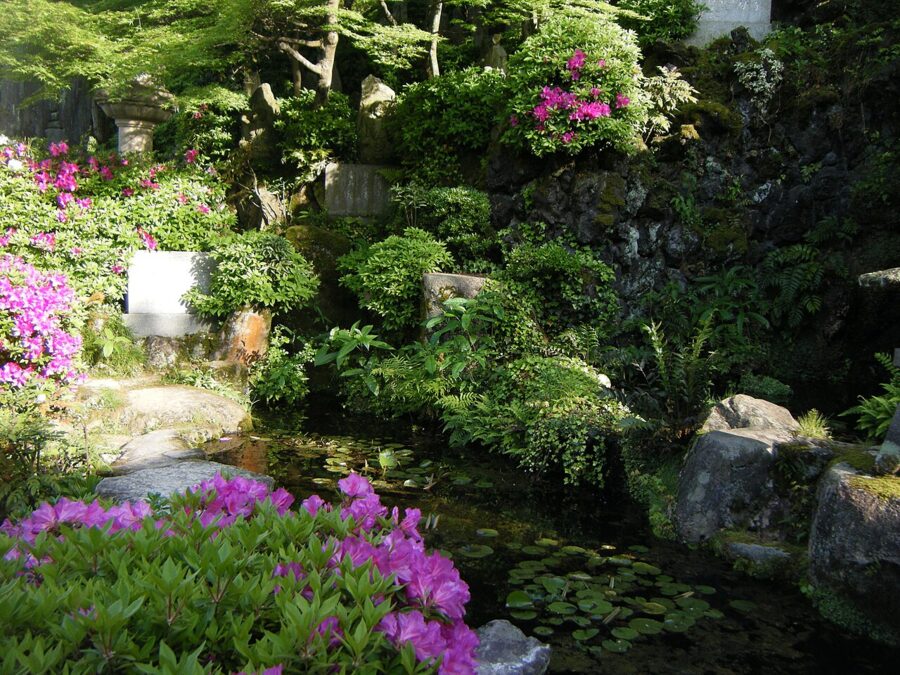
The temple is open every day, so the choice is about weather and crowds. Go early in the day, before the coach tours, and avoid holiday weekends if you can. In spring the deep pink kawazu cherries open early, around February, the main cherries follow from late March and the azaleas peak in early May; in autumn the maples around the Tahoto turn from late November. Hot summer days are the hardest, because the marble has nothing to hide behind.
After the temple, the Hirayama Ikuo Museum of Art is a few minutes’ walk away, and the street has lunch and lemon cake. The rest of the island, the beach, the cafes and Kojoji’s pagoda on the hill, fills the rest of the day. If you want a temple with centuries in its timbers rather than in its blueprints, Senkoji in Onomichi and Oyamazumi Shrine on Omishima are the places on the route.
Hand the bike in at the Setoda tourist office, be at the Kosanji gate by two, and leave the marble until last. The 17:00 boat goes from the end of the street.