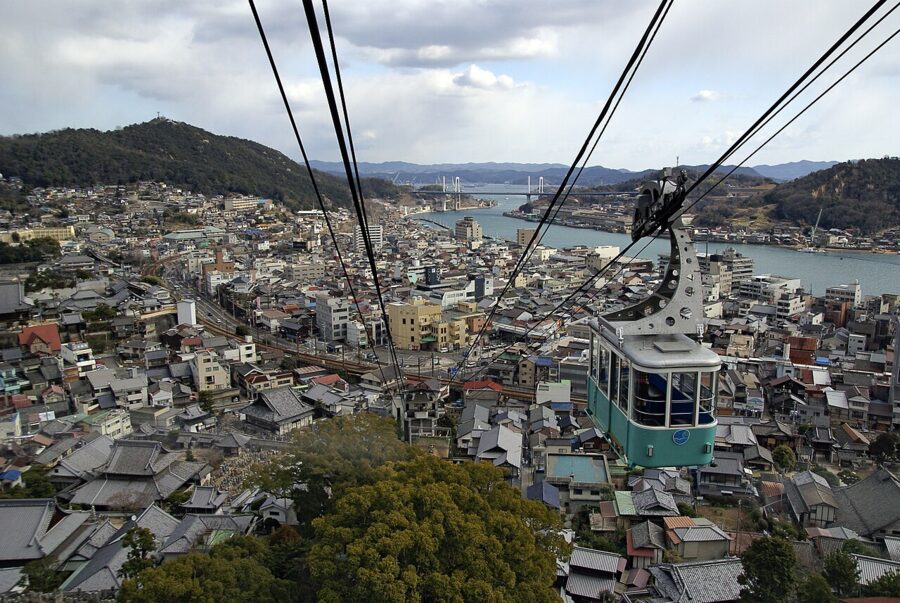
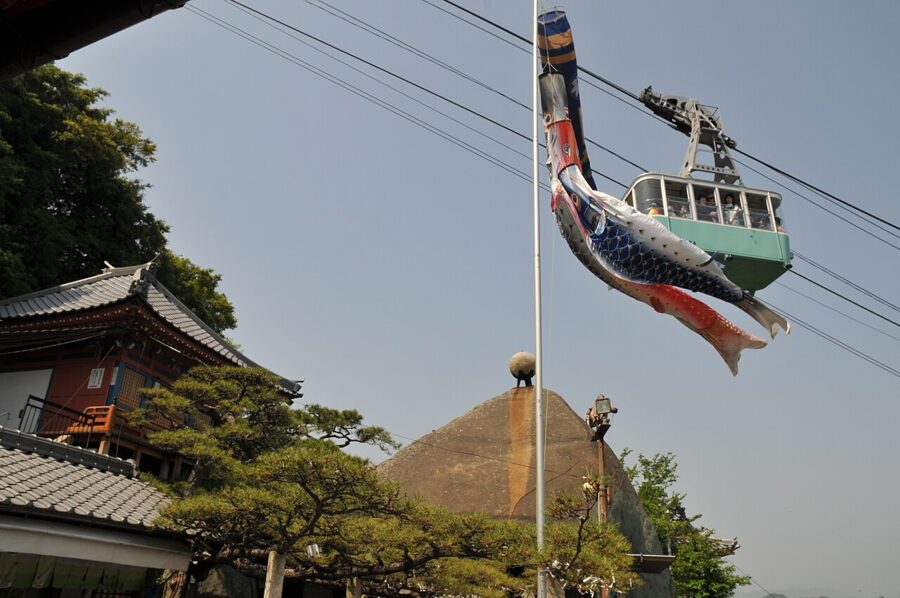
The ticket machine at the foot of the Senkojiyama Ropeway sells a return for ¥700 (about US$5) and a single for ¥500 (about US$3), and the single is the one to buy. Three minutes later you step out near the top of a 144 m hill, and everything worth seeing on it lies below you: the viewing deck, a path of poems cut into boulders, a red temple hall propped over a cliff, a pagoda, a lane of painted stone cats and an old shrine under giant camphor trees.
Going down on foot is the whole point. The temple’s own suggested route is a single ticket up and the walk down. Downhill, the order sorts itself out: summit, Path of Literature, Senkoji, the Tenneiji pagoda, the cat alley, and out at the bottom station beside Ushitora Shrine, about where you started.
Most people give the hill an hour. It repays a morning, and longer if you carry on east along the slope to Saikokuji and Jodoji. The station, the arcade and the ferries below are the rest of Onomichi.
The hill and the order to walk it
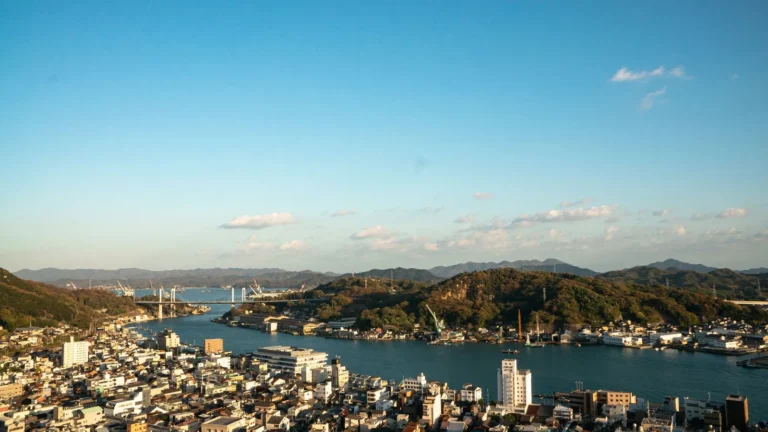
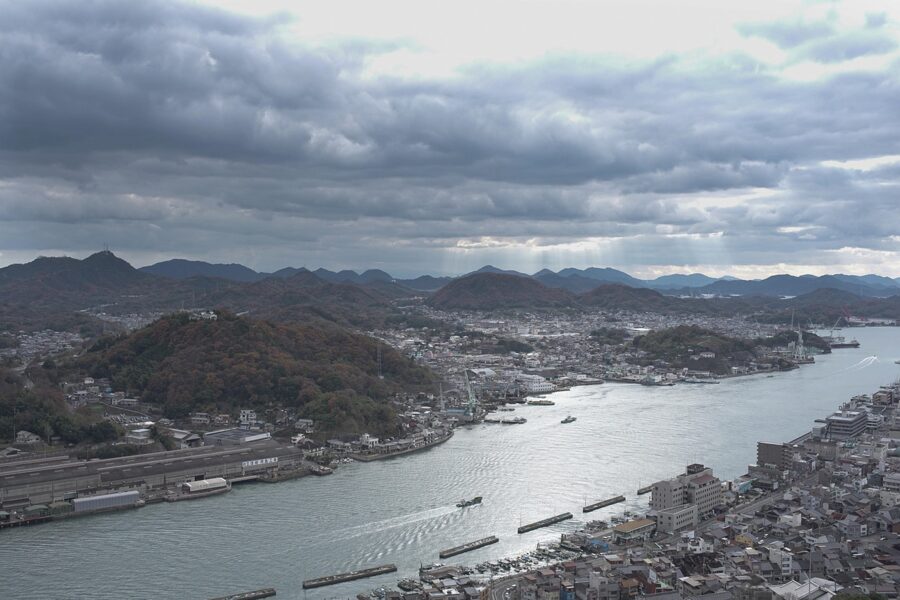
Senkoji-yama (千光寺山), which the temple calls Daihozan, rises straight behind JR Onomichi Station to 144.2 m. Senkoji Park covers the summit and upper slopes; the temple sits partway down, about 100 m above the sea, with the old town packed below it and the start of the Shimanami Kaido on the water at the bottom.
The ropeway’s bottom station is at Nagaeguchi (長江口), about 15 minutes’ walk east of the station, or about five minutes on an eastbound bus from stand 1. Everything else is on foot, mostly on steps. These are the temple’s, the ropeway’s and the temples’ own walking times; add time for looking.
| Stretch | Time on foot |
|---|---|
| Onomichi Station to the ropeway bottom station | About 15 minutes |
| Top station to PEAK | About 2 minutes |
| Top station to Senkoji by the Path of Literature | About 10 minutes (about 15 uphill) |
| Top station to Senkoji by the museum road | About 12 minutes |
| Senkoji to the cat alley (steps below the main hall) | About 5 minutes |
| Senkoji to the foot of the hill by the steps | About 10 minutes |
| Bottom station to the top, walking all the way | About 30 minutes |
For the ropeway, PEAK and the temple, the ropeway advises 60 to 90 minutes. Add Tenneiji and the cat alley and it is nearer two hours; with Saikokuji and Jodoji, half a day.
The Senkojiyama Ropeway
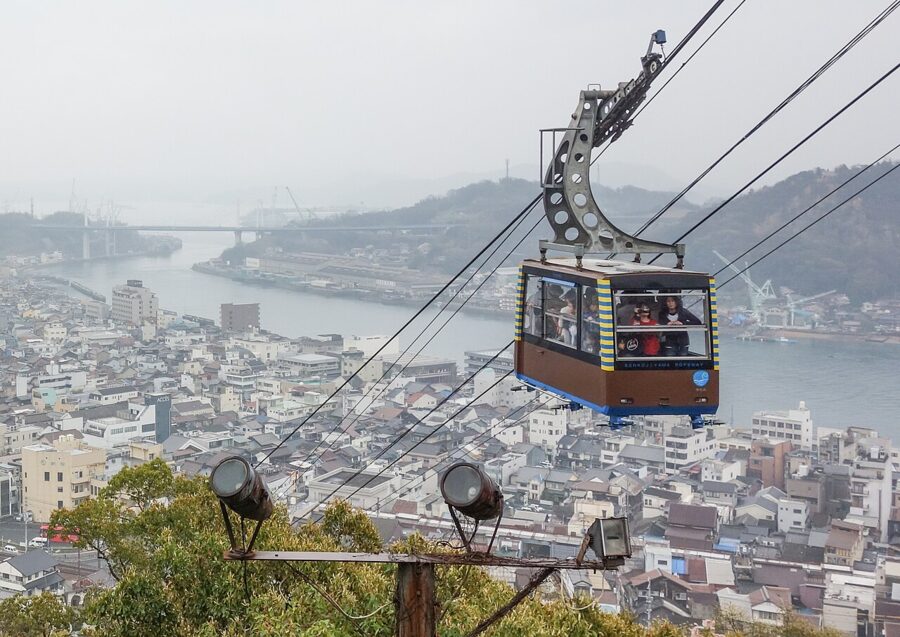
The ropeway opened in March 1957; the city owns it and Onomichi Bus runs it. Two cars cross in the middle, one of them called Kamome (gull). It runs from 09:00 to 17:15, every 15 minutes, with extra runs whenever a car fills.
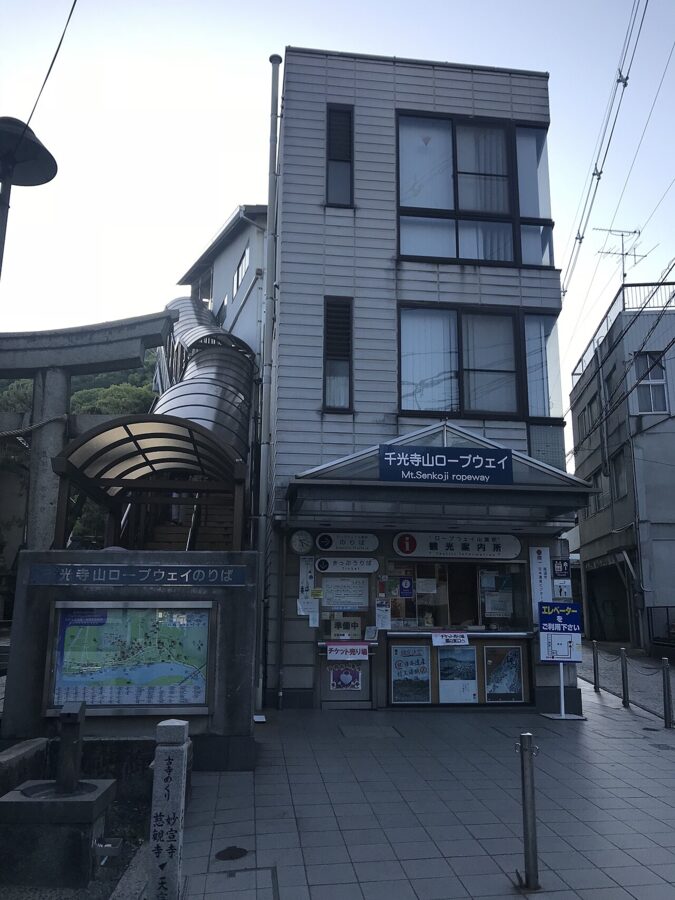
| Senkojiyama Ropeway (as of 2026) | One way | Return |
|---|---|---|
| Adult (junior high school and over) | ¥500 | ¥700 |
| Child (primary school and under) | ¥250 | ¥350 |
| Adult with JR-WEST RAIL PASS or JAF card | ¥450 | ¥630 |
One child under school age rides free with each paying adult, and the ropeway’s fare page lists the small discounts printed on the back of each ticket. Show a rail pass before you buy and pay cash for the discount; the machines take contactless cards and IC cards only at full fare.
The ropeway will also mind luggage: ¥300 a piece at the top station office, ¥500 at the bottom. And it stops every December for inspection: in 2026 there are no cars from 7 to 25 December. The closure notice adds that you can still walk, about 30 minutes each way, and PEAK stays open.
The Onomichi Free Pass
The Onomichi Free Pass, ¥1,000 (¥500 for children), covers a ropeway return plus a day on Onomichi Bus within set sections, including the run east past Jodoji. It is sold at the station bus centre, the station tourist office and several hotels, not at the ropeway. For the hill alone, the single is cheaper.
Walking up instead
From the bottom station the climb is about half an hour on steps and steep lanes, passing Senkoji. In summer I would not: the slope faces the sun all day.
PEAK and the top of Senkoji Park
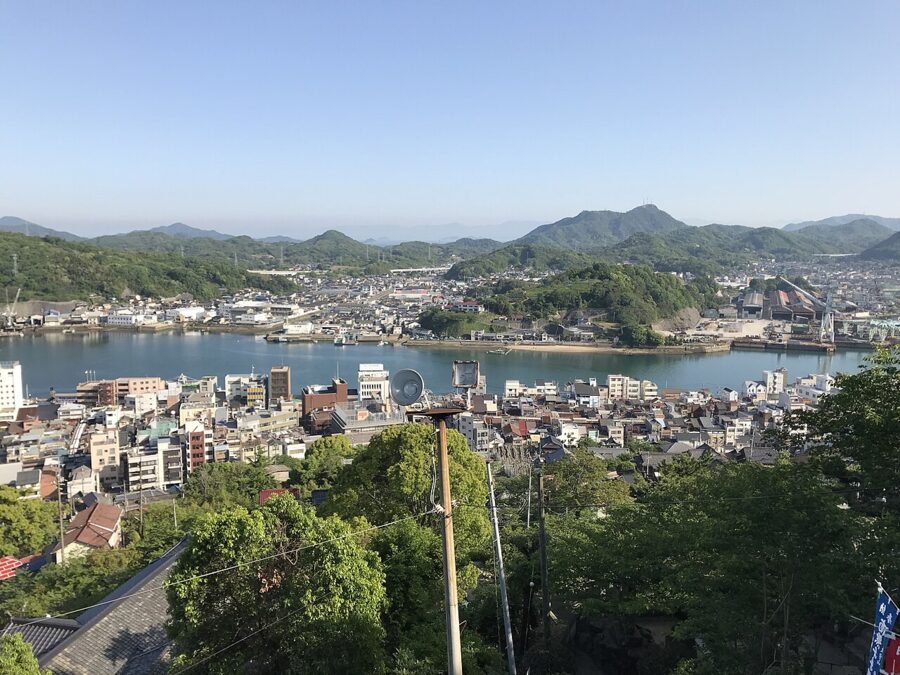
The top station opens onto Senkoji Park, open 24 hours, every day, free. Two minutes along the path is PEAK, the observation deck that replaced the old one on 29 March 2022: a single deck 63 m long by the architects AS, built thin and light so as not to break the skyline of the hill.
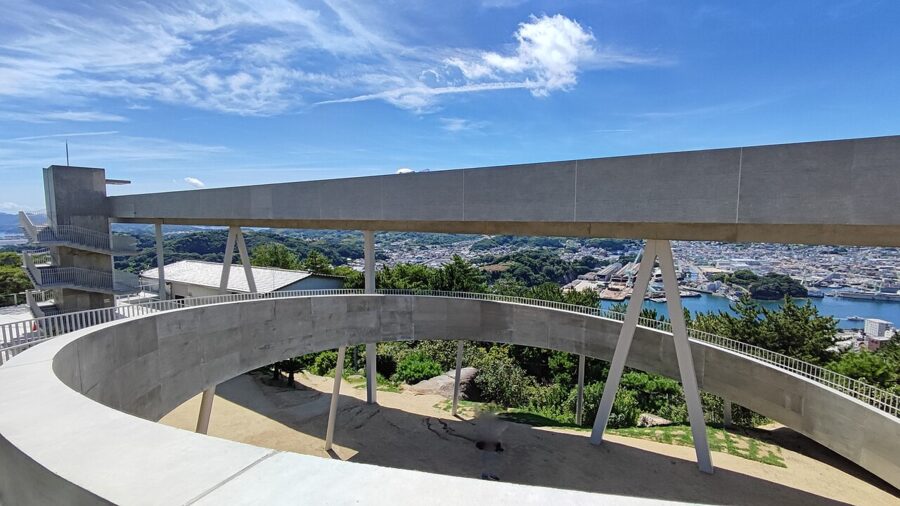
The deck runs parallel to the channel, so you walk along the view: the old town’s roofs, the railway, the channel and Mukaishima, with the Onomichi and Shin-Onomichi bridges to the east. On a clear day the city says you can see the mountains of Shikoku. Under the deck are a souvenir shop and drinks machines; use the summit toilets, as there are none in the temple.
Cherry blossom and the park in season
Senkoji Park is on the national list of the 100 best cherry-blossom sites, and the trees usually flower in late March and early April, the hill’s most crowded fortnight. In 2026 the city closed the roads around the park from 10:00 to 17:00 on the weekends of 28 and 29 March and 4 and 5 April, and the ropeway ran late from 29 March to 5 April.
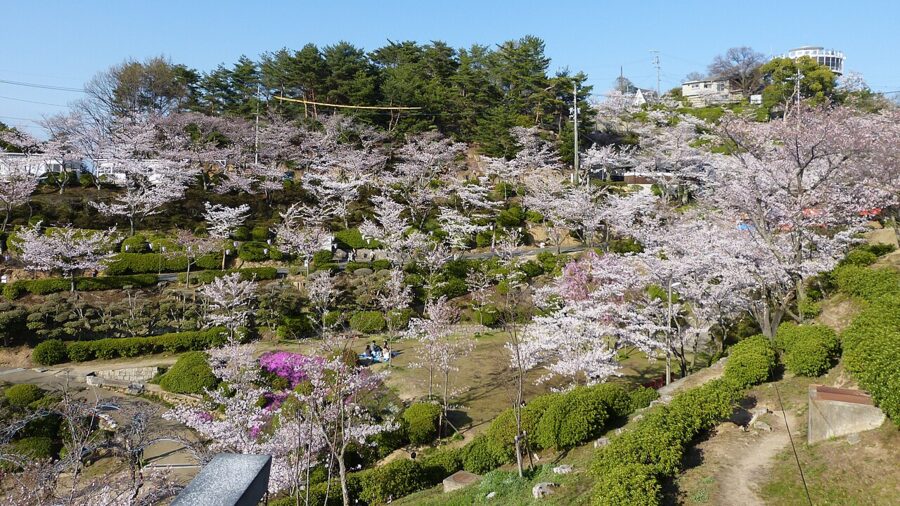
Blossom week is also one of the busiest of the year on the bridges, the spring half of the best time to visit the Shimanami Kaido. At blossom time, go up on a weekday morning.
The ropeway also ran late in 2026 for Golden Week, the Sumiyoshi fireworks over the channel (25 July), Obon and the Akari Matsuri lantern festival (17 October, timetabled to 21:15). On fireworks night tripods, drones and sheets to save space are banned on PEAK.
The Path of Literature
From the top of the park, the Path of Literature (文学のこみち) winds down through woods and boulders to the temple. Along it, 25 natural rocks carry lines by writers connected with Onomichi, each with a small board. It takes about ten minutes if you do not stop, which you will.
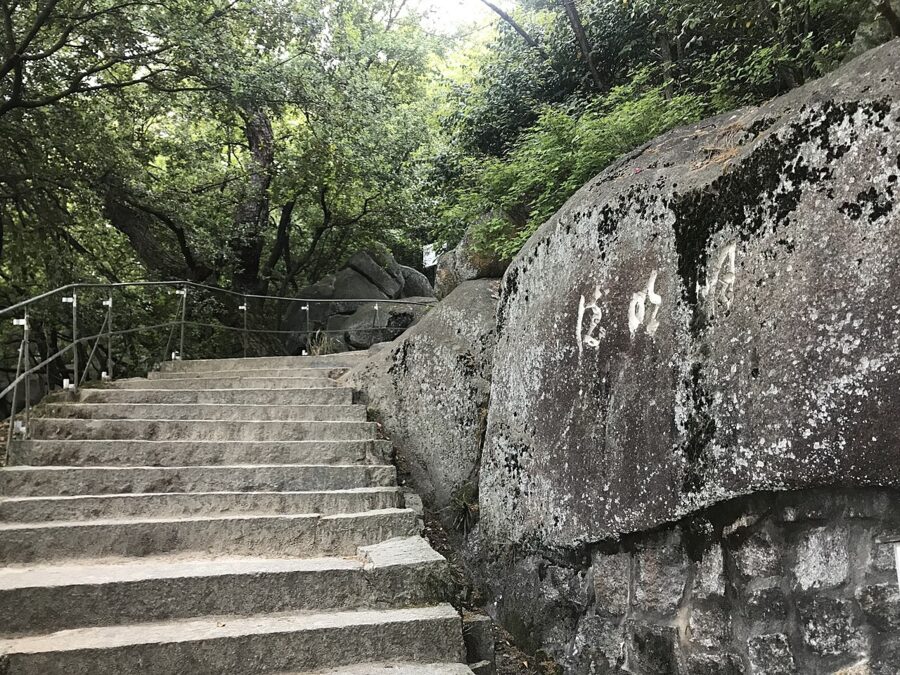
The names run from Matsuo Basho to the novelists Shiga Naoya and Hayashi Fumiko, by way of the comic writer Jippensha Ikku and the doctor Ogata Koan. Several describe the view you are standing in. Ikku made a pun of the town’s name, the “tail road”: the sea off Onomichi shining like a peacock’s tail.
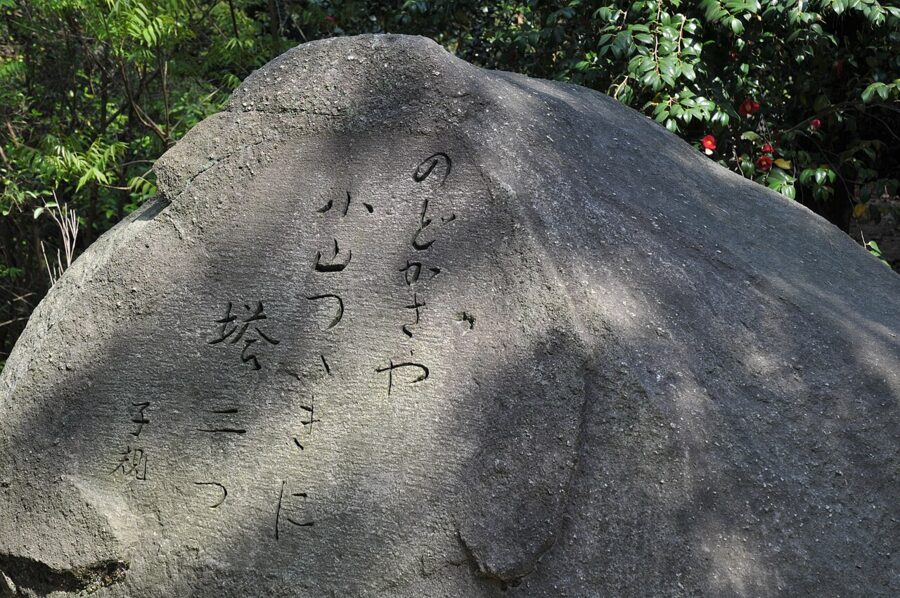
Hayashi Fumiko’s stone is from Diary of a Vagabond: her train comes round to the sea at Onomichi after five years away, and she can see the red tower of Senkoji. Shiga Naoya’s is the passage from A Dark Night’s Passing about the temple bell at six and its echoes across the water. The city’s list of the 25 stones has every inscription in Japanese. The path comes out at the top of the temple precinct.
Onomichi City Museum of Art
The city art museum sits inside the park, a few minutes from the top station. It opened in 1980 after a campaign by local people and was rebuilt to a design by Tadao Ando, reopening on 11 January 2003.
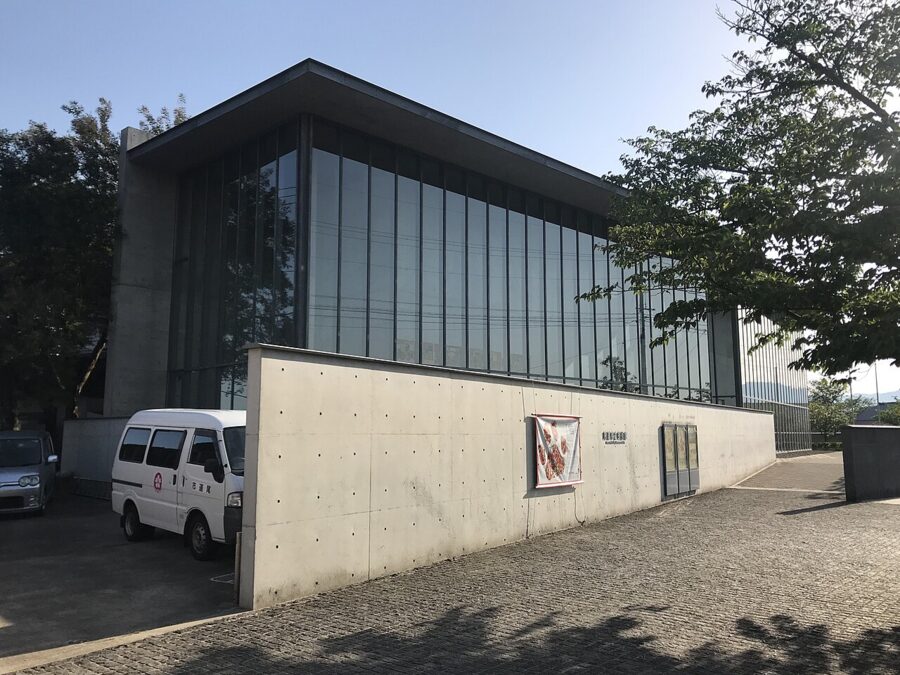
There is no permanent display: the museum opens only while an exhibition is on and shuts for a week or more between them. Hours are 09:00 to 17:00 (last entry 16:30); it closes on Mondays unless Monday is a public holiday, and from 29 December to 3 January.
The current exhibition is a collection show of painters of Onomichi, 28 November 2026 to 11 January 2027: ¥310 (about US$2) for adults, ¥210 for students, free for junior high pupils and under and for anyone 70 or over. The collection centres on Kobayashi Wasaku, the oil painter who lived in Onomichi. After it, the museum shuts until a free graduation show from 5 to 14 February 2027.
Senkoji, the temple on the rocks
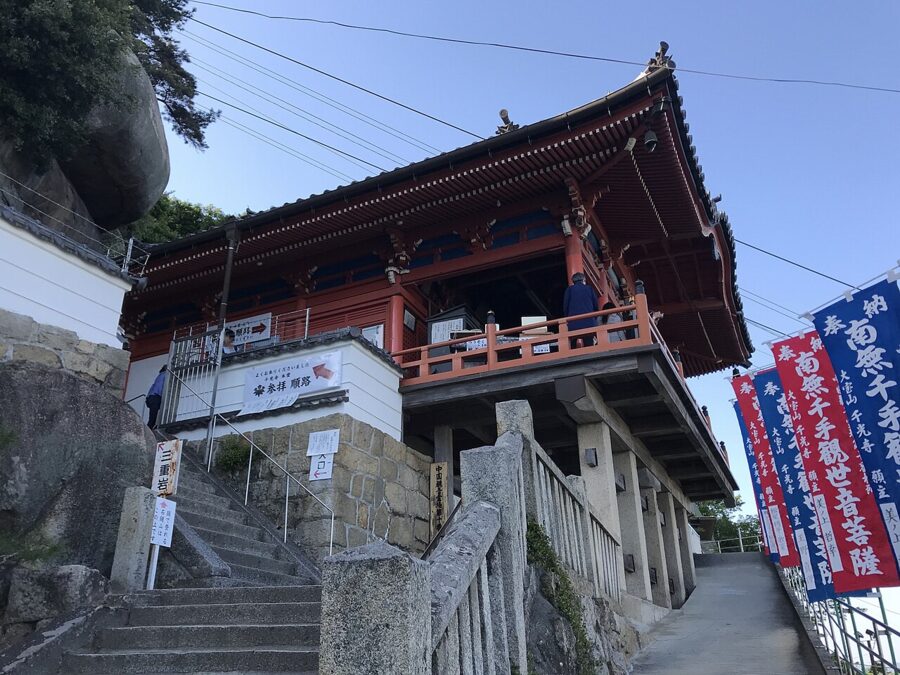
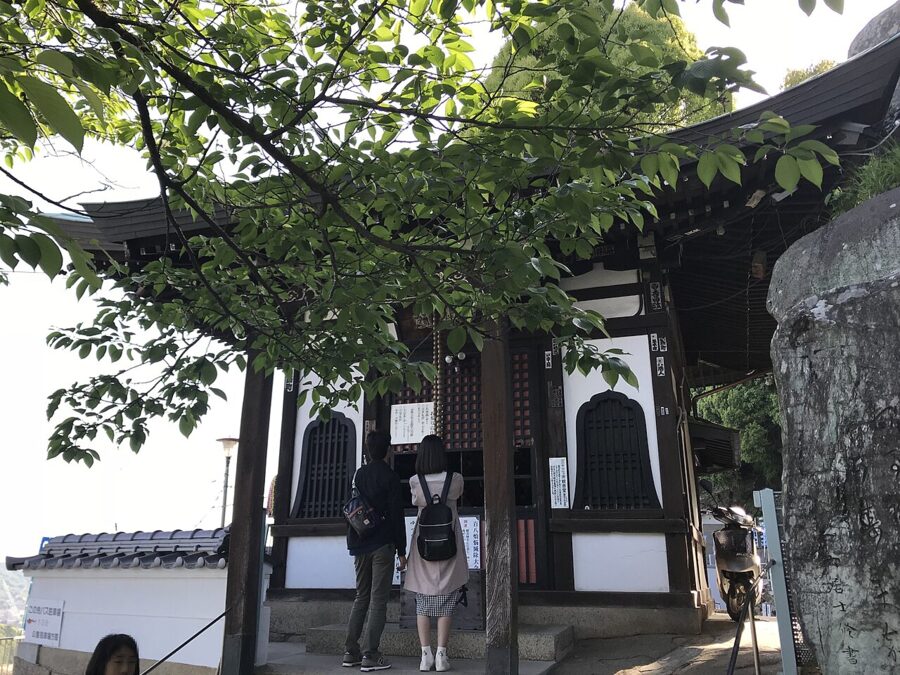
Senkoji (千光寺), formally Daihozan Gongen-in Senkoji, is a Shingon temple. It traces its founding to 806 and to Kobo Daishi, and its revival to the warrior Tada Mitsunaka. The main hall went up in 1686 on a timber stage over the cliff, and its main image, a thousand-armed Kannon said to be the work of Prince Shotoku, is a hidden Buddha shown only once every 33 years; the last showing was in 2013.
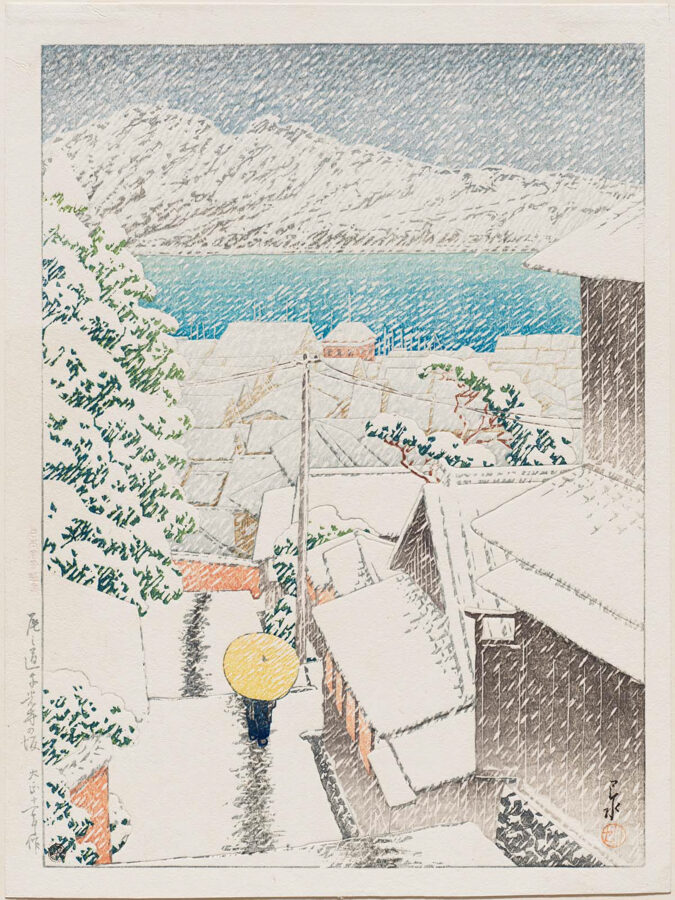
It is known as the Kannon that stops fires. In the temple’s story, a fire in neighbouring Kurihara village in 1704 was about to reach a man’s house when he prayed to the Senkoji Kannon, and the wind turned. A poem by the monk-poet Saigyo hangs on a plaque in the hall.
The precinct is open from 09:00 to 17:00. There are no toilets inside it, so use the ones at the summit or the car park first. A temple stamp (goshuin, 御朱印) costs ¥500 from 1 April 2026, written at the temple’s stamp office; the temple’s history page lists the halls and their dates.
Tama no Iwa and the jewel
The great boulder in the middle of the precinct is Tama no Iwa (玉の岩), also called Eboshi-iwa for its shape, like a court cap. It is about 50 m round and 15 m high, and it is only the third-largest rock on the hill. The main hall is on its right as you face it, the bell tower on its left.
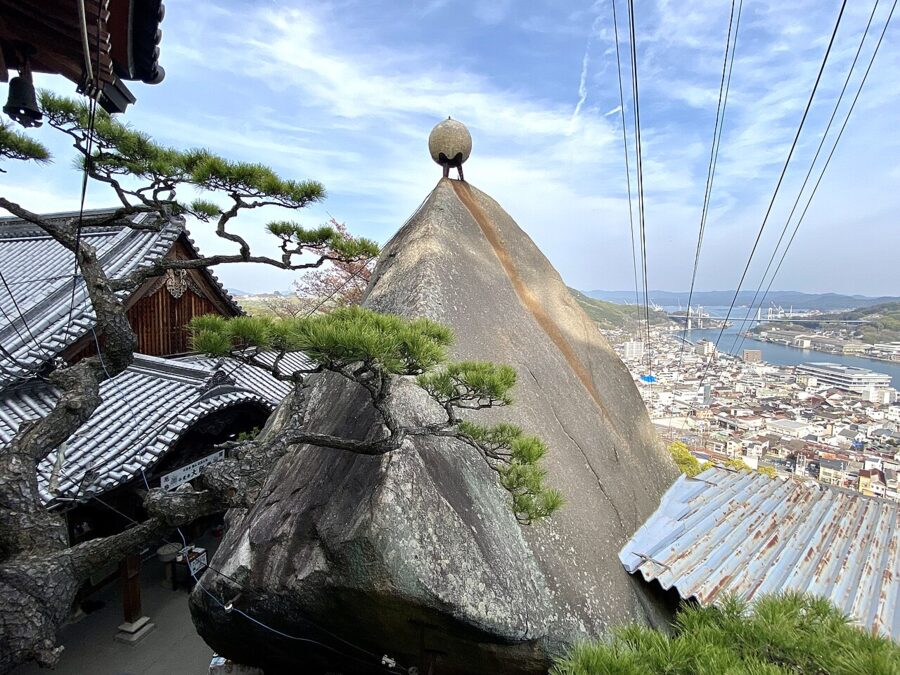
In the temple’s version of the legend, a wish-granting jewel on top of the rock shone out over the sea every night. A foreigner offered the monks gold for the boulder; when the puzzled monk would not sell, the stranger, now sure the monks knew nothing of the jewel, climbed up in secret and took it.
The hole where it sat is still on the summit, 14 cm across and 17 cm deep. The hill (Daihozan, “great treasure mountain”), the temple (“temple of a thousand lights”) and the harbour’s old name (Tama no Ura, “jewel bay”) are all said to come from the story. The temple’s page on the rock tells it in full.
The other rocks
Senkoji is built among granite boulders, and the named ones are the best reason to slow down.
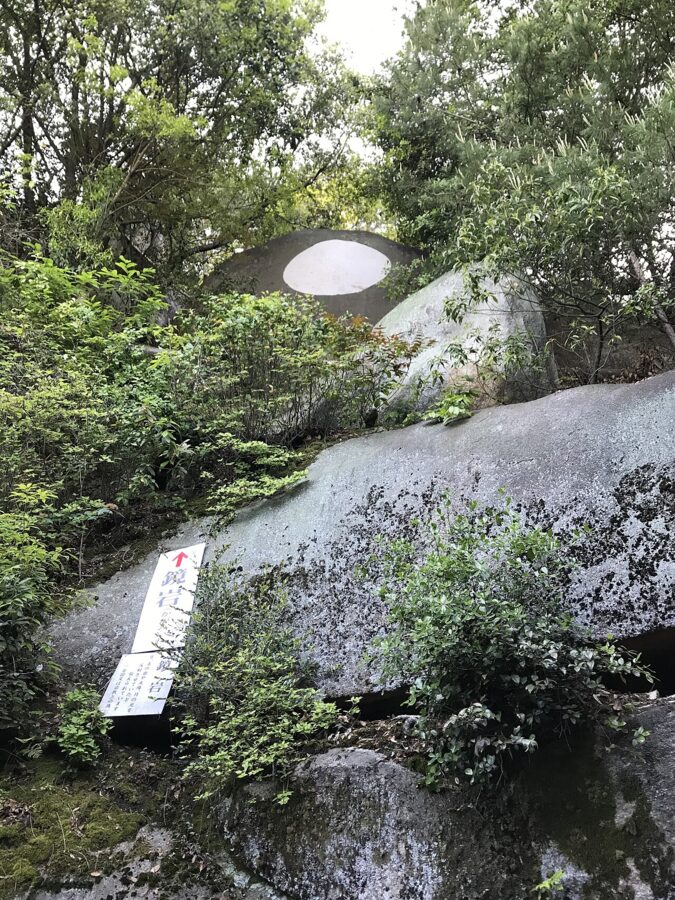
- Tsuzumi-iwa (鼓岩), the Pon-pon rock, is the second-largest on the hill. Tap the top with a pebble and it answers with a hollow note like a hand drum; in 2026 the Acoustical Society of Japan named it one of its Acoustic Heritage sites. The wedge marks on its side are said to be from cutting stone for Osaka Castle.
- Kagami-iwa (鏡岩), the mirror rock, is said to have reflected the jewel’s light, or the sun and moon.
- Bonji-iwa (梵字岩), just west of Tama no Iwa, carries a round mandala of Sanskrit mantras, said to have been written out by Jogon, a priest to the fifth Tokugawa shogun.
- The three-layered rock (三重岩) stands over a row of stone Jizo by the steps.
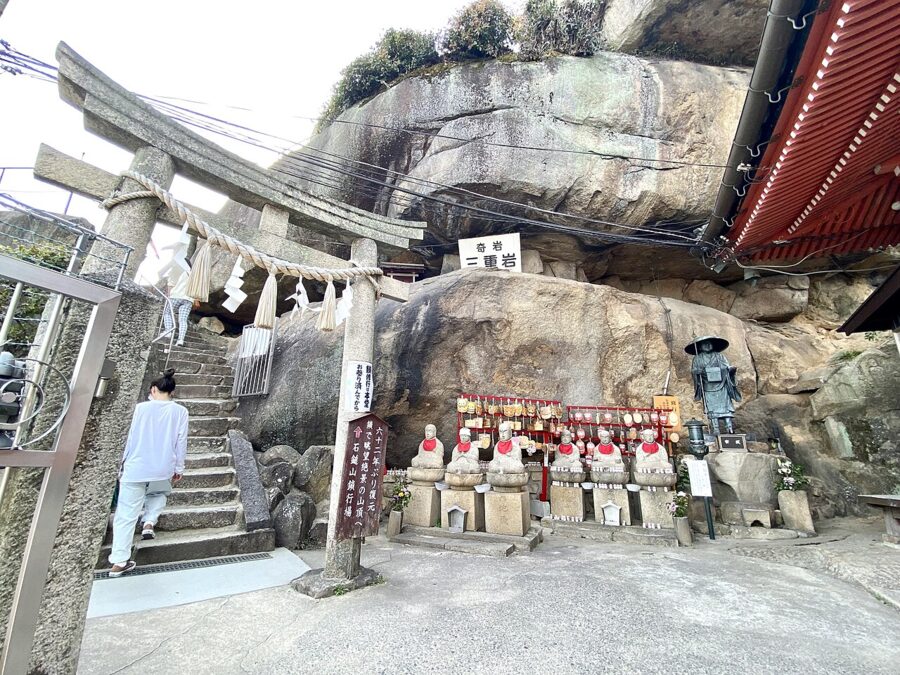
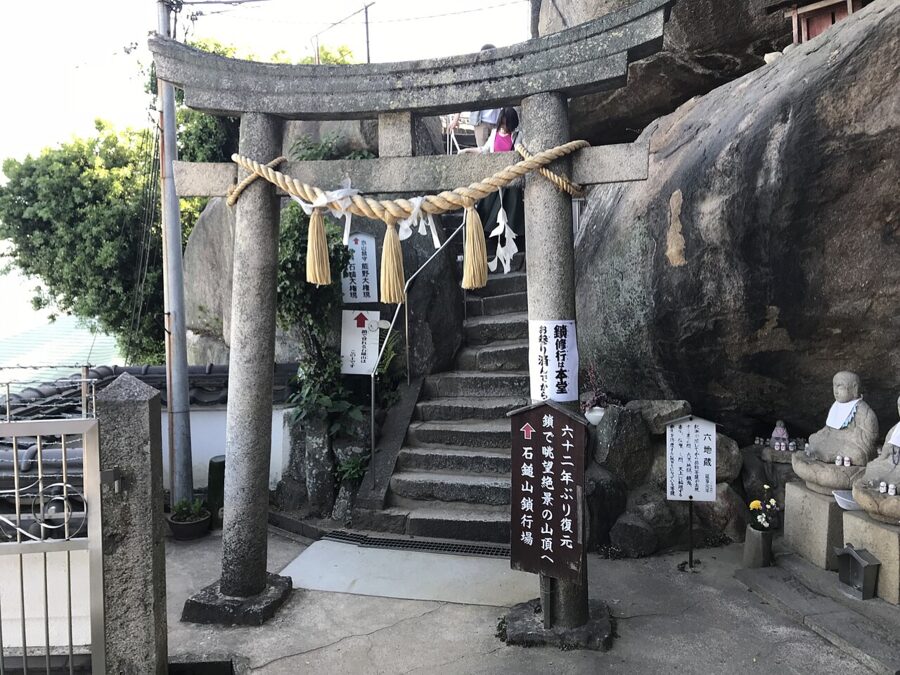
Behind the main hall, a stone torii leads to Kusariyama (くさり山), a small shrine to the mountain god of Ishizuchi on the rocks above, reached by hauling yourself up on iron chains. The chains, fitted in 1926, went for the war effort in 1943 with the temple bell; since 2005 anyone may climb again. It is short and steep: skip it in the wet or with a bag on your back.
The temple says recent study shows the main hall was set to line up with the great rock on Iwayasan at sunrise on the winter solstice, and that Saikokuji and Jodoji, on the town’s other two hills, face the same way.
The bell and the halls
The bell tower on the cliff edge, rebuilt in 1890, holds the bell Onomichi has told the time by since the late 17th century; a local song says it is heard for one ri and echoes for two. In 1996 it joined the national list of 100 soundscapes of Japan.
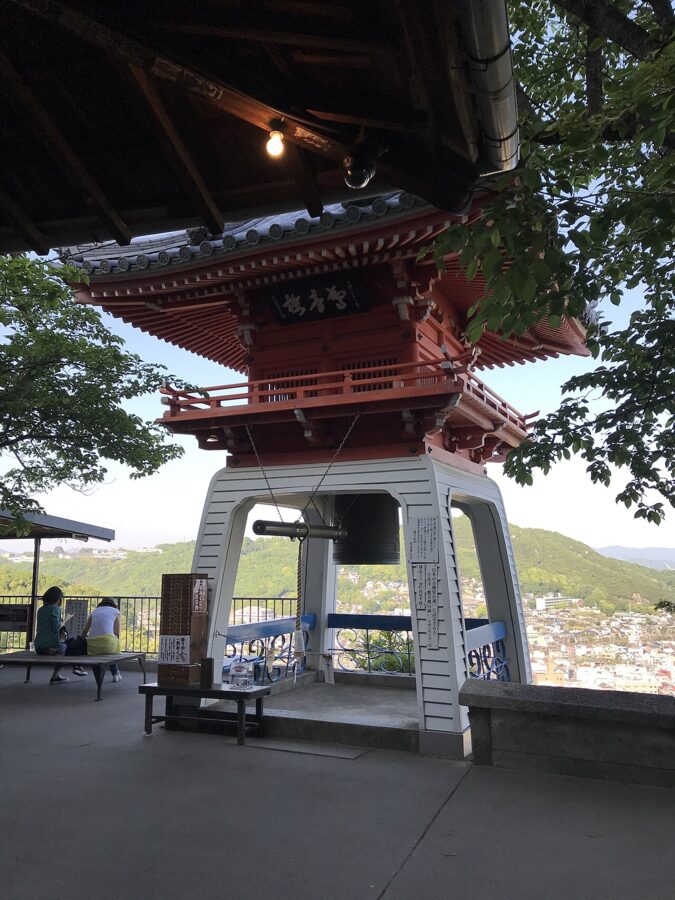
On New Year’s Eve the public rings it. Last time the temple handed out numbered tickets from 22:00 and began at 22:30, and the first 400 ringers got a special stamp sheet; check its notices in December.
At the Sanjusan Kannon-do (1743), a rosary of 108 cherry-wood beads hangs at the front; pull it slowly and the beads click down one by one, each click knocking away a worldly desire. The Daisendo keeps a mild-faced figure people call the smiling Jizo. The Gomado, built in 1710 where a pagoda stood until a falling rock flattened it, holds a fire ceremony open to anyone at 10:00 on the 28th of each month.
Down the hill: the temple walk
Below Senkoji the hillside is temples, cemeteries and houses all the way to the railway. The city’s old-temple walk links 25 temples in about three hours; a shorter set, the Onomichi Seven Buddhas (尾道七佛めぐり), picks seven, and the Seven Buddhas map gives the walking times between them.
| Stop, in walking order | From the last stop | Hours | Entry |
|---|---|---|---|
| Senkoji | Start | 09:00–17:00 | Free (stamp ¥500) |
| Tenneiji (pagoda and main temple) | About 5–10 minutes down | 09:00–16:30 | Free |
| Cat alley and Ushitora Shrine | A few minutes | Lane open at all hours | Free |
| Daisanji | About 15 minutes from Senkoji | 09:00–16:30 | Free |
| Saikokuji | About 15 minutes | 08:00–17:00 | Free (Jibutsudo ¥500) |
| Jodoji | About 15 minutes | 09:00–16:00 | ¥300 (¥500 from 2027) |
| Kairyuji | About 1 minute | 09:00–16:30 | Free |
Stamp offices at the seven are open 09:00 to 17:00. With an hour, do Senkoji, Tenneiji and the cat alley. With a morning, carry on east to Saikokuji and Jodoji, the two I would not miss, and take the bus back from Jodoji-shita.
Tenneiji and its pagoda
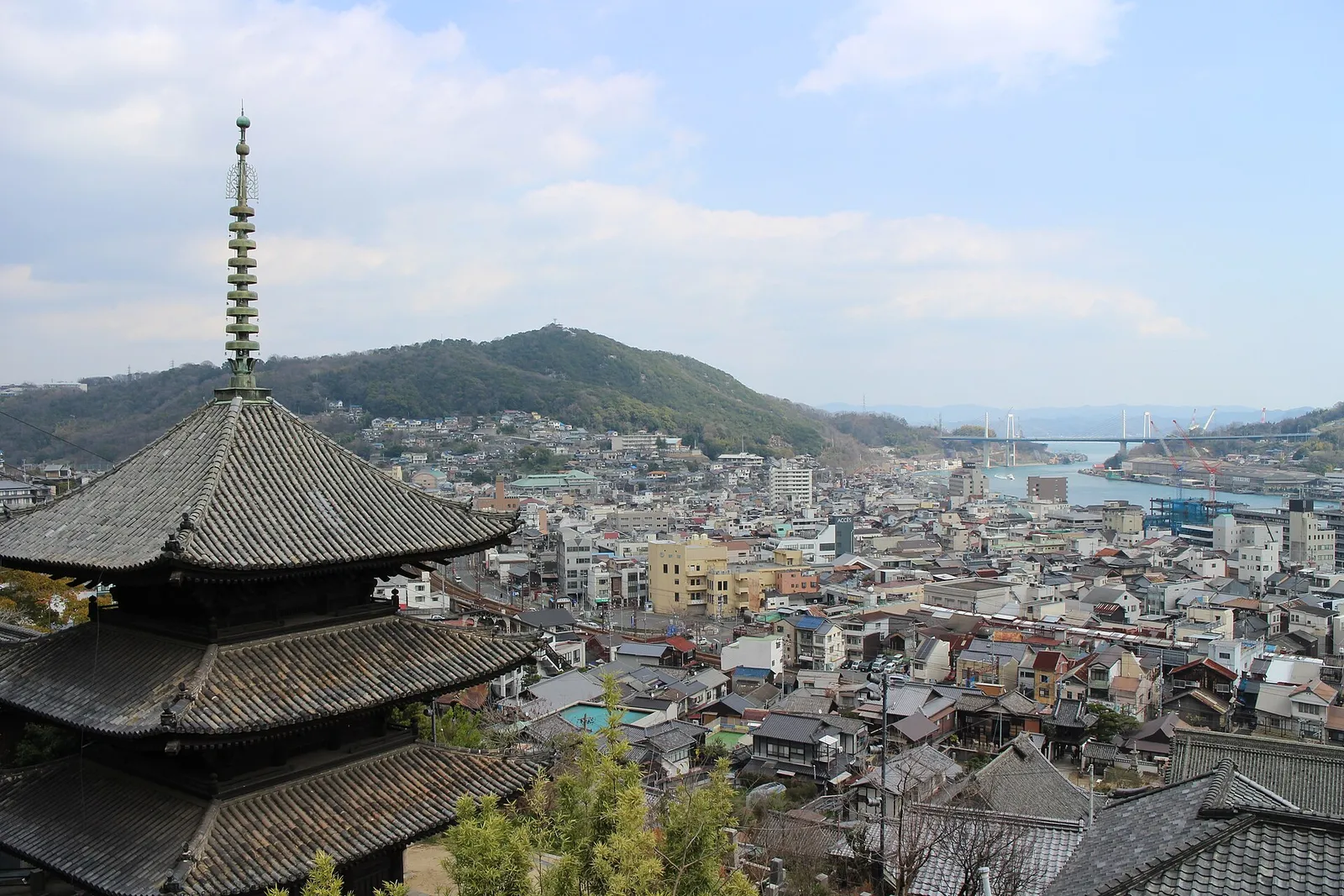
Five to ten minutes down the steps from Senkoji you come out beside the three-storey pagoda of Tenneiji (天寧寺), the Kaiun-to, set on the slope above the main temple. Tenneiji was founded in 1367 by the shogun Ashikaga Yoshiakira, carrying out his father Takauji’s wishes, as a great Zen temple across the hillside. The pagoda is an Important Cultural Property.
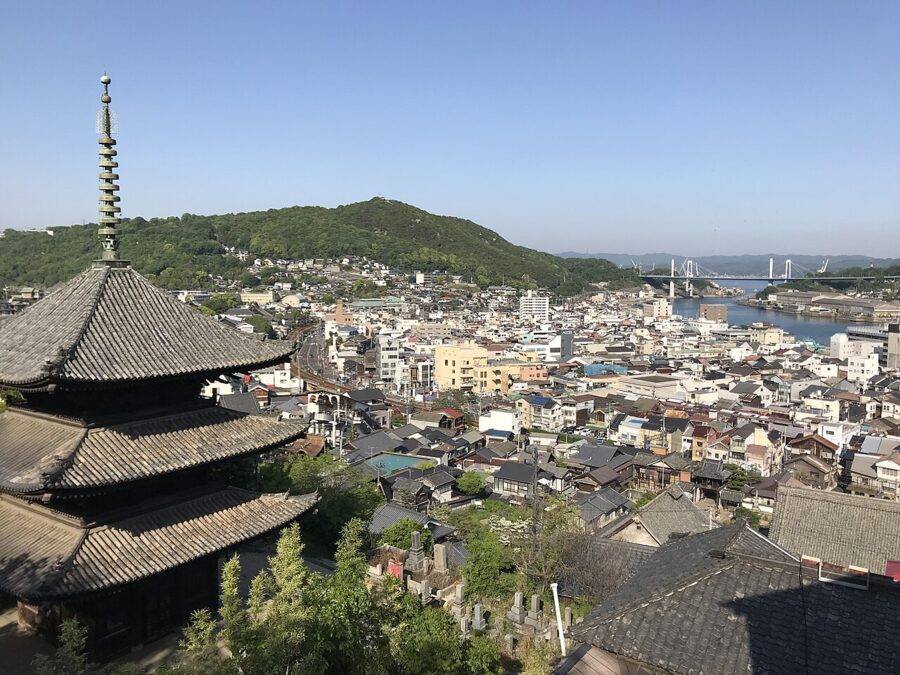
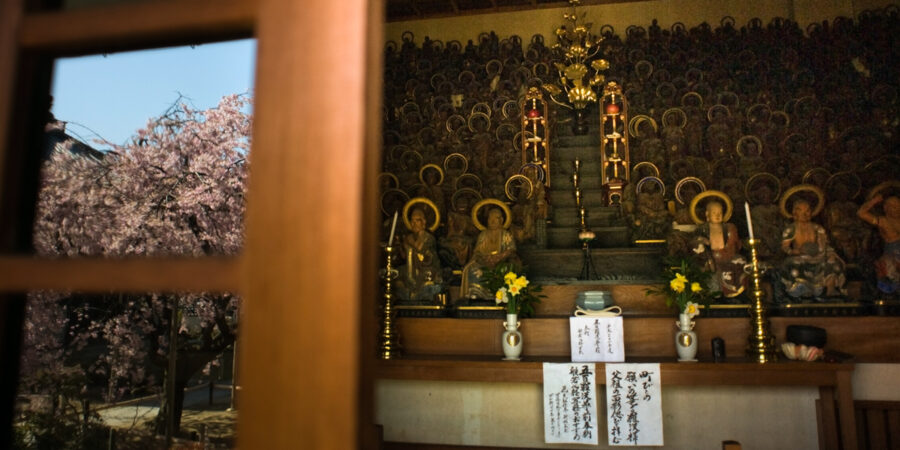
The main temple is lower down, free, from 09:00 to 16:30. Inside are the five hundred rakan, small seated disciples of the Buddha, and on the left as you enter is the sasuri-botoke, a figure you rub where you hurt. In late March and April there are weeping cherry, magnolia and hundreds of peonies.
The priest’s own tip, on the Seven Buddhas page for Tenneiji: stand at the main gate, crouch, and look through it into the precinct. The temple kitchen, the pagoda and Senkoji line up in one frame.
Ushitora Shrine
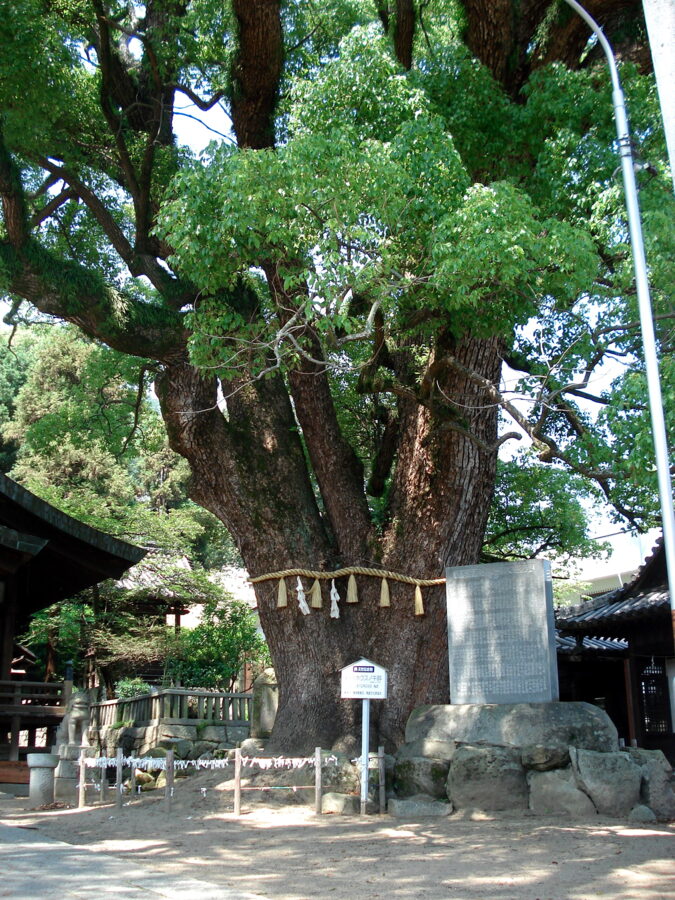
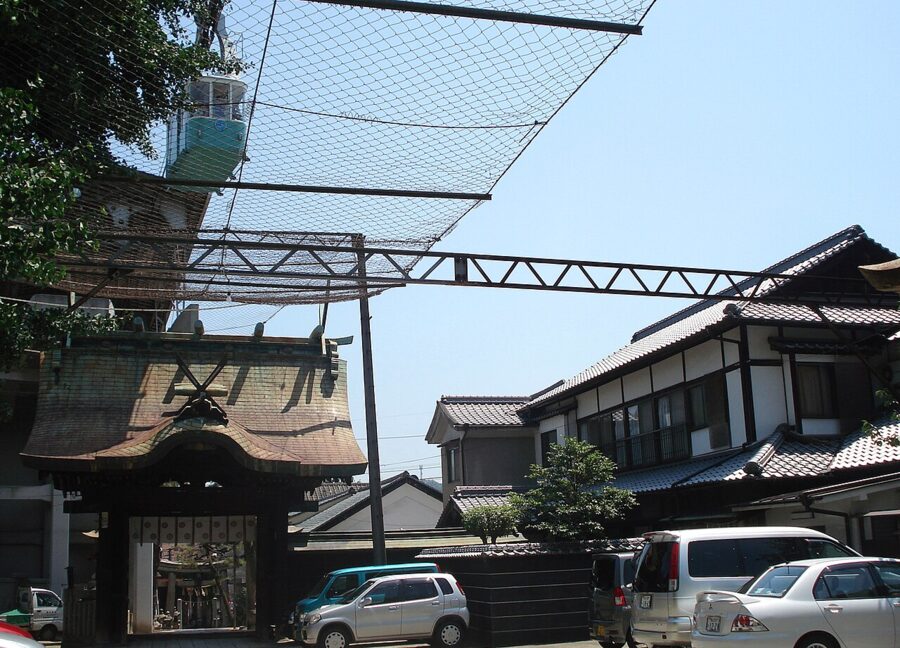
At the bottom of the cat alley, beside the ropeway’s bottom station, is Ushitora Shrine (艮神社), said to be the oldest shrine in Onomichi. Its group of great camphor trees has been a prefectural natural monument since 1988, and the ropeway cables pass directly over the precinct.
East to Saikokuji and Jodoji
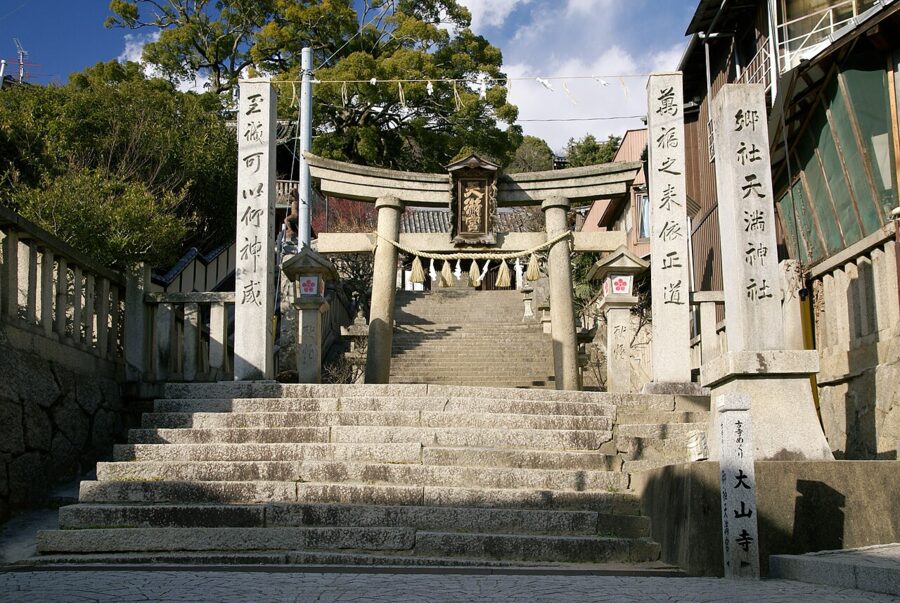
From the foot of the hill the walk carries on east along the lanes above the railway. Daisanji (大山寺) is first, about 15 minutes from Senkoji, with the Misode Tenmangu shrine next door; students come to pray for exam passes.
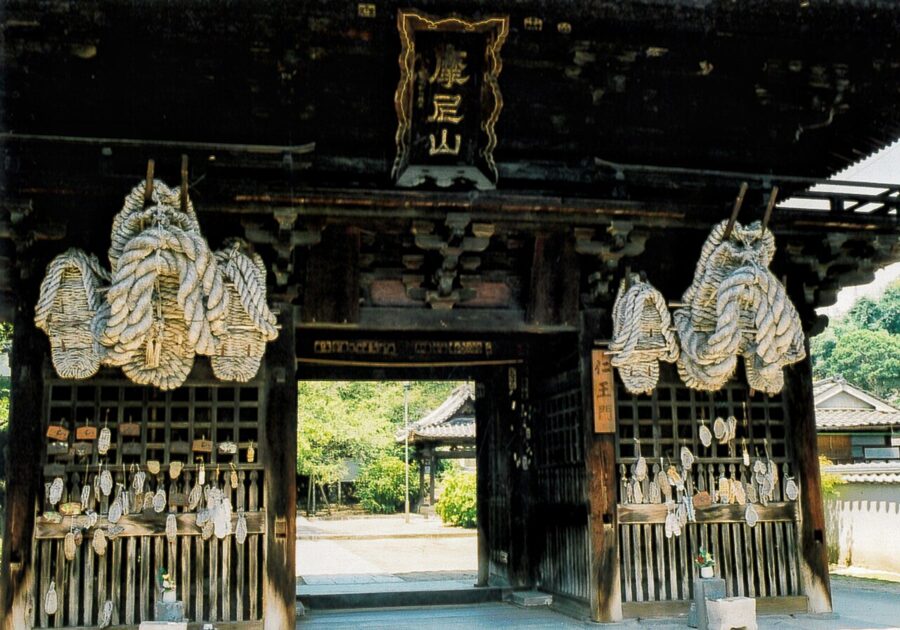
Saikokuji (西國寺) is another 15 minutes on, on the slope of Atagoyama. It dates its founding to the Tempyo era (729 to 749) and the monk Gyoki, and is a head temple (daihonzan) of the Daigo branch of Shingon. Its gate, the Niomon, is hung with enormous straw sandals, about 2 m long, and rows of smaller pairs: in a town built on steps, people pray to the gate’s guardian kings for strong legs.
Above the gate, 108 stone steps climb to the Kondo, an Important Cultural Property rebuilt by the Yamana clan in the 14th century, with a vermilion three-storey pagoda higher up. The precinct is open from 08:00 to 17:00 and costs nothing; the temple’s visiting page lists the stamp at ¥300 and entry to the Jibutsudo, with its sliding-door paintings, at ¥500 from 09:00 to 16:30.
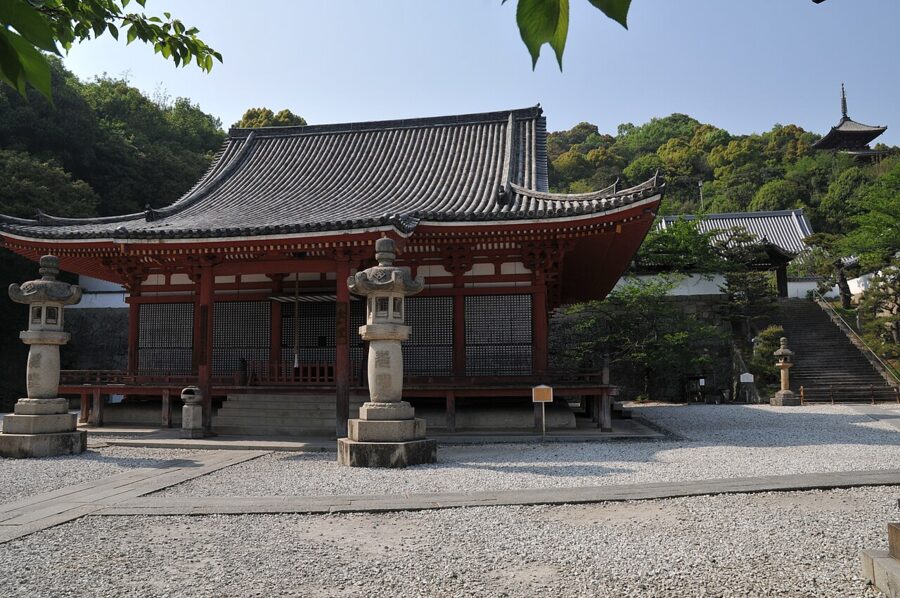
Jodoji (浄土寺), 15 minutes further east, is the town’s most important temple on paper. Its main hall (1327) and two-storey Tahoto pagoda (1329) are National Treasures, rebuilt within a few years of a fire in 1325 by a local couple who vowed to replace them. Ashikaga Takauji prayed here for victory before the battle of Minatogawa.
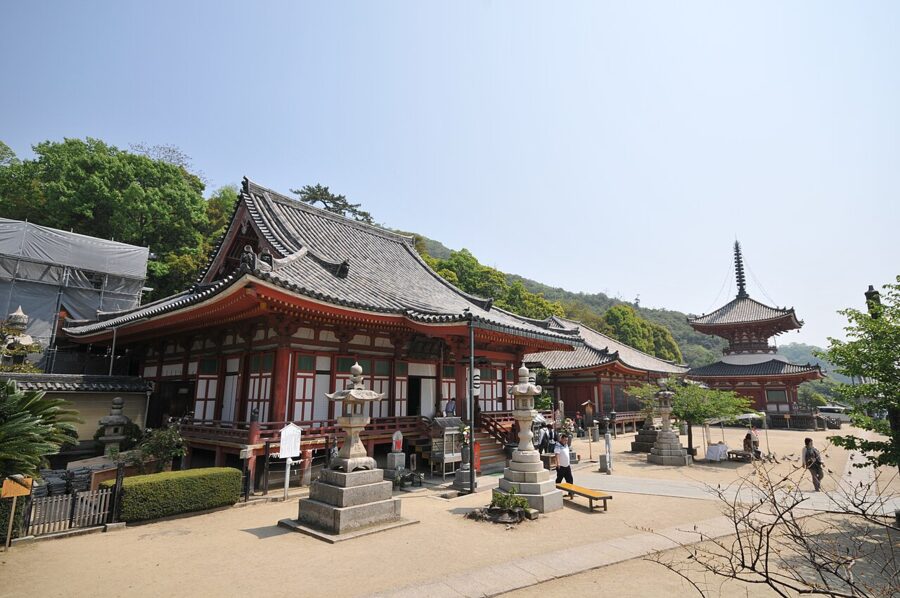
Jodoji charges for its halls and garden: the temple’s visiting page gives ¥300 for adults and ¥150 for junior high and under, rising to ¥500 and ¥250 from 1 January 2027, 09:00 to 16:00 (last entry 15:45), closed 1 to 4 January. Kairyuji is a minute east, and from the Jodoji-shita stop the bus takes about five minutes back to the station.
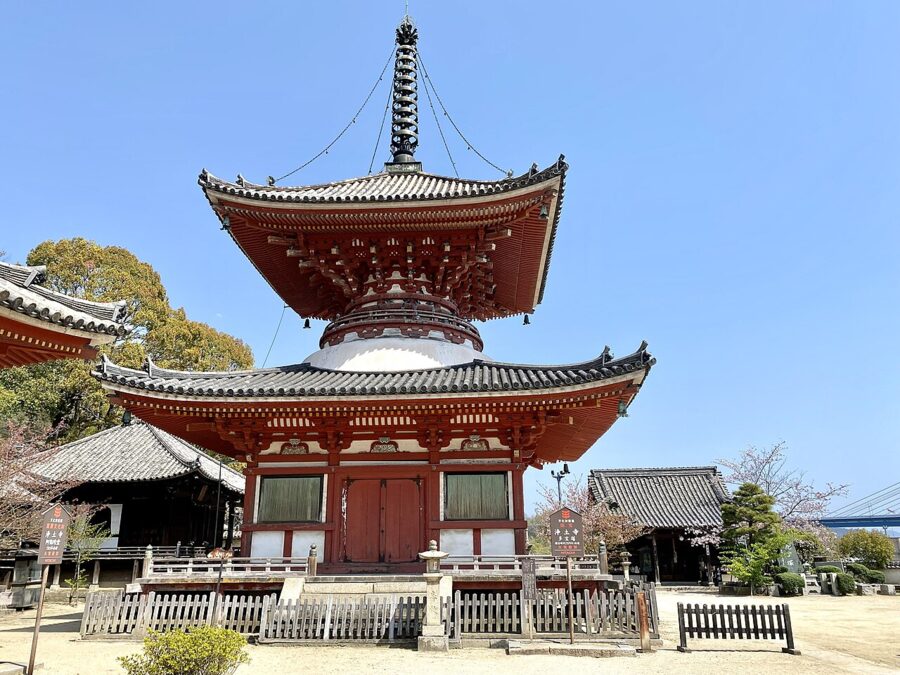
West to Jikoji, and collecting stamps
Jikoji (持光寺), five minutes from Onomichi Station, is the western end of the seven. Its gate is a tunnel of 36 granite slabs said to lengthen your life, and for ¥1,500 the priest will fire a small Buddha you squeeze out of clay in your left hand.
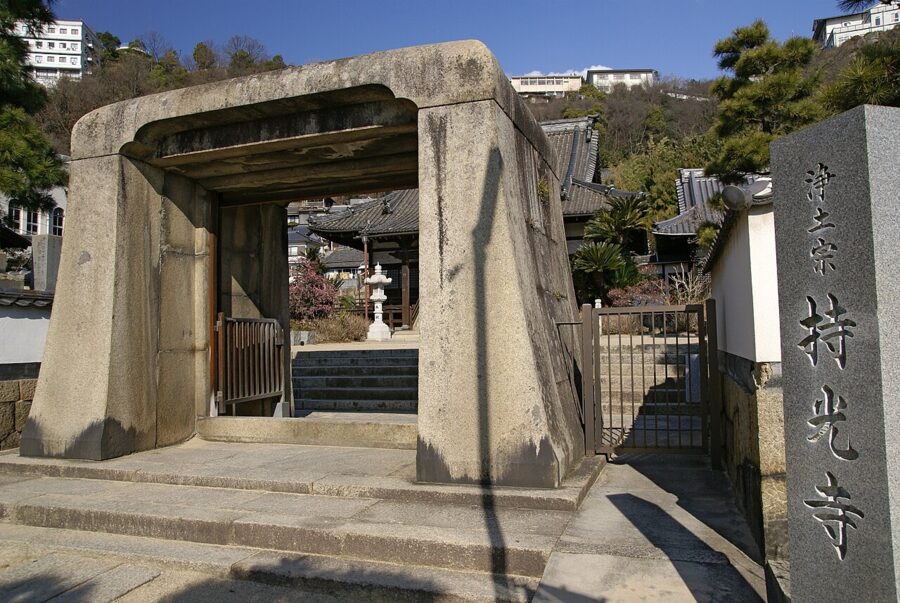
For the full set, each temple sells a stamp board for ¥500 and stamps it for ¥300; fill all seven and the last temple gives you a paper scroll mount. Allow about three hours on foot.
The cat alley and the back lanes
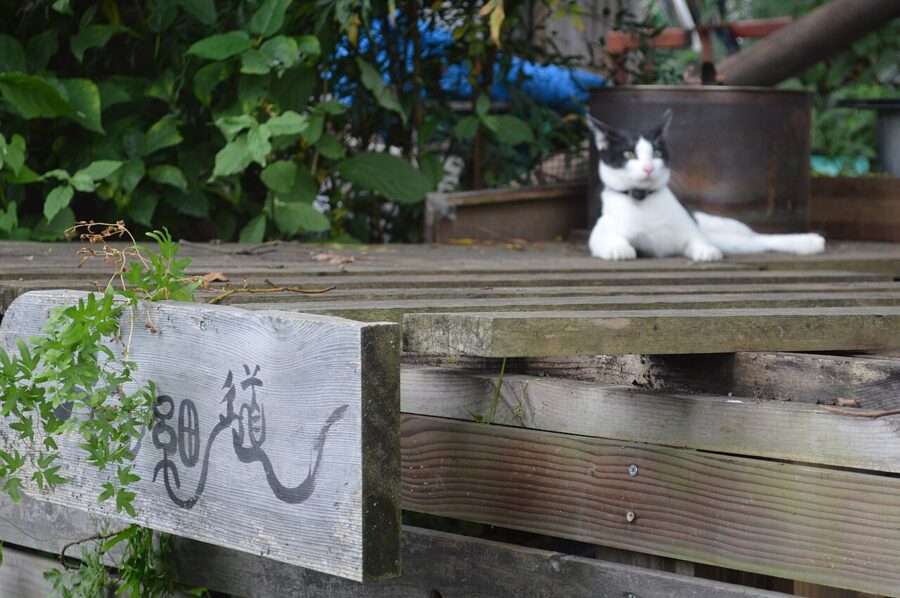
Neko no Hosomichi (猫の細道), the cat alley, starts on the left side of Ushitora Shrine as you face it and runs about 200 m along the slope towards the Tenneiji pagoda; from Senkoji it is about five minutes down the steps below the main hall. People live along it, and it is all steps, no good for pushchairs or wheelchairs.
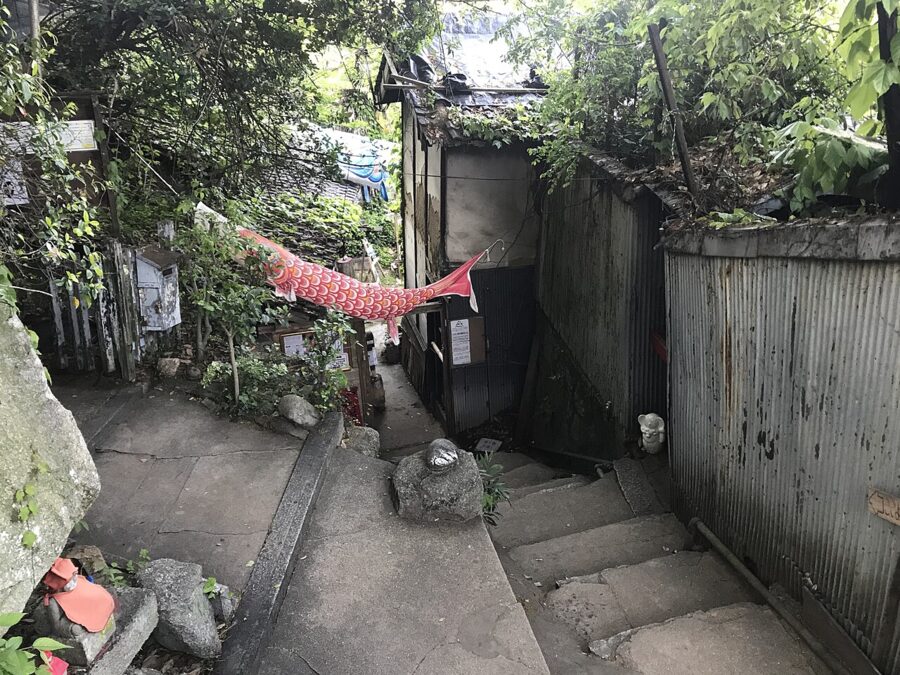
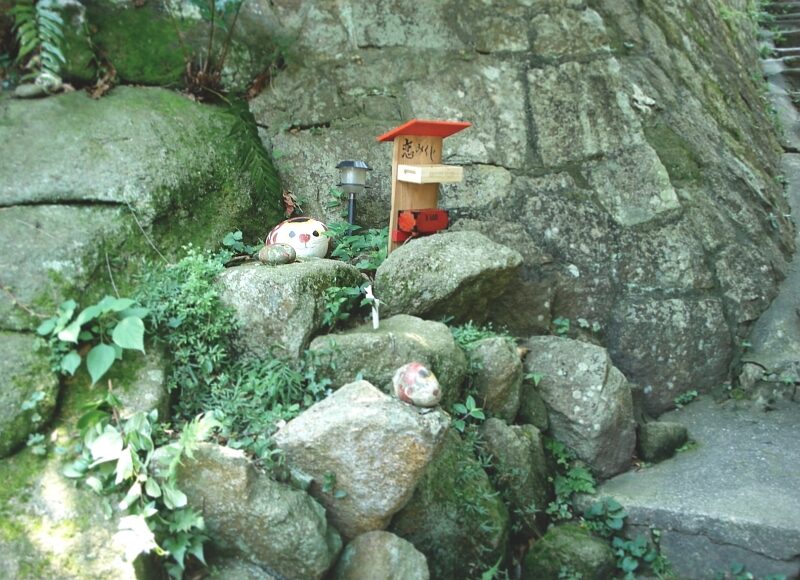
The lane is the work of the artist Sonoyama Shunji and his project Onomichi Ihatov, named after Miyazawa Kenji’s ideal land; “Hosomichi” plays on Basho’s Narrow Road to the Deep North. His fukuishi neko, “lucky stone cats”, are round stones painted as cats and tucked into walls all the way along, more than a thousand of them around the town.
The real cats are community cats, watched over by the neighbourhood; some days you meet several, some days none. The project’s own page on the lane tells their story, and its requests to visitors are plain: stay off private land, keep out of people’s way and keep your voice down.
Off the alley the hillside is a tangle of stepped lanes, and you will get mildly lost. Every lane goes downhill to the railway, and the railway leads to the station. Watch for Bizen-ware casts of famous visitors’ footprints set into the paving, including near Tsuzumi-iwa and at the top station.
Shoes, heat, bikes and the light
Wear proper shoes; even the art museum’s directions ask for trainers. The hill is steps, smooth stone and steep concrete, slippery after rain. Leave the suitcase at the station or with the ropeway, or send it on ahead with one of the bag services in Shimanami Kaido luggage and ferries.
In summer, go up at 09:00 or late in the afternoon. The south-facing slope holds the heat, and the ropeway takes fewer people per car in summer (about 20 instead of 25), so queues build at midday. Carry water.
With a bike or a car
If you are riding the cycling route, do the hill on foot before you set off or after you get back. The ropeway has no bike parking: its FAQ sends ordinary bikes to the public bicycle park at Yutori no Hiroba nearby, and road bikes to one of the city’s Shimanami Cycle Oasis racks. With a rental bike, it is easier to do the hill before you collect it or after you hand it back.
By car, the Senkoji Park car park near the summit has 63 spaces and charges ¥800 a visit, ¥1,000 at weekends and on public holidays (as of 2026), with extra temporary space at blossom time and in Golden Week. From there it is five to ten minutes on a steep path to PEAK or the temple. A bus also runs to the top from stand 5 at Onomichi Station, but only a few times a day and not at weekends, on public holidays, at Obon or over the New Year.
Early, late and after dark
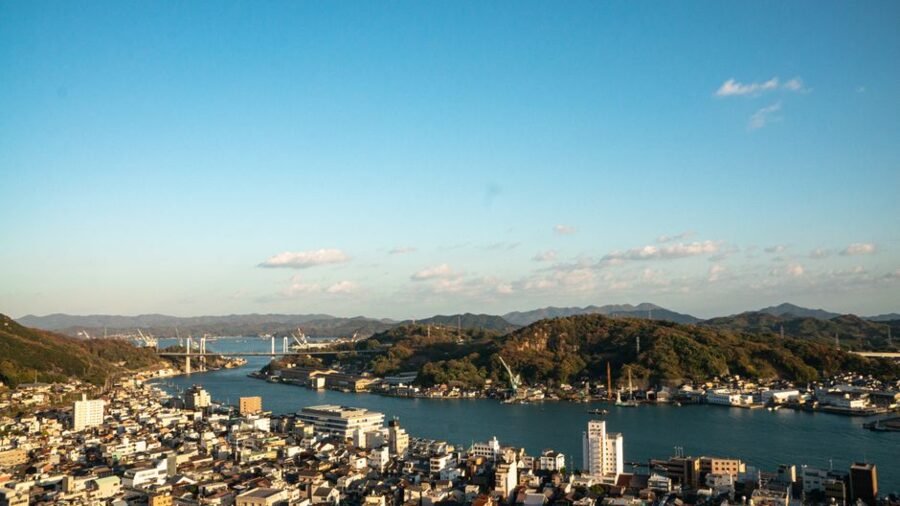
The main hall and the deck face south over the channel, so the light is behind you most of the day. Early morning is the quietest time, though the temple opens at 09:00, with the first car. On New Year’s Day the ropeway starts at 06:30 for the first sunrise.
After dark PEAK stays open, the town and channel are lit below, and the jewel on Tama no Iwa glows. Take a torch and use the road past the museum rather than the Path of Literature.
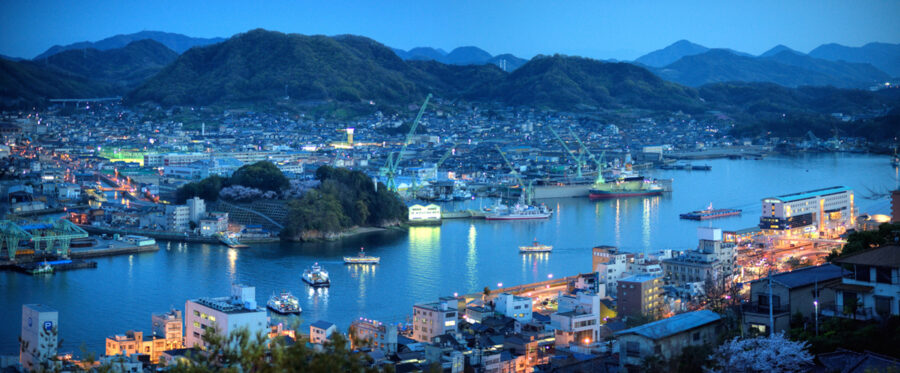
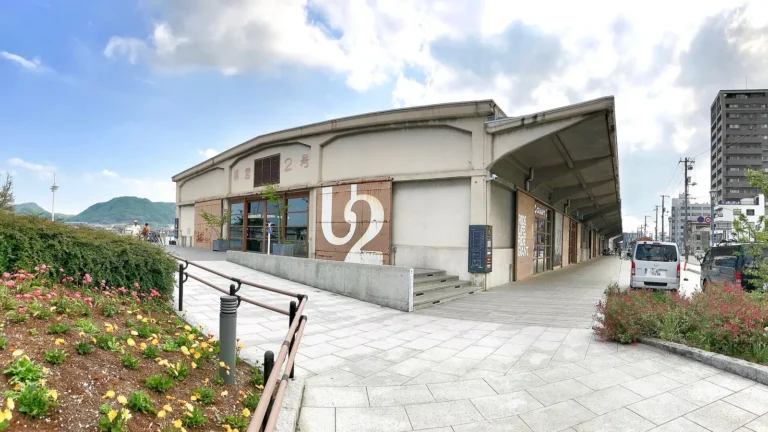
A night in town lets you do the hill at both ends of the day; Onomichi has the widest choice of beds at the start, in where to stay on the Shimanami Kaido. At the bottom, the arcade has the Onomichi ramen queues, and ONOMICHI U2 is along the quay to the west.
So: walk to Nagaeguchi, buy the ¥500 single, and go up on the first car at 09:00. You will be at the bottom again, by Ushitora’s camphors, with the morning still in hand.