Last entry to the keep of Imabari Castle is 16:30, and on a day that began in Onomichi that is the number to ride for. The castle sits on flat ground between the station and the port, a few minutes by bike from the station terminal where many riders hand back their bikes at the end of the Shimanami Kaido. The doors shut at 17:00 whether you have reached the top floor or not.
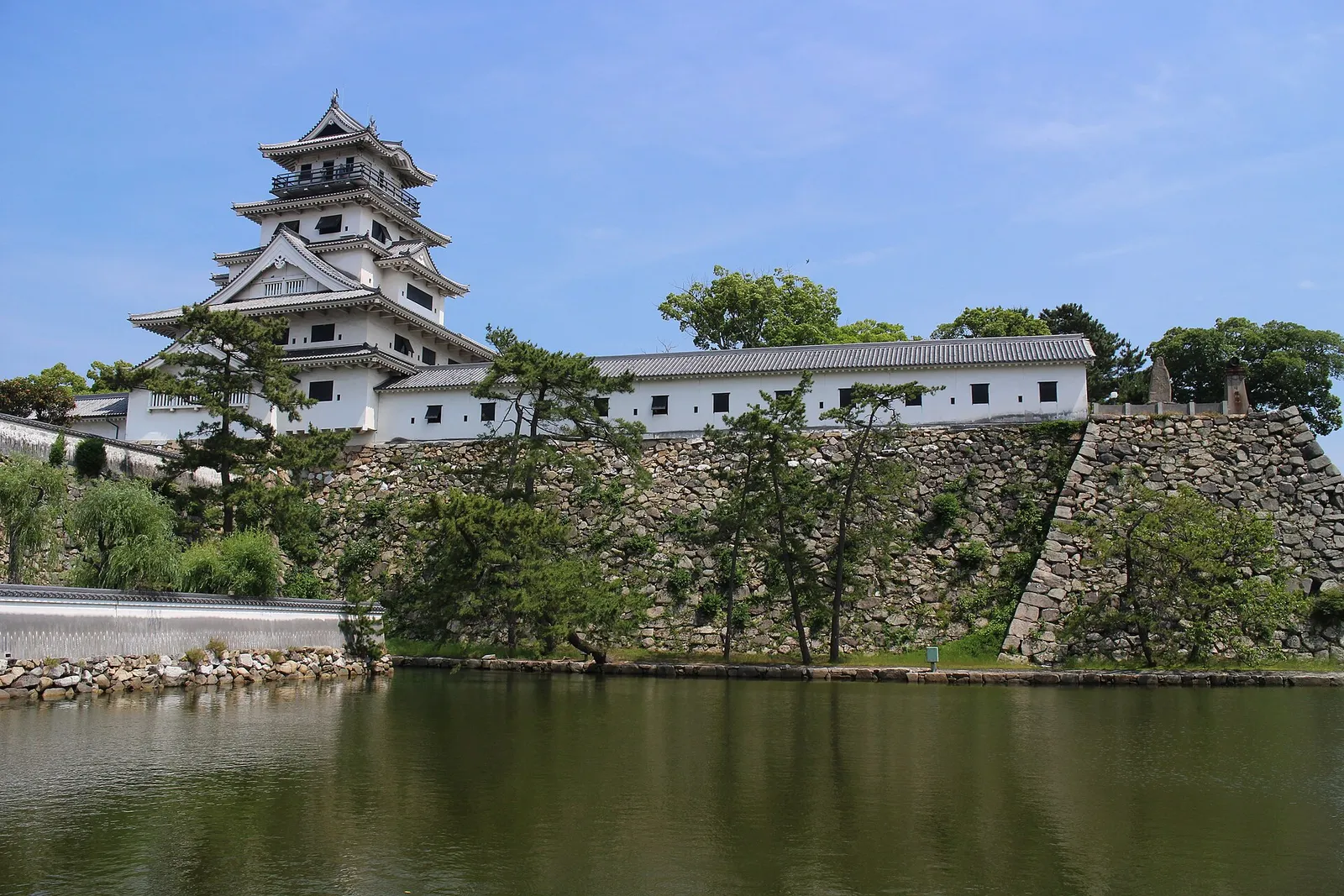
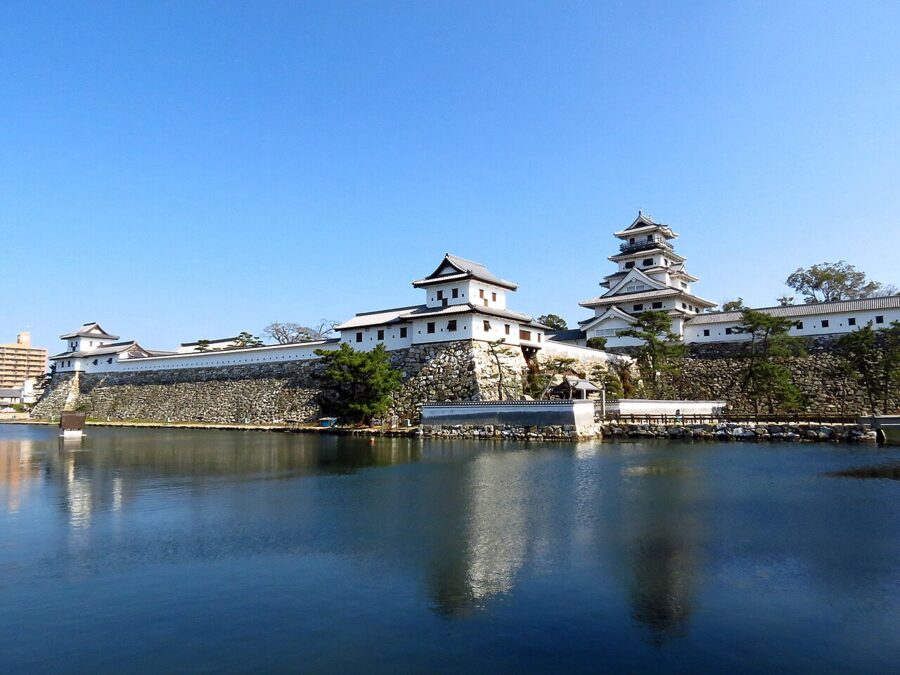
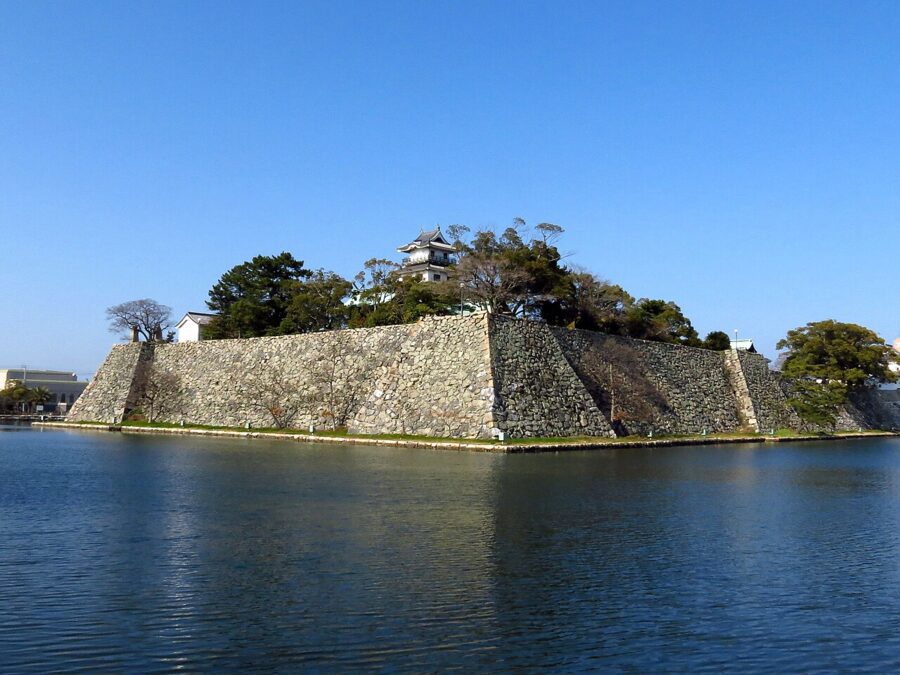
Arrive with time in hand and the first thing you notice is not the keep. It is the water: a moat so broad it reads more like a harbour basin, fed from the sea and rising and falling with the tide around stone walls that were begun in 1602.
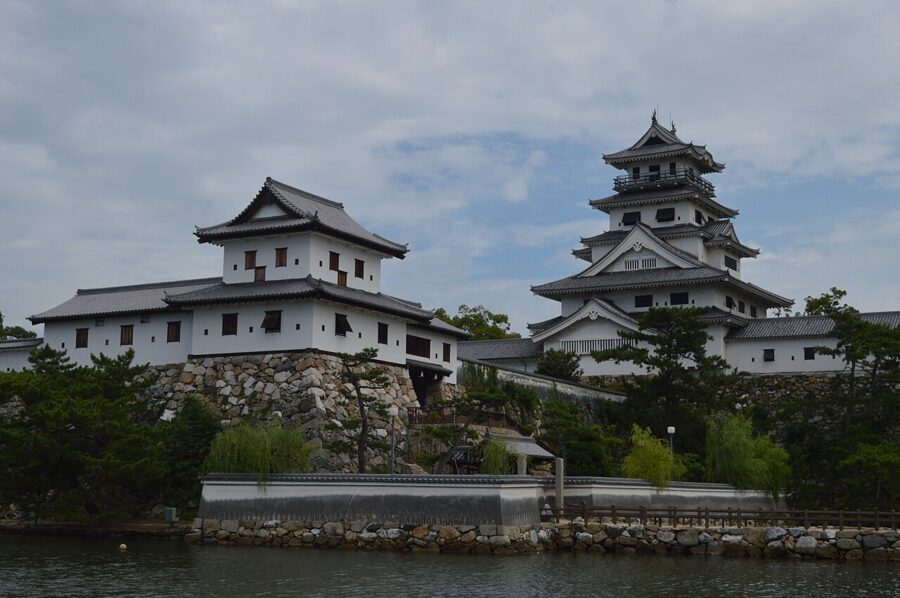
Most of what stands on those walls is new. The keep went up in concrete in 1980, and the turrets and the great gate followed over the next 27 years. Todo Takatora, who built the place, would know the stones and the water far better than the buildings, and that split, old stone and sea against new plaster and timber, is the way to read the whole site.
In this guide10
- Where it is, and how long to give it
- Todo Takatora builds on the beach
- The sea-water moat
- What is original, and what was rebuilt
- Inside the keep, floor by floor
- The gates and turrets
- Hours, tickets and what they cover (as of 2026)
- Lighting, cherry blossom and festivals
- Getting there
- Fitting it into a Shimanami Kaido ride
Where it is, and how long to give it
Imabari Castle (今治城) stands at Tori-machi 3-chome, in the middle of Imabari on Shikoku. It is about 1.5 km (1 mile) east of JR Imabari Station and a ten-minute walk south of Imabari Port, on the same flat ground as the shopping streets.
Give it about 90 minutes for the keep, the turrets and a walk round the outside of the moat. If you only want the keep and the view from the top, 45 minutes will do. The grounds, Fukiage Park, are free and open around the clock, so the walk round the walls can wait until after dinner if the afternoon runs short.
Todo Takatora builds on the beach
The builder
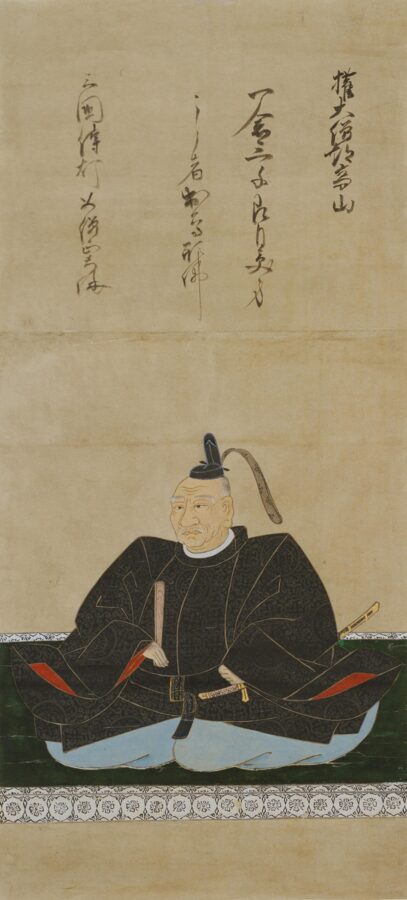
Todo Takatora (1556–1630) is the most famous castle builder in Japanese history, and he got there the hard way. He was a foot soldier from Omi who served a string of lords, rose under Toyotomi Hidenaga, Hideyoshi’s younger brother, and then backed Tokugawa Ieyasu at the right moment. After the battle of Sekigahara in 1600 he was rewarded with half of Iyo province, worth 200,000 koku of rice a year.
Iyo was a sea province. The water off Imabari had been the domain of the Murakami pirates a generation earlier, and the Kurushima Strait, just to the north, carries some of the fastest tides in Japan. Takatora’s existing seat was a hilltop fort on Karakoyama, south-east of the present town. He wanted a castle on the shore instead, with a port town attached to it.
A castle the ships could sail into
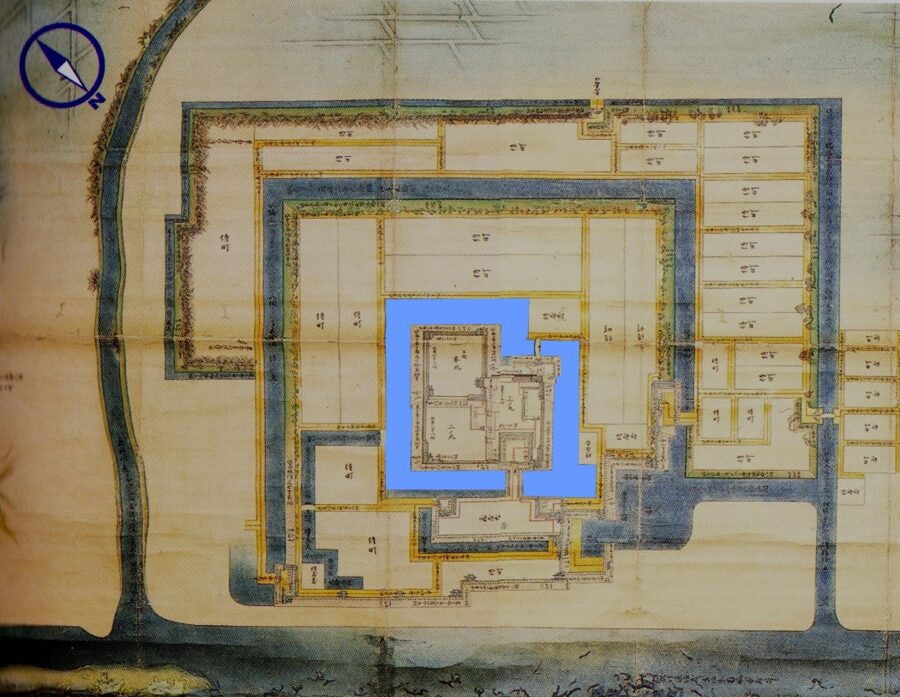
Work began in 1602. The earthworks were finished in 1604, and the city’s own history puts the completion of the buildings at around 1608. The castle was a big flat square on the beach, ringed by three moats, all filled with sea water.
Inside the walls was a funairi, a harbour for the lord’s ships, which the city counts among the largest any Japanese castle ever had. Boats could come in from the strait and moor inside the defences. In its finished form the castle had nine gates and about twenty turrets, with the lord’s residence in the second enclosure and his senior retainers housed between the inner and middle moats.
The keep that left
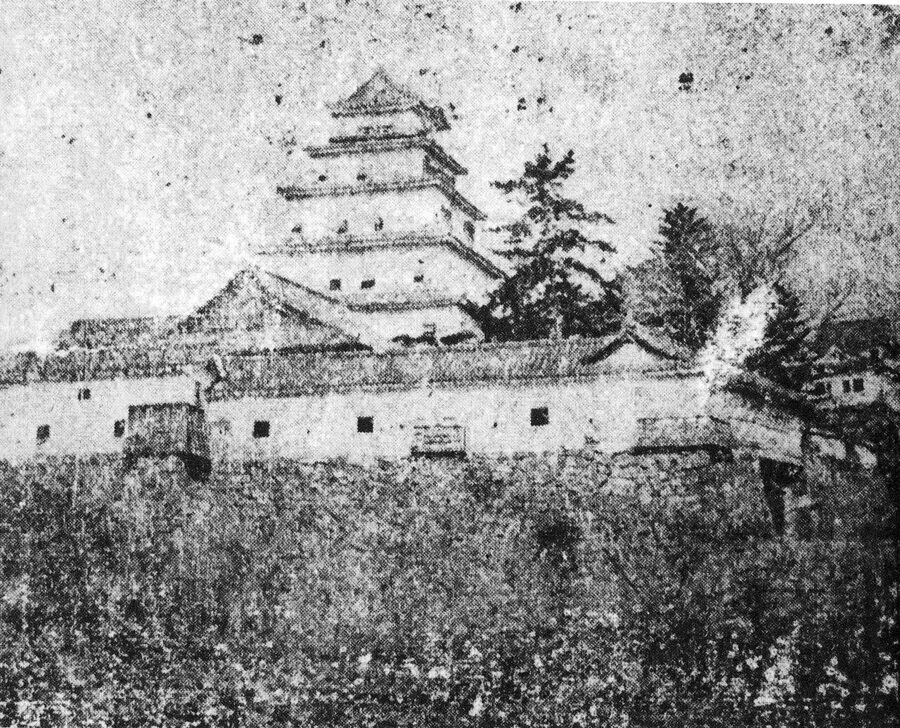
In 1608 Takatora was moved to Iga and Ise, far to the east, and by most accounts his keep went with him. The castle’s own history says he built a five-storey keep of the newest kind, a stacked, regular tower that later became the standard Japanese design, and that it was taken down when he left.
Where it went is a good argument. An Edo-period genealogy of the shogun’s vassals records that Takatora presented the Imabari keep to Ieyasu in 1610 and that it was rebuilt at Kameyama Castle in Tamba, west of Kyoto. No foundation for a keep has ever been found at Imabari, though, and historians still disagree about whether it stood here at all.
Lords, demolition and a shrine
Takatora’s adopted son Takayoshi held Imabari with 20,000 koku until 1635, when he too was moved and Matsudaira (Hisamatsu) Sadafusa took over. His family kept the castle for the rest of the Edo period. Through all those years the main enclosure made do with a two-storey corner turret, dressed up with one decorative gable to stand in for the missing keep.
The castle was abandoned in 1869, at the start of Meiji, and almost every building was pulled down. One storehouse turret survived with its contents, until a fire in 1871 reached the gunpowder inside and it blew up. In 1872 four of the town’s shrines were merged and moved into the empty main enclosure as Fukiage Shrine, taking the castle’s other name, Fukiage-jo.
What was left, the inner moat and the walls of the central enclosures, became a prefectural historic site in 1953. In 2006 Imabari was chosen as number 79 of Japan’s 100 Fine Castles, the list behind the stamp books you will see castle fans carrying.
The sea-water moat
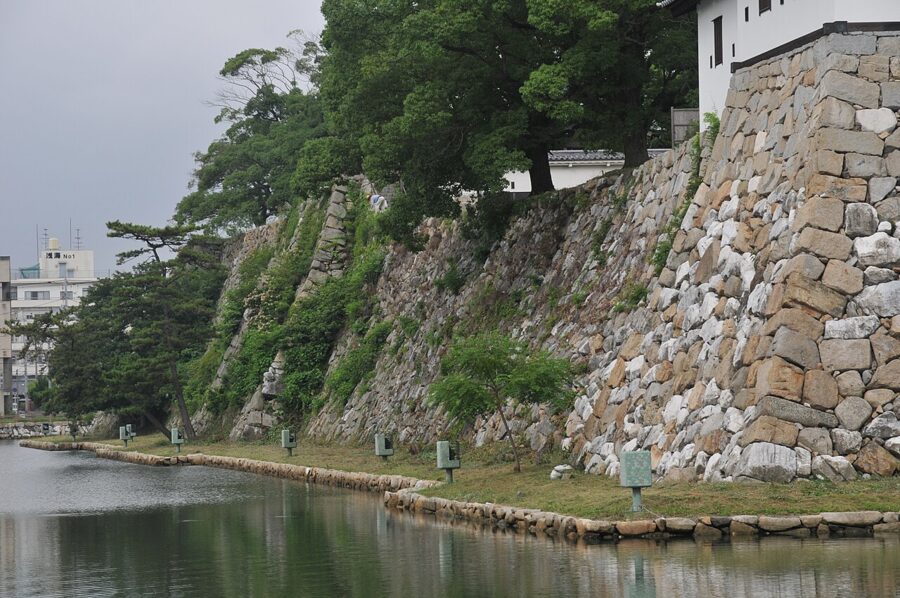
The moat is the reason to come, and it is real sea water. It is still connected to the sea, so its level rises and falls with the tide, and sea fish come and go with the water; on a calm day you can often see them under the surface by the walls.
Imabari is usually counted with Takamatsu and Nakatsu as one of Japan’s three great sea castles, the ones whose moats were filled from the sea. Of the three moats here, only the inner one survives. The middle and outer rings have gone under the streets of the town.
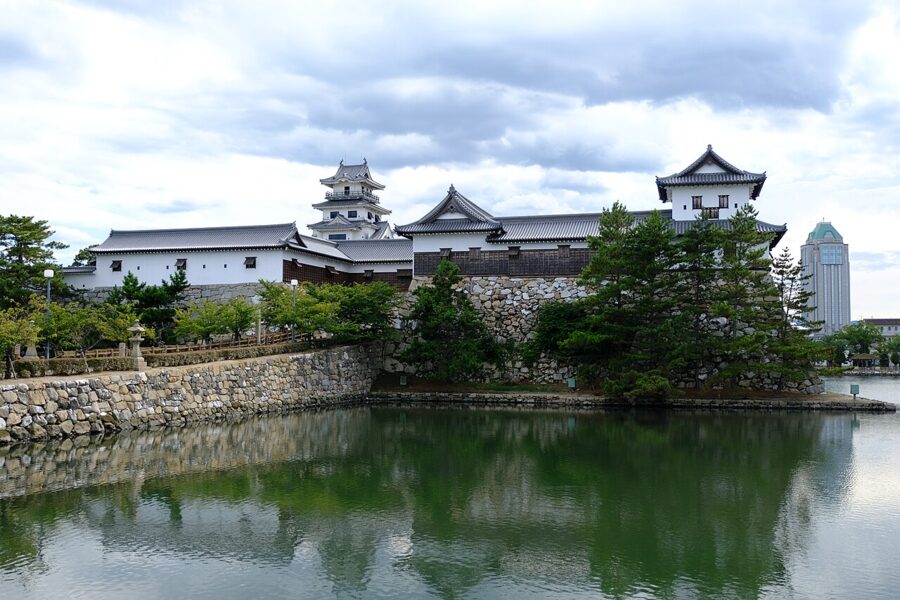
Even the inner moat is not quite as Takatora left it. Part of it was filled when the road beside it was widened, a fence now runs along the edge, the earth bridge on the north-east side has been made wider, and the old timber bridge on the west was replaced with earth and stone. None of that spoils the view, but it is why the line of the water looks tidier than an Edo-period plan.
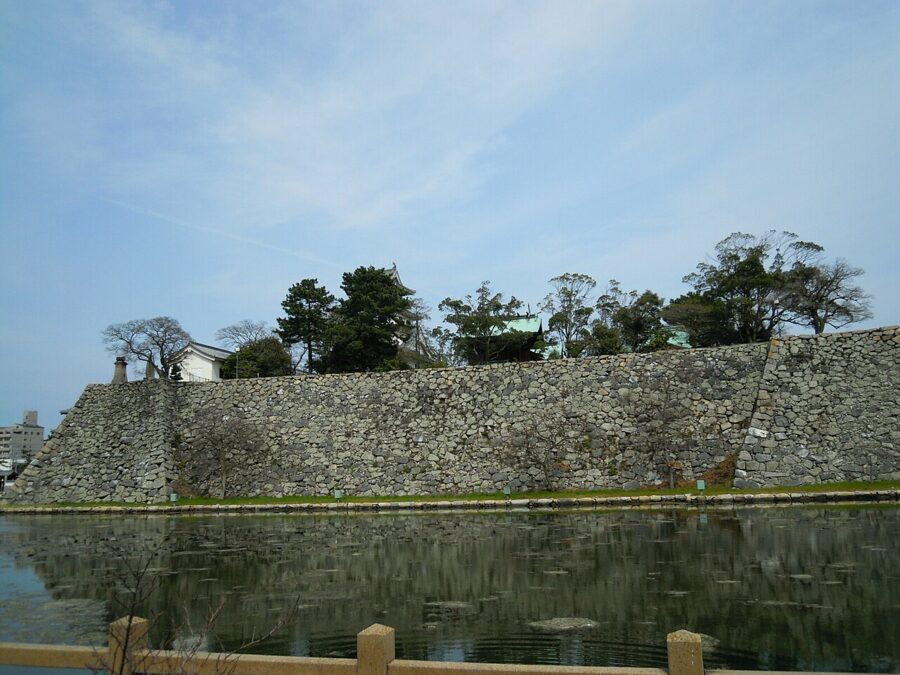
The best way to see it is on foot, all the way round, on the path outside the moat. On the sides away from the gates the long walls of the main enclosure rise straight out of the water, with nothing between you and them but the moat.
What is original, and what was rebuilt
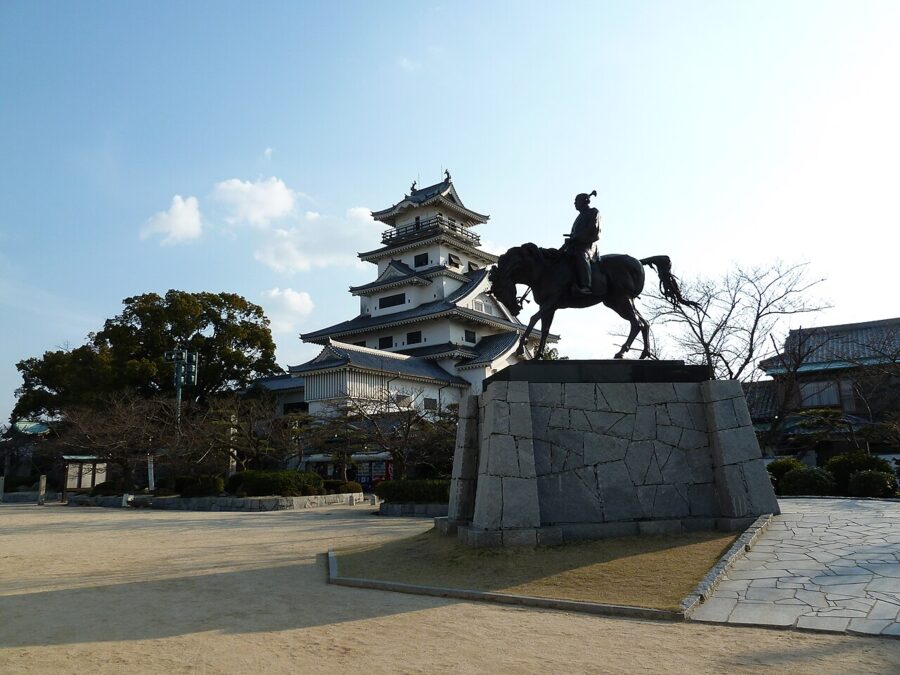
The short answer to the question everyone asks: the stone walls of the main and second enclosures and the inner moat are original, from Takatora’s time. Every building you can walk into is a reconstruction. The castle itself puts it plainly, calling the keep a mock keep, built where the north corner turret of the main enclosure once stood.
| Building | Rebuilt | What it is now |
|---|---|---|
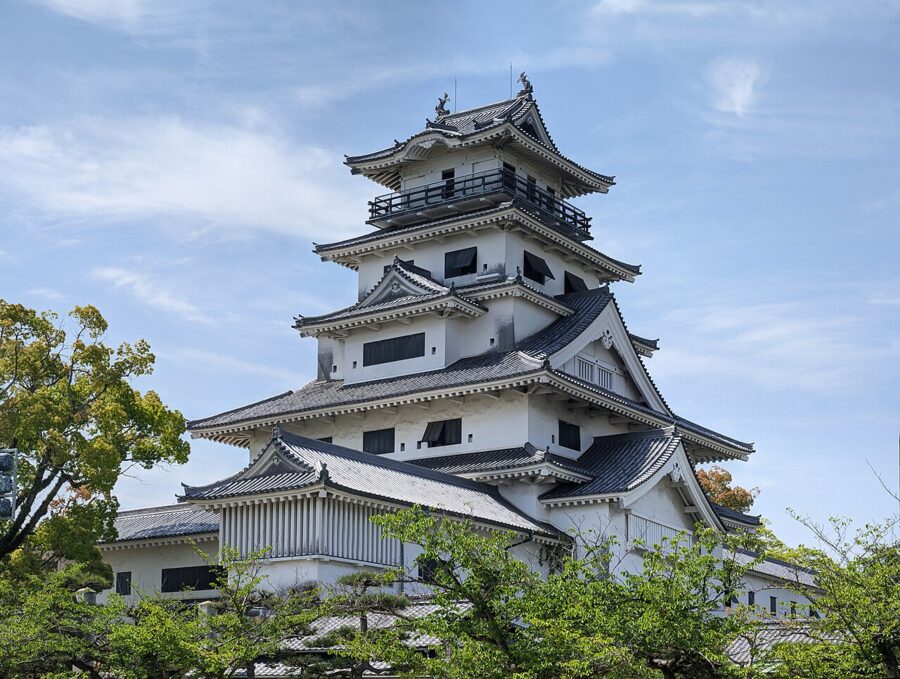
| Keep (天守) | 1980, reinforced concrete | Museum on five floors, viewing deck on the sixth |
| Tamon turret (多聞櫓) | 1980 | Natural science room |
| Okane turret (御金櫓) | 1985 | Gallery of local artists |
| Yamazato turret (山里櫓) | 1990, timber | Armour and antiques |
| Kurogane-gomon gate and Bugu turret (鉄御門・武具櫓) | 2007, timber | Open inside, to show the gate’s frame |
The later rebuilds follow the evidence more closely than the keep does. The Okane turret’s outside was copied from an old photograph taken by the domain doctor Nakarai Goan, and the 2007 gate was rebuilt from photographs and excavation, as faithfully to the Edo-period original as the city could manage.
The keep is the exception. It was modelled loosely on the Kameyama keep, but it is built in a different, older style, with a large gable at its base and bay windows the Kameyama tower never had. Even the walls carry a few modern touches: a curve added to the wall under the Okane turret, and stonework at the Kurogane-gomon gate built higher than the original so emergency vehicles can get into the park.
Inside the keep, floor by floor
You buy your ticket on the ground floor of the keep, and the stairs take you up through a small museum to a viewing deck on top. Every building is entered by stairs, and the castle says plainly that the keep, the turrets and the gate are not barrier-free; the accessible toilets are in the car park and in the second-enclosure park.
| Floor | What is there |
|---|---|
| 1 | Ticket counter, office, toilets |
| 2 | Armour of the Imabari lords, swords by the domain’s smiths, spears, glaives and matchlocks; maps of the castle |
| 3 | Calligraphy and paintings, including the lords’ own brushwork and shogunal red-seal letters |
| 4 | Changing exhibitions |
| 5 | Photographs of castles around Japan and a timeline of local history |
| 6 | Viewing deck |
The labels are mostly in Japanese, and the armour is the part that needs no translation. If armour is what you came for, the far bigger collection is at Oyamazumi Shrine on Omishima, on the route behind you.
As of late November 2026 the second floor has a panel display on the Toyotomi brothers and Imabari, running to 27 December 2026 and tied to this year’s NHK drama about Hidenaga, Takatora’s old master. The fourth floor shows recent additions to the collection until the same date, and the autumn special exhibition on Takatora and his son Takayoshi closes on 29 November 2026. The current list is on the castle’s exhibitions page.
The Tamon turret, joined to the keep, holds the natural science room: shells and fish specimens, stuffed birds and minerals. It is a slightly odd thing to find in a castle and the easiest part to skip if time is short.
The view from the top
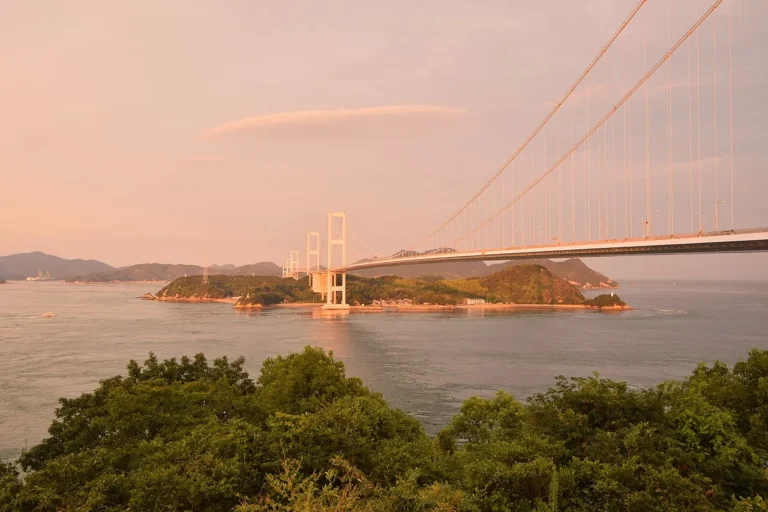
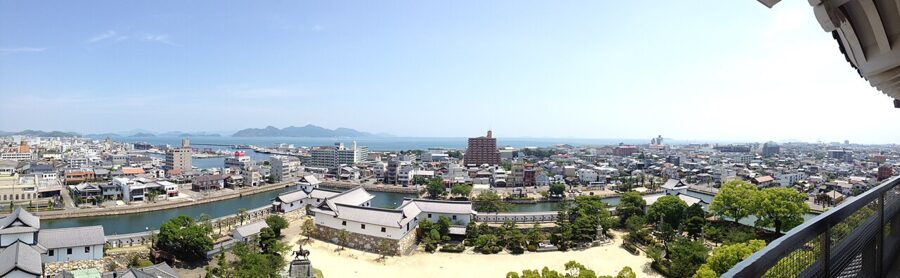
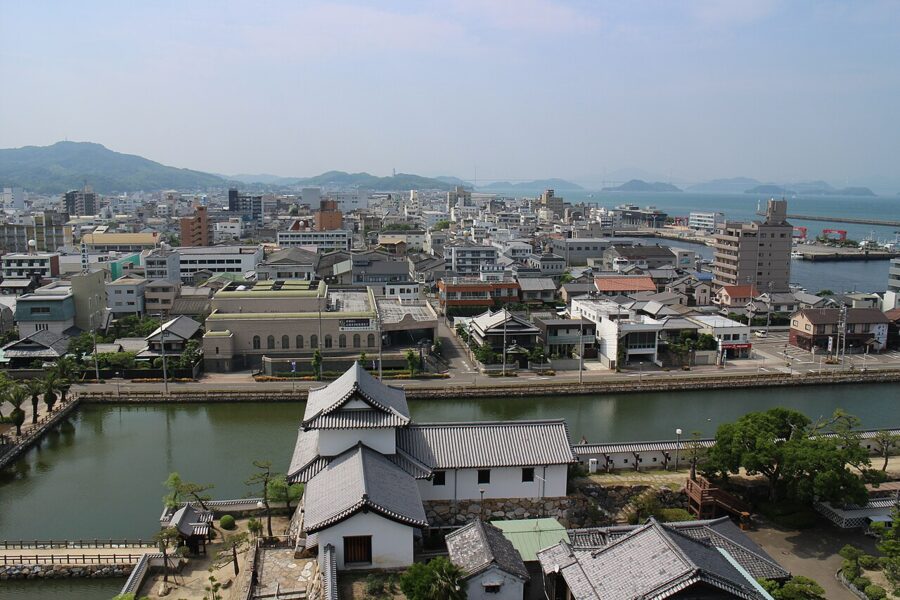
The sixth floor is an open deck, and on a clear day it is the best free lesson in the geography of the route. North across the town you can see the Kurushima-Kaikyo Bridge, the last of the bridges you rode over; east is the Hiuchi-nada sea; inland, the Ishizuchi range, with the highest peak in western Japan.
Look straight down as well. From here you can see how the moat squares off the castle and how close the sea still is, a few streets away past the port. The free Imabari-jo AR app, used only on this deck, lays the Edo-period castle and its town over the modern view on your phone.
The gates and turrets
One ticket covers the keep and three other buildings, and each has its own door, so it pays to plan a loop: keep first, then the Yamazato turret, then across the second enclosure to the Okane turret, and out through the Kurogane-gomon gate.
Kurogane-gomon and the Bugu turret
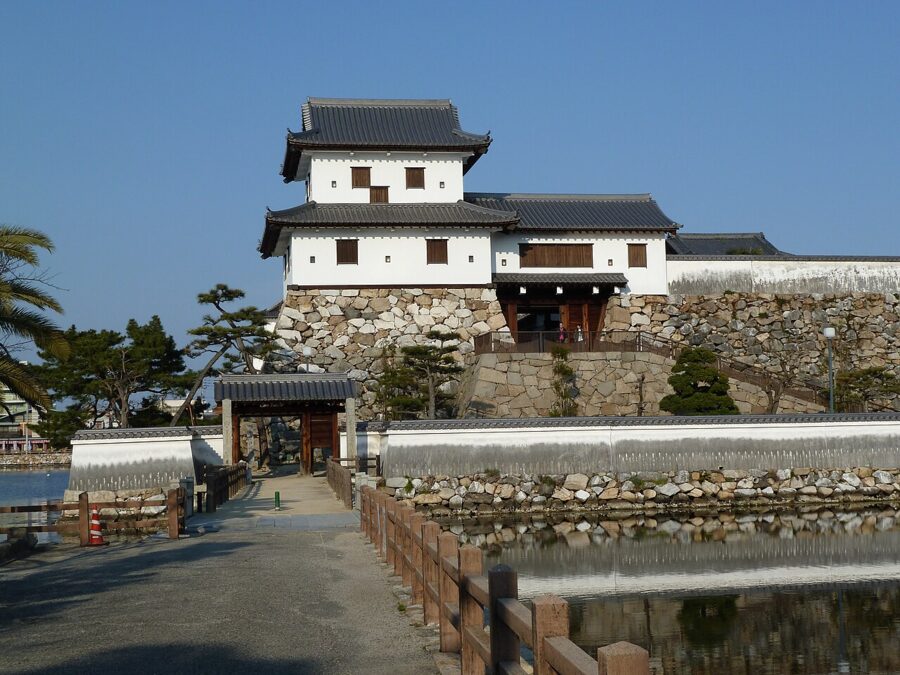
Kurogane-gomon (鉄御門), the iron gate, was the front door of the second enclosure. Anyone coming in had to pass first into a large square courtyard of stone, a masugata, where defenders could shoot down on them from three sides, including from the gatehouse above. The city rebuilt the gate, its long turrets and the courtyard walls in 2007, and the inside is open, so you can see how the timber frame goes together.
Stop in the courtyard before you go in. In the courtyard is the biggest stone in the castle, the Kanbei-ishi, said to have been brought here by Watanabe Kanbei, Takatora’s commissioner for the building works. Big stones placed on the way in were meant to impress, and this one still does.
The Okane turret
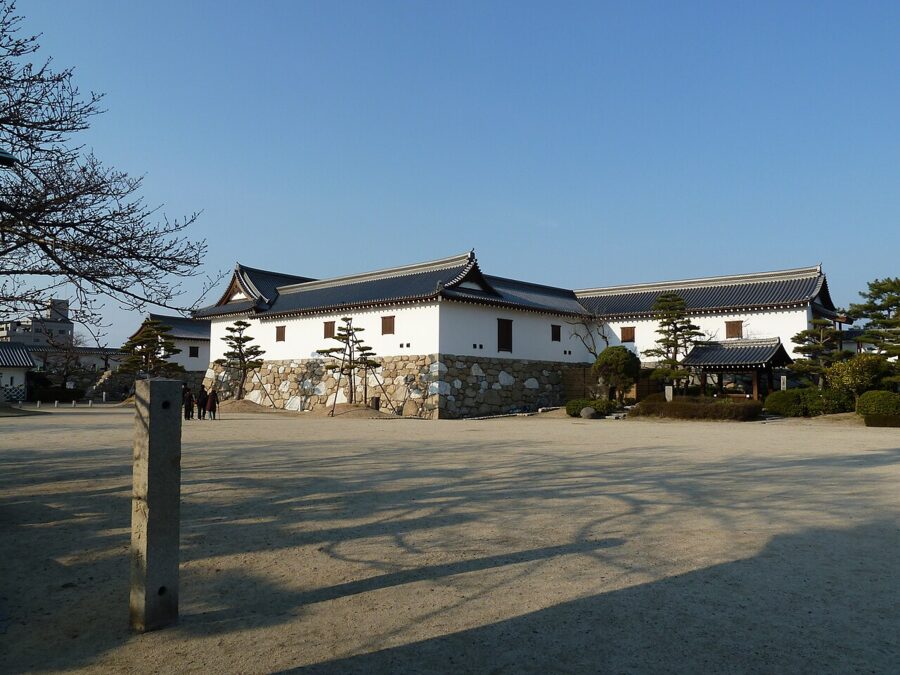
The Okane turret (御金櫓) stands at the east corner of the second enclosure, a two-storey turret rebuilt in 1985 and named after the treasury storehouse that stood beside it on the old plans. Inside is the city’s gallery of local artists.
From 27 November 2026 to 31 March 2027 it shows works from the collection, including fifteen pieces by the Imabari-born painter Waki Junkei (1939–2006), given to the city in September 2025 and shown for the first time.
The Yamazato turret and the Koraimon gate
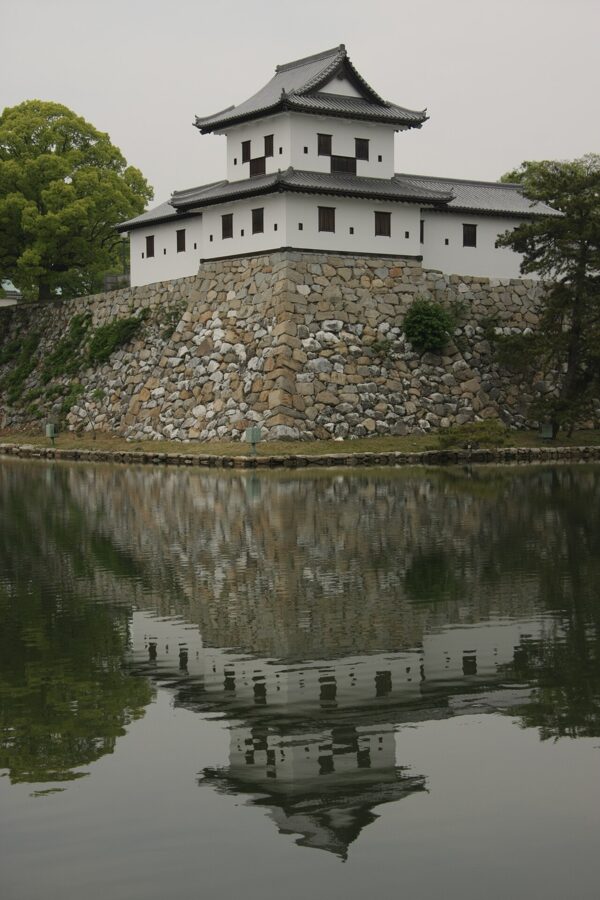
The Yamazato turret (山里櫓) is the two-storey turret at the north-west corner of the second enclosure, rebuilt in timber in 1990, with a small gate of the type called koraimon beside it. It holds armour and antiques from the collection, and from across the moat it is the most photogenic corner of the castle.
Fukiage Shrine
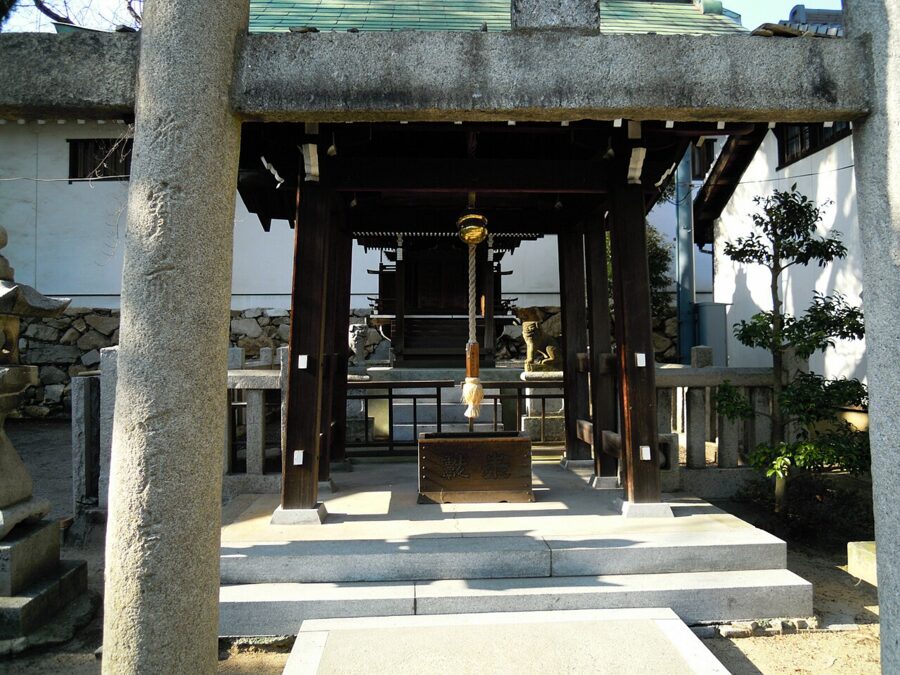
In the middle of the main enclosure, where Takatora’s keep may or may not have stood, is Fukiage Shrine (吹揚神社), founded in 1872 from four of the town’s shrines. The name comes from the castle’s old nickname, Fukiage-jo, after the sand that the wind blew up along this shore. It stands in the free part of the grounds, open with the park.
Hours, tickets and what they cover (as of 2026)
As of 2026 the buildings open 09:00–17:00, with last entry at 16:30. They close from 29 to 31 December and on the odd day for changing exhibitions; there is no weekly closing day. The grounds are open 24 hours a day, every day, at no charge, and the castle’s visitor information gives any changes.
| Ticket | Price (as of 2026) |
|---|---|
| Adult | ¥520 (about US$3.50) |
| Student | ¥260 |
| 65 and over | ¥420 |
| High-school age and under, or under 18 | Free |
| Groups of 20 or more | ¥420 adults, ¥210 students |
The one ticket covers the keep, the Okane turret, the Yamazato turret, and the Kurogane-gomon gate with the Bugu turret. Holders of a Japanese disability handbook and one carer go free. Hold on to it after the keep: it is your way into the other three.
The castle shop sells things you will not find elsewhere. The castle’s goshuin card, a souvenir seal card, is ¥500 (about US$3.30) in its newest design, a rainbow over the moat, on sale since 1 July 2026. It also stocks handkerchiefs at ¥800 woven under the Imabari towel brand, with Takatora on horseback or the Todo family crest in gold; the full list is in the castle shop.
Lighting, cherry blossom and festivals
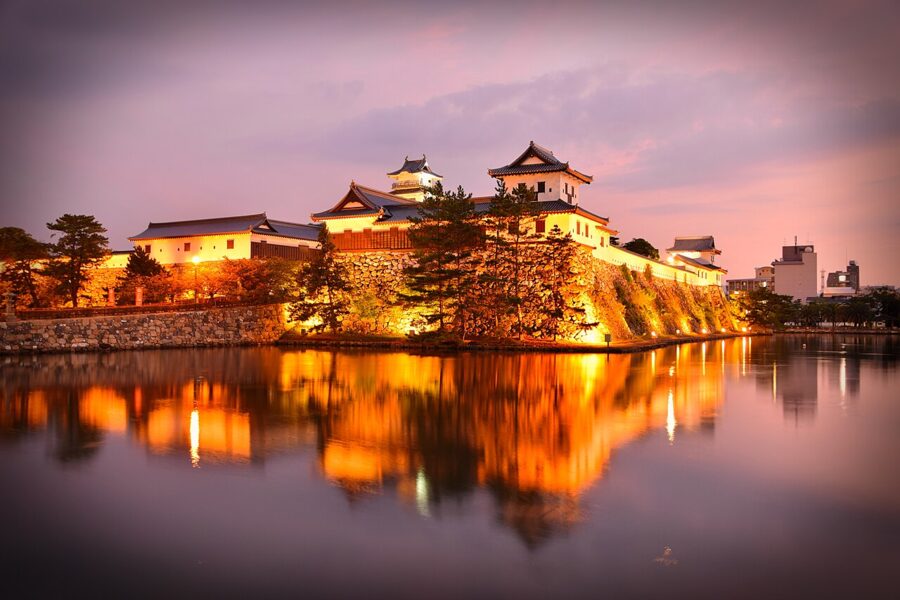
The castle is lit every night from 30 minutes after sunset until 22:00. The lighting designer Kaito Haruki placed about a hundred lamps along the walls and on the keep, in warm colours, and on a still evening the whole lit castle appears a second time in the moat. This is when the water earns its keep.
There are two exceptions worth knowing. Over the New Year, from the night of 31 December to the morning of 4 January, the lights stay on all night. On 21 June, often the day of the summer solstice, and on 7 July, the Tanabata star festival, the castle stays dark. The castle’s own page on the site sets out the schedule and the rebuilding dates.
Cherry blossom here is modest. There are not many trees on the approach and inside the walls, but they frame the keep and the gates well, and the night lighting catches them; they usually bloom in late March and early April. Spring is also one of the kinder seasons for riding, the best time to visit the Shimanami Kaido along with autumn.
Imabari’s big summer festival, Onmaku, does not use the castle: it fills the port and the shopping streets a few minutes north, on 8 and 9 August in 2026. Fukiage Shrine keeps its own calendar of festivals in the main enclosure. In the last days of December the buildings close for three days, but the park, the shrine and the moat path stay open.
Getting there
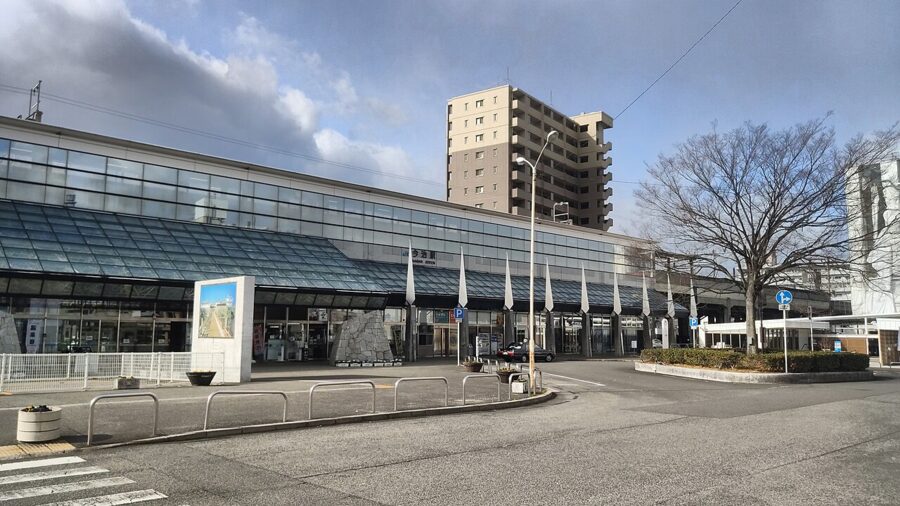
From JR Imabari Station
On foot it is about 20 minutes east from the station, on flat streets all the way. If you would rather ride, Setouchi Bus services bound for Imabari Eigyosho (今治営業所) reach the Imabari-jo-mae stop (今治城前) in about 9 minutes, according to the castle’s access page. Unless a bus is about to leave, walking is just as quick.
If you are carrying bags, deal with them before the castle: the station lockers and the forwarding services in Shimanami Kaido luggage and ferries both work here. A big bag on the keep’s stairs is not a good idea.
From Imabari Port
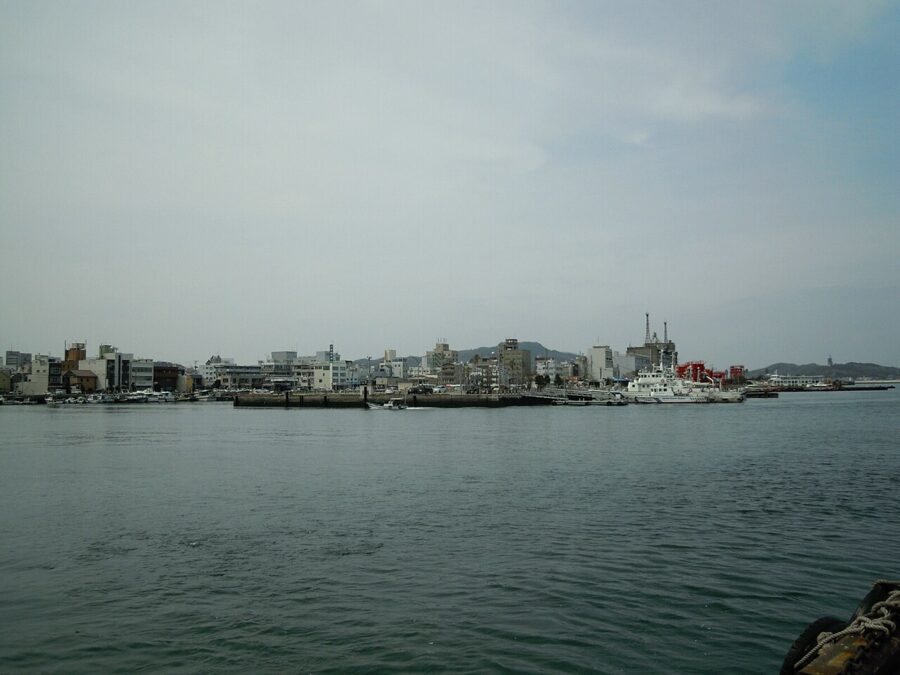
From the island boats at Imabari Port it is about a ten-minute walk south to the castle. The port grew out of the boat district Takatora laid out at the castle’s northern corner, so the walk follows the old line between castle and sea.
By bike from the bridge
From the foot of the Kurushima-Kaikyo Bridge at Itoyama, it is around half an hour of flat riding south into town. The castle is east of the station, so you can ride to the castle first and drop the bike at the station afterwards, or the other way round if you would rather walk.
By car
From the Imabari-Kita interchange on the Shimanami Kaido expressway it is about 15 minutes; from Imabari-Yunoura on the Imabari-Komatsu expressway, about 20. The castle car park has 66 spaces, open 24 hours, at ¥100 an hour, and its machines do not take ¥10,000, ¥5,000 or ¥2,000 notes. On Saturdays, Sundays and holidays from 09:00 to 18:00, ordinary cars may also park free in the marked lane on the moat side of the road along the south-east of the moat.
Fitting it into a Shimanami Kaido ride
The castle is one of the few sights on the route that is open after you get off the bike, and the way to fit it in is to keep the bike. Ride in from Itoyama rather than handing it back at the bridge, see the castle, then return it at the rental terminal in front of JR Imabari Station.
That terminal and the one at Itoyama both open 08:00–19:00 from March to November and 08:00–18:00 from December to February. Bikes have to go back within opening hours, and e-bikes the same day, under Shimanami Japan’s rental rules; the terminal list has the addresses. Handing an ordinary rental back at a different terminal costs an individual nothing extra.
Work back from 16:30. To have an hour inside, be at the castle by 15:30, which means leaving Itoyama by about 15:00 and being on the Kurushima-Kaikyo Bridge a little before that. From Onomichi, on an ordinary bike, that means a start around 08:00 and few long stops; on an electric-assist bike it is easier. Booking the assisted bike through Shimanami Kaido bike rental is what makes a castle finish realistic on a one-day Shimanami Kaido itinerary.
If you are late, do not race for it. Hand the bike in, eat, and walk to the castle after dark, when the lighting is on and the park is free; then see the inside at 09:00 the next morning before your train. For that, stay near the station, and for the dinner in between, eat Imabari’s griddled chicken, the city’s share of Shimanami Kaido food.
Is it worth it? If you have just ridden 70 km (43 miles), the keep’s museum floors are fine but not essential; the moat, the walls and the view from the top are the part only Imabari has. I would always walk the moat, always go up for the view, and skip the natural science room without guilt.
So ride in by half past three, keep the bike until the castle is done, and hand it back at the station on the way to dinner. The moat will still be filling and emptying with the tide when you come back past it in the dark.