The last boat from Okunoshima to Sakari leaves Pier No.2 at 16:39, and on a short winter afternoon it is the time everything else hangs on. Miss it and every boat still to come runs the other way, to Tadanoumi on the Hiroshima mainland, and you are going back to Omishima the long way round.
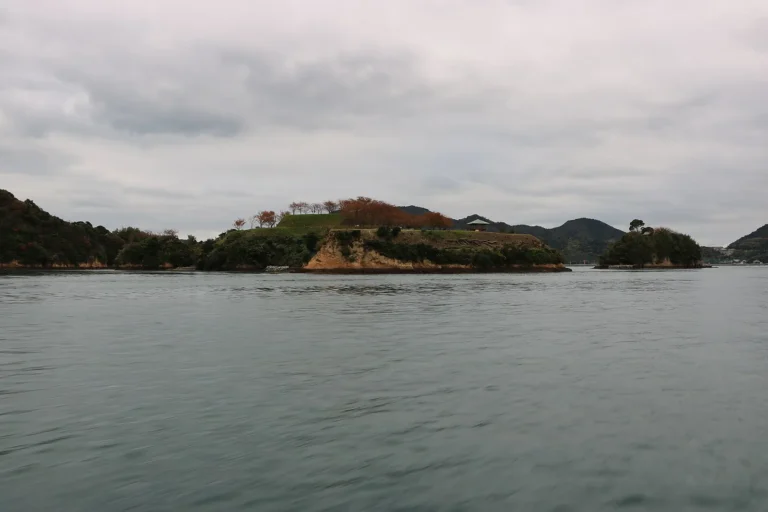
Okunoshima (大久野島) is a small wooded hill in the sea, 4.3 km (2.7 miles) round, 3 km (2 miles) off Tadanoumi in Takehara and about 15 minutes by ferry from Sakari (盛) on the north coast of Omishima. A few hundred rabbits live on it, fed almost entirely by the people who come over to see them. From 1929 to 1945 it was also where the Japanese army made poison gas, and the concrete that work left behind still stands among the rabbits.
For a Shimanami Kaido rider it is the one side trip that needs a timetable in your pocket. Sakari is 5.5 km (3.4 miles) along Omishima’s north coast from the foot of the Tatara Bridge, the ferry carries a bike for ¥120 (about US$1), and two or three hours on the island is enough for the rabbits, the museum and the ruins, with the 16:39 still in hand.
In this guide9
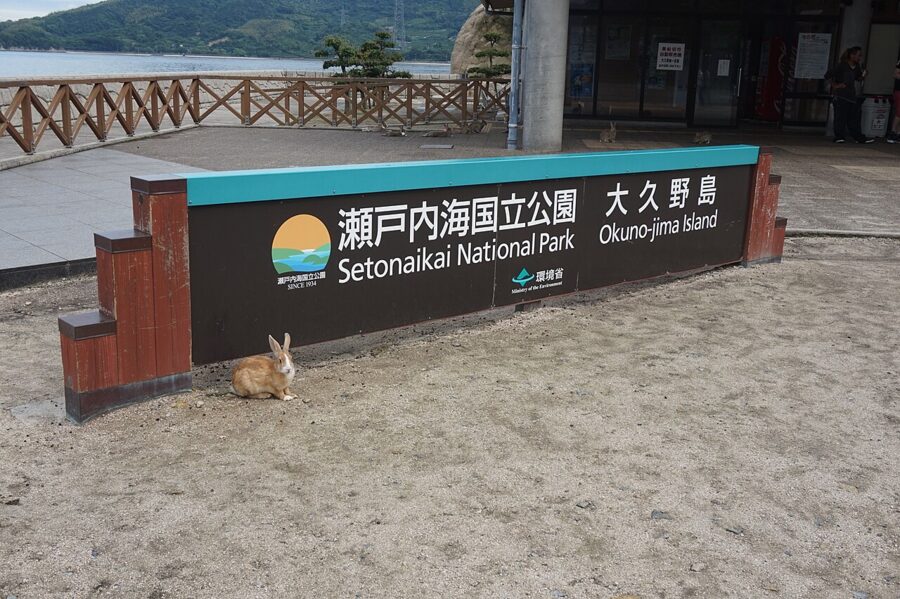
The island is national land, looked after by the Ministry of the Environment, with one hotel, a small museum and a visitor centre. Ordinary cars stay on the mainland, so the roads belong to walkers, bikes, the hotel’s shuttle bus and the rabbits.
Two ports, two piers and one timetable
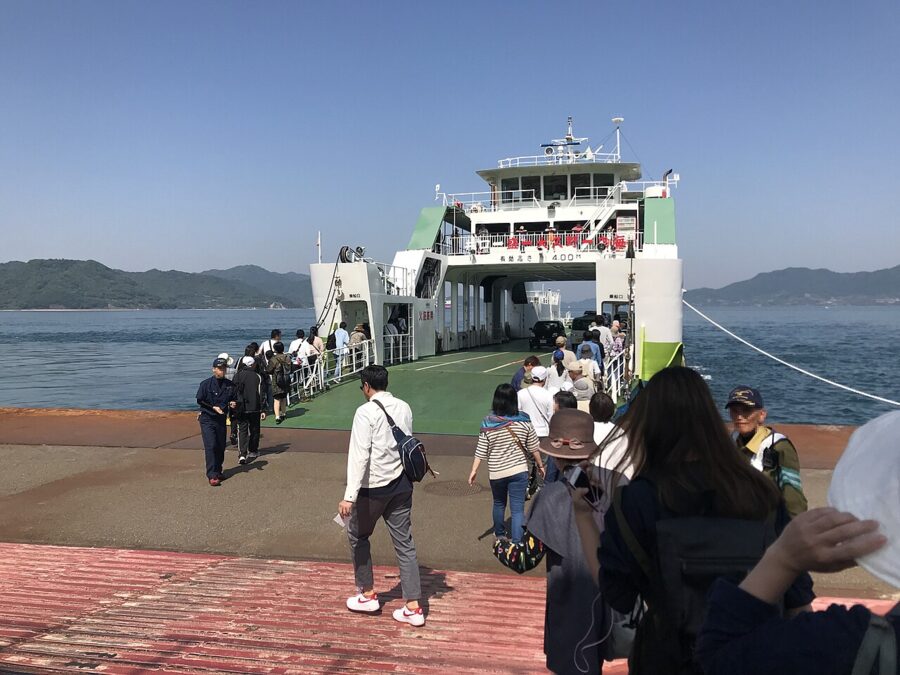
Two companies sail to the island. The Omishima Ferry (大三島フェリー) runs a car ferry between Tadanoumi and Sakari that calls at Okunoshima on most of its crossings, and it is the only boat that links the island with Omishima and the cycling route. Kyukamura Okunoshima, the island’s hotel, runs smaller passenger boats that shuttle between Tadanoumi and the island only. Both charge the same fares and share one timetable.
From Sakari, on Omishima
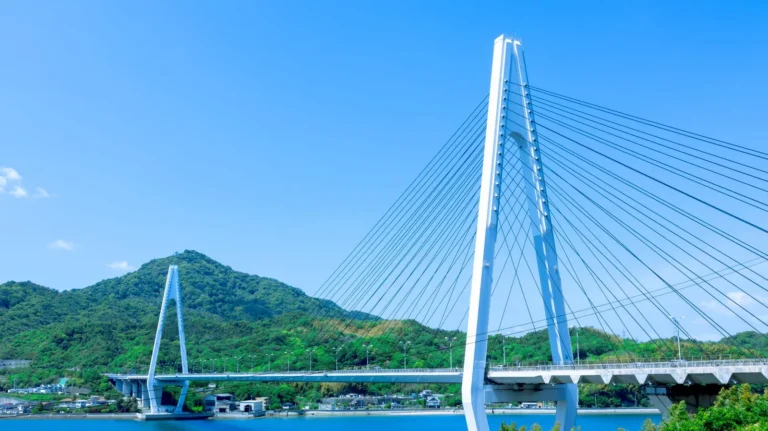
Sakari is a small harbour on the north coast of Omishima, in the Kamiura district, and it is easy to reach from the cycling route. Coming off the Tatara Bridge at Tatara Shimanami Park, ride north-west round the coast road for 5.5 km (3.4 miles); from Oyamazumi Shrine it is 7.7 km (4.8 miles) the other way.
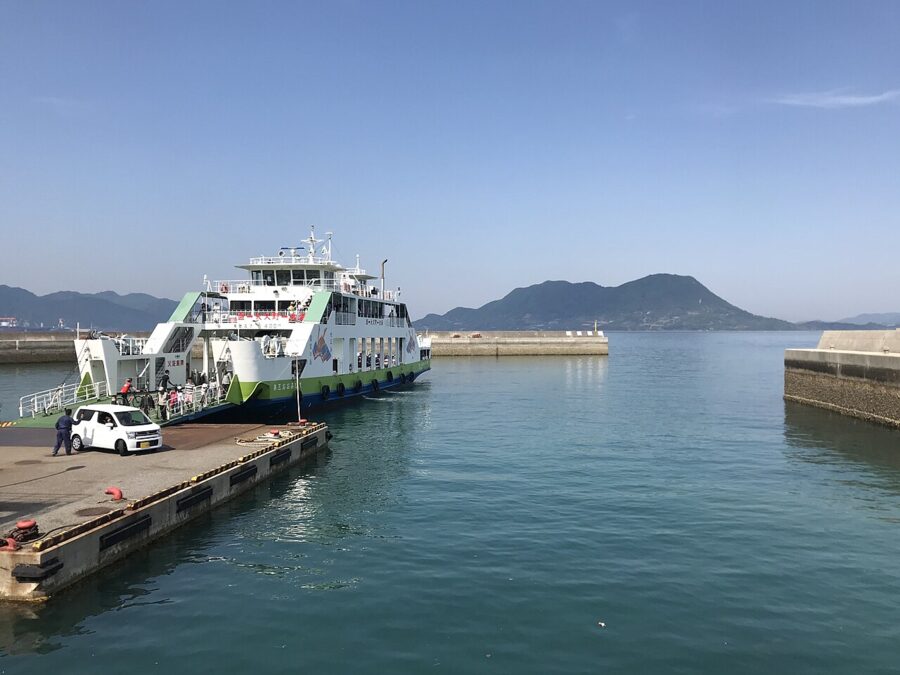
From Sakari the crossing to Okunoshima takes 15 or 16 minutes. On the Omishima Ferry timetable in force since October 2025, these are the sailings that link the two:
| Sakari dep. | Okunoshima arr. | Okunoshima dep. | Sakari arr. | |
|---|---|---|---|---|
| 09:05 | 09:20 | 08:45 | 09:00 | |
| 10:15 | 10:30 | 09:55 | 10:10 | |
| 11:25 | 11:40 | 11:05 | 11:20 | |
| 13:35 | 13:48 | 12:15 | 12:30 | |
| 14:40 | 14:56 | 14:19 | 14:35 | |
| 15:50 | 16:06 | 15:29 | 15:45 | |
| 17:00 | 17:16 (February to October only) | 16:39 | 16:55 |
The first ferries of the day (07:00 and 08:00 from Sakari, 07:30 from Tadanoumi) and the evening ones (17:35 from Tadanoumi, 18:40 from Sakari, 19:10 from Tadanoumi) run straight across without calling at the island. The 17:00 from Sakari stops at Okunoshima from February to October but not from November to January, and from the island it carries on to Tadanoumi, not back to Omishima. In practice the latest you can go out from Sakari and still come back the same way is the 15:50, which gives you half an hour on the island before the 16:39.
If you do miss the 16:39, the passenger boats keep running to Tadanoumi until 19:15, and the ferry leaves Tadanoumi for Sakari at 17:35 and 19:10. It costs an extra fare and an hour, not a night.
From Tadanoumi, on the mainland
Tadanoumi (忠海) is a small port town in Takehara, on the JR Kure Line about 20 to 25 minutes from Mihara. The port is a five-minute walk from Tadanoumi Station. From Onomichi, take the Sanyo Line west to Mihara and change.
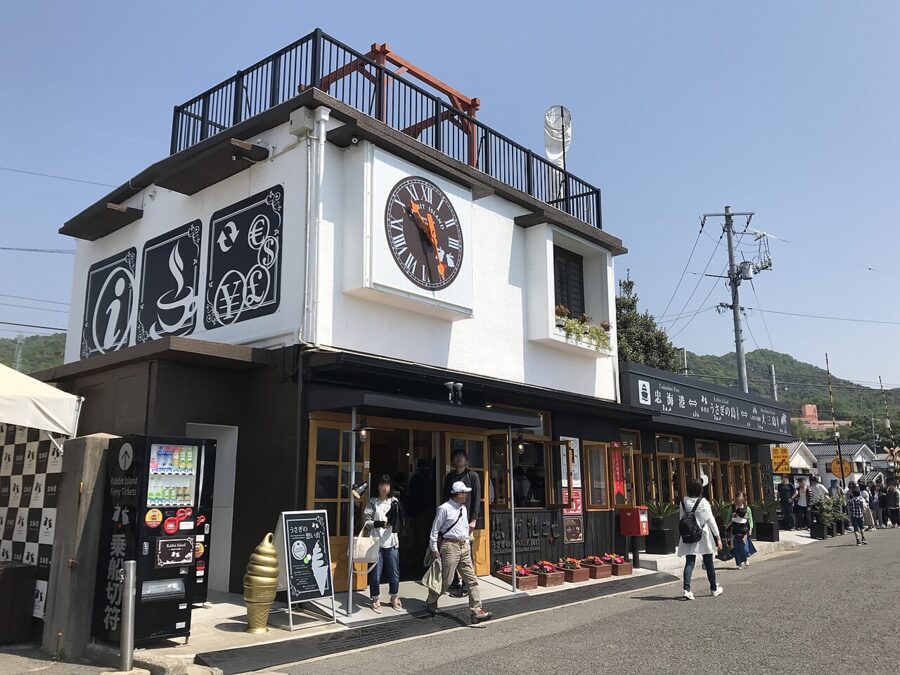
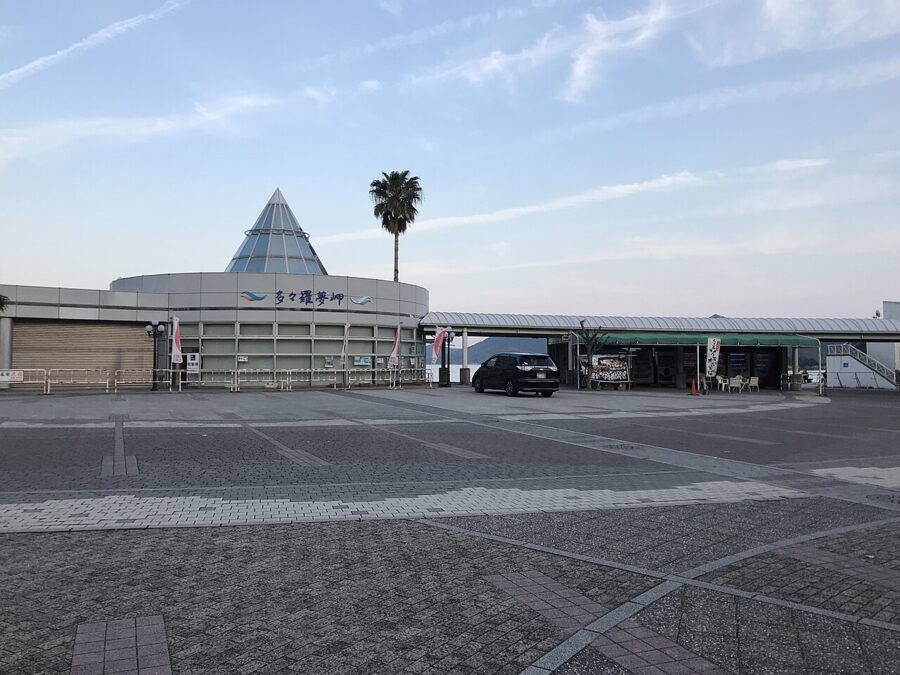
Boats leave Tadanoumi for the island from 07:40 to 18:40, roughly every 30 to 60 minutes, and the crossing takes 10 to 15 minutes. The last boat back from the island is the 19:15 passenger boat from Pier No.1. The 13:00 from Tadanoumi and the 13:20 back run on weekends and public holidays only. The Tadanoumi port terminal opens at 07:00 every day, has coin lockers at ¥500 (about US$3) a time, and has a free car park of about 200 spaces that fills early on busy days.
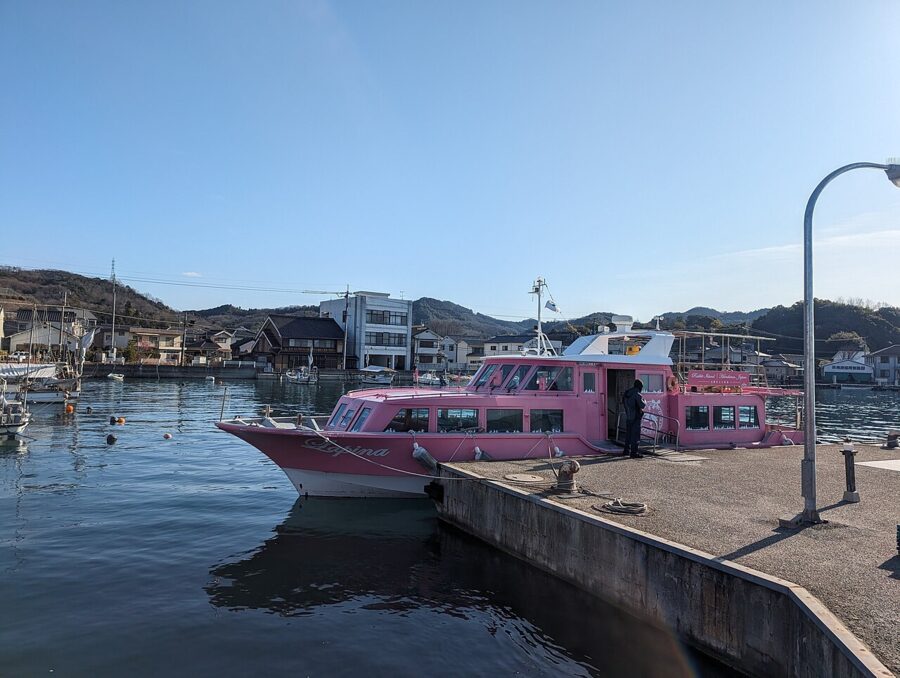
Fares, bikes and the two piers
An adult ticket costs ¥360 (about US$2) one way between the island and either Tadanoumi or Sakari, ¥720 (about US$5) return, and half that for primary-school children, as of 2026. A bicycle is ¥120 one way on any of the routes. Tadanoumi to Sakari direct is ¥370. The ferry company’s fare table has the rest, including cars, which can land on the island only by arrangement with the hotel.
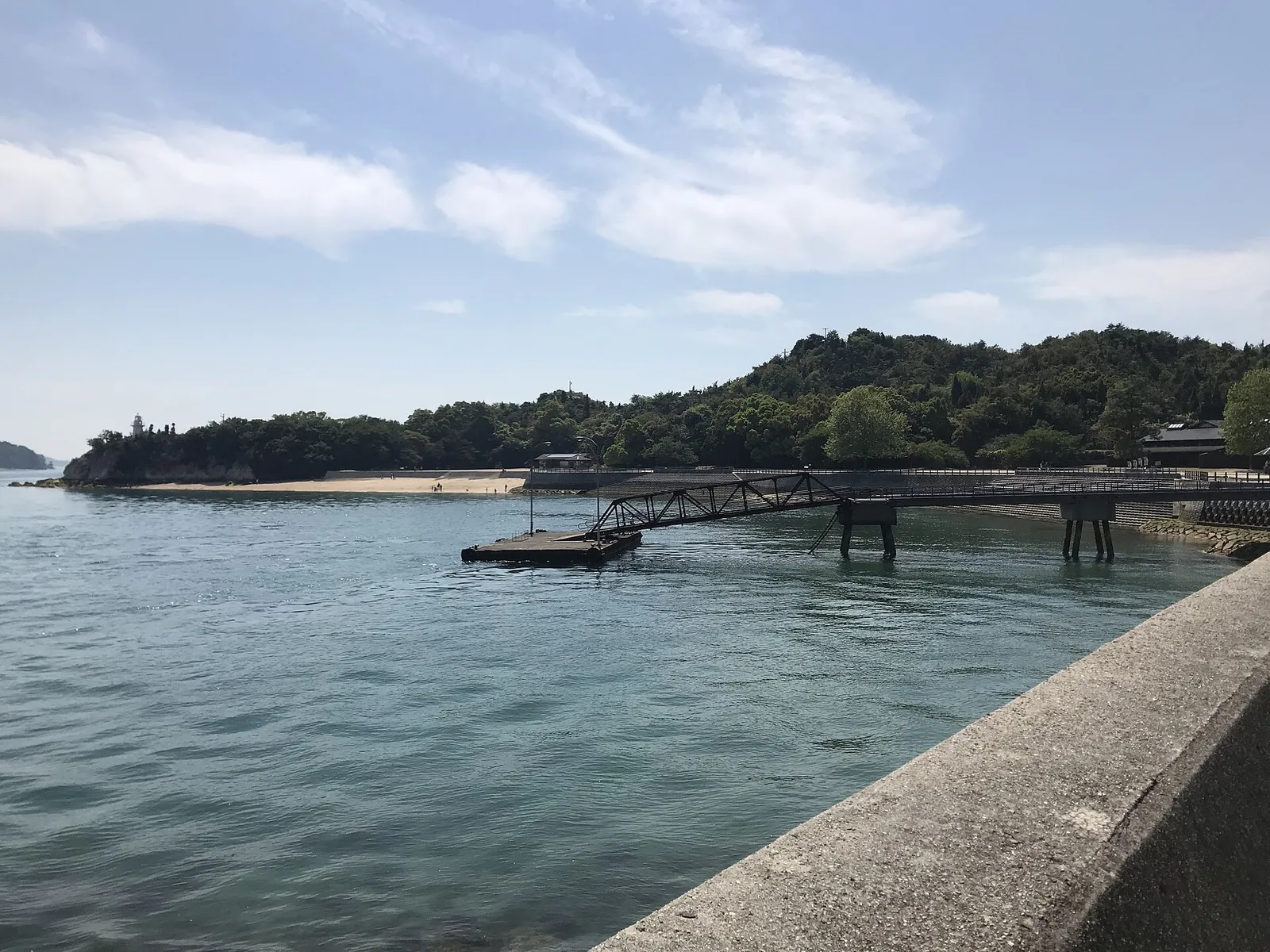
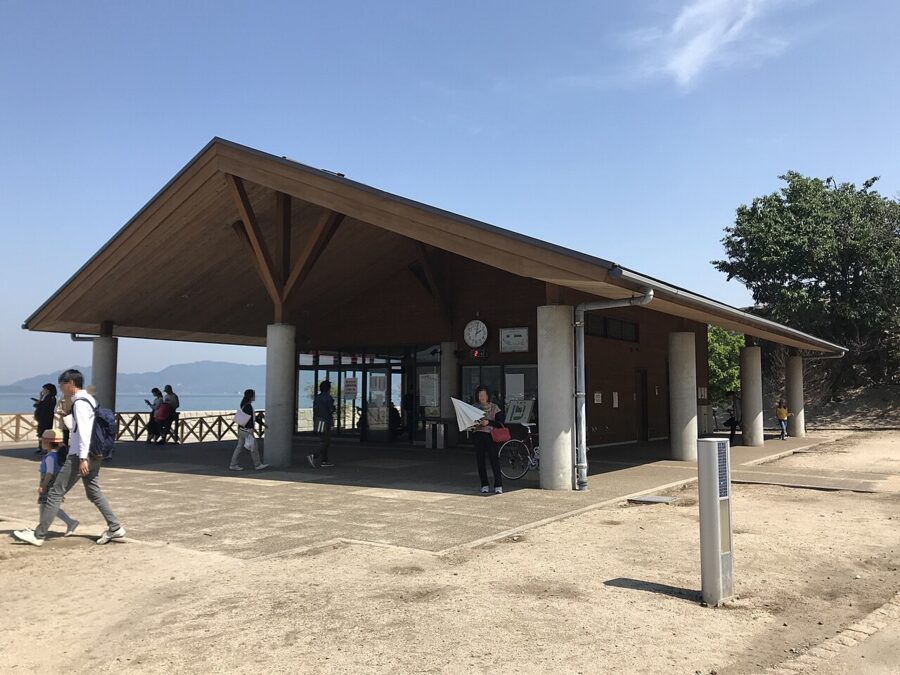
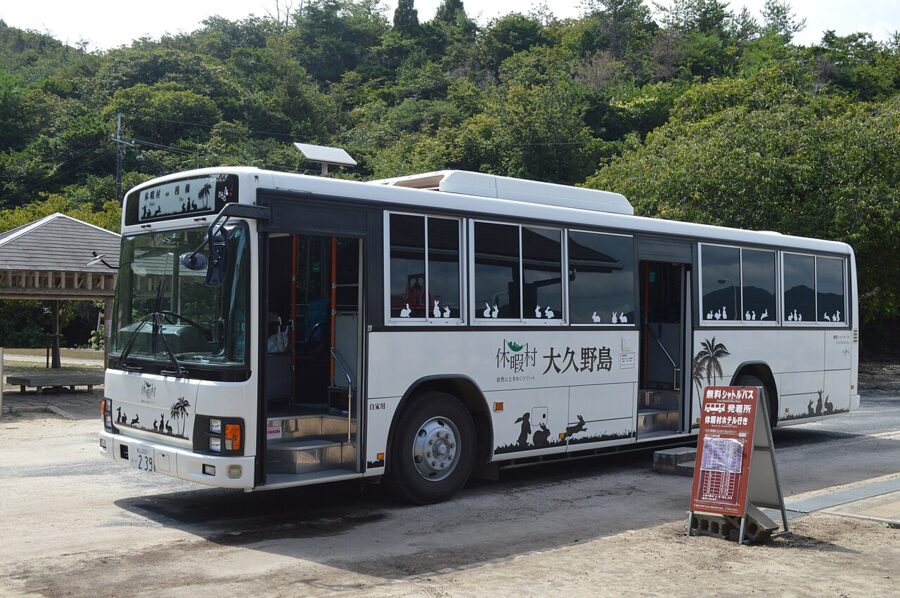
The island has two piers, and the timetable marks which boat uses which. Pier No.2, on the east side by the old power station, takes the Omishima Ferry and most of the passenger boats. Pier No.1, on the west side near the hotel, takes the first two boats of the morning and the last two of the evening. From Pier No.2 the hotel is about 15 minutes on foot, or a few minutes on the free shuttle bus, which meets the boats and needs no booking.
Boats stop for bad weather, and now and then for maintenance: in 2026 the hotel closed from 1 to 6 June and its passenger boats did not run from 2 to 4 June. The Omishima Ferry posts each day’s cancellations on its home page, so look before you ride to Sakari.
The rabbits
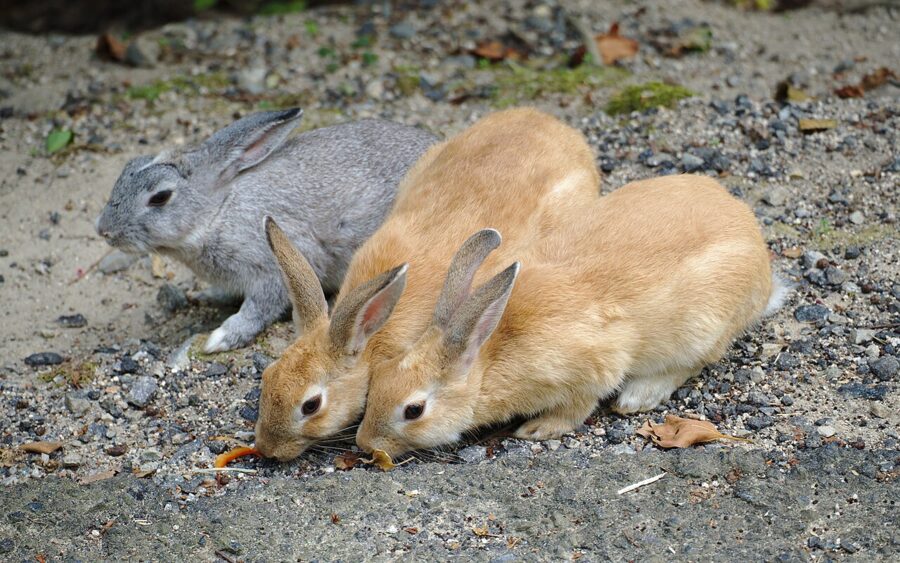
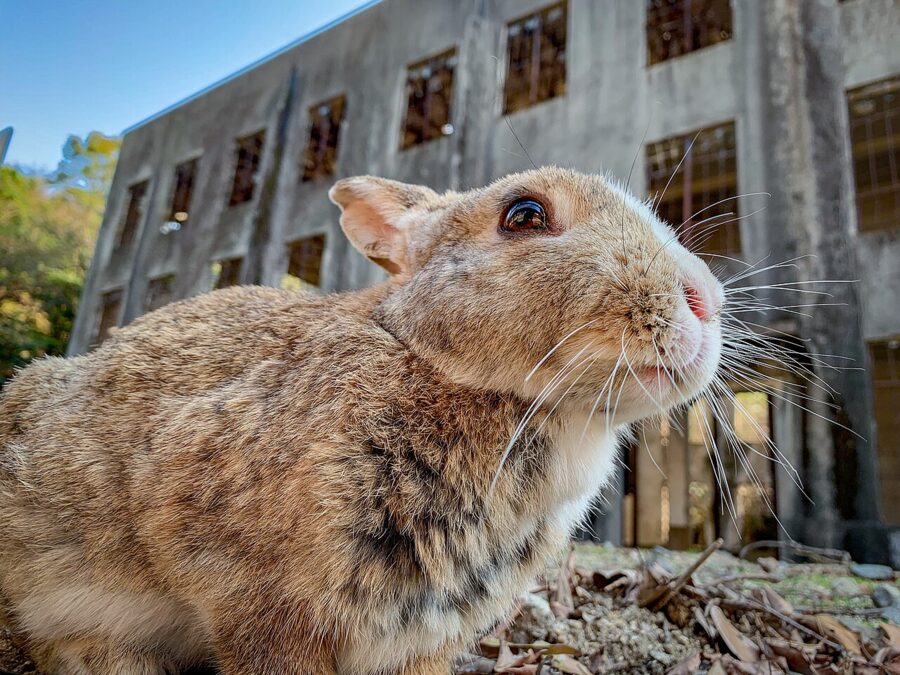
The rabbits are not native and not quite wild. They are kai-usagi, domestic European rabbits, the pet-shop animal, living free in a national park; in Japanese the island is simply Usagi-shima (うさぎ島), rabbit island.
How many, and where they came from
The rabbits have nothing to do with the gas works. Rabbits were kept for testing during the war, but the accepted account is that today’s population began in 1971, when rabbits kept at a primary school off the island were let go. Genetic work by Professor Shingo Kaneko of Fukushima University found a mix of types, which suggests that people have kept on bringing rabbits over and leaving them.
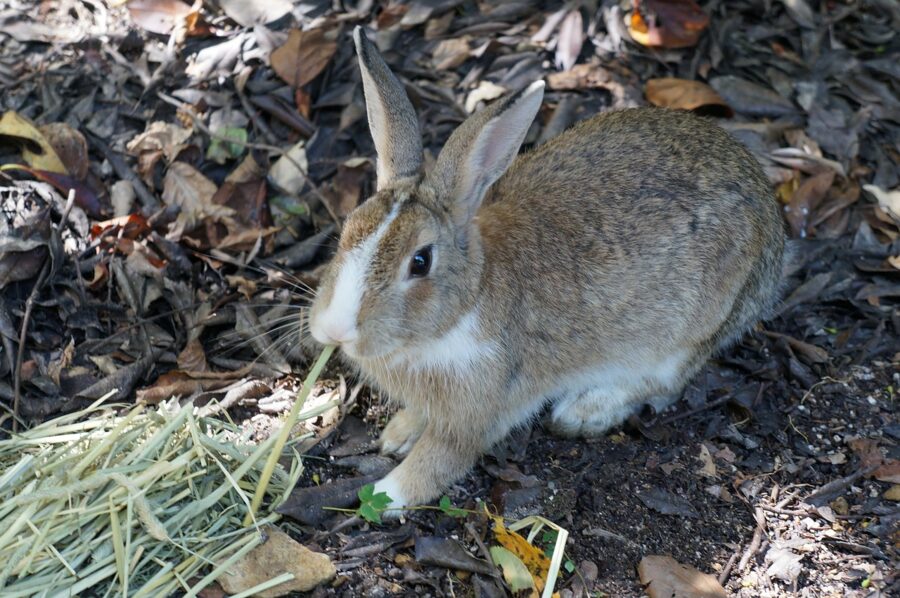
The island’s own signs still talk of about a thousand rabbits, but the counts tell a different story. In the Ministry of the Environment’s surveys, the highest figure was 921 in the first half of 2018. Numbers fell when visitors stopped coming in the pandemic, to 324 in early 2022, because the rabbits live on what visitors bring. They recovered to 510 by late 2023.
Then, between November 2024 and January 2025, 99 rabbits were found dead. A man who had come to the island twice to kill them was caught in January 2025 and given a one-year suspended sentence in April 2025. The count fell to 262 in late 2024 and was back to 449 in the first half of 2025. There are more cameras on the island now, and Takehara is looking again at a visitor tax for the island.
The island’s four rules
The rules come from a committee of the Ministry of the Environment, Takehara City, the hotel and local people, last revised in September 2024, and they are posted all over the island:
- Don’t touch the rabbits, and don’t feed them from your hand. They can carry fleas, ticks and illnesses that pass to people, a picked-up rabbit panics and can be dropped and hurt, and a rabbit going for food in your fingers can bite.
- Don’t feed them on the road, and watch your feet. A rabbit eating does not watch for bikes, and the shuttle bus uses the same roads.
- Stay until they have finished, and take the leftovers home. Food left lying rots and feeds rats, crows and wild boar.
- Bring no pets, and take no rabbits away. Dumping an animal is a crime, and the island’s rabbits do not take in newcomers kindly.
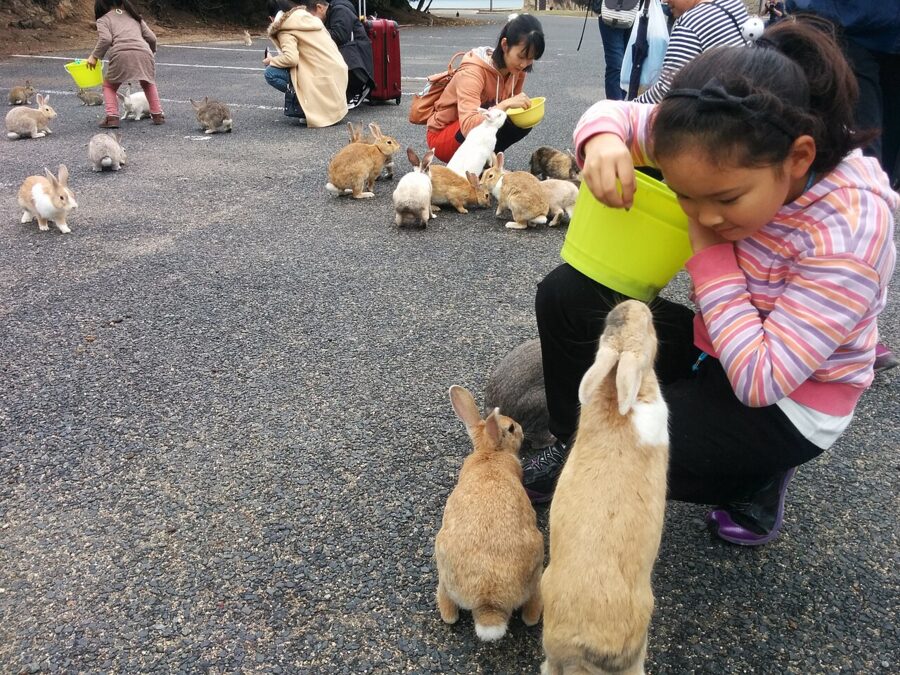
The notices from the Tadanoumi port terminal add a few more from long experience. No bread, crisps or other human food, and no potatoes or sweet potatoes, which rabbits cannot eat. Pellets left in the damp are wasted, since the rabbits will not touch them wet, and food pushed into a burrow shows the crows where the young are. Where there are water bowls, fill them: for the rabbits round the hotel, away from the springs in the hills, those bowls are their water.
What to bring them
Nothing on the island sells rabbit food, which the Hiroshima prefectural tourism guide makes a point of. Coming from Tadanoumi, buy a bag at the port shop or a convenience store near the station. Coming from Sakari, bring it with you from Omishima: cabbage leaves and carrots cut small travel well, and a small amount goes a long way.
Bring less than you think. The committee’s volunteers collect and weigh the leftovers, and on busy days there is a lot of it; a rabbit that has eaten all morning will ignore you in the afternoon.
The boars and the trouble with leftovers
Okunoshima also has wild boar. On 5 March 2024, at about three in the afternoon, a boar was seen near the ferry pier seizing a young rabbit and carrying it into the woods. A team from Fukushima University and Kure College of Technology published the case in July 2026; a visitor had seen the same thing in 2017.
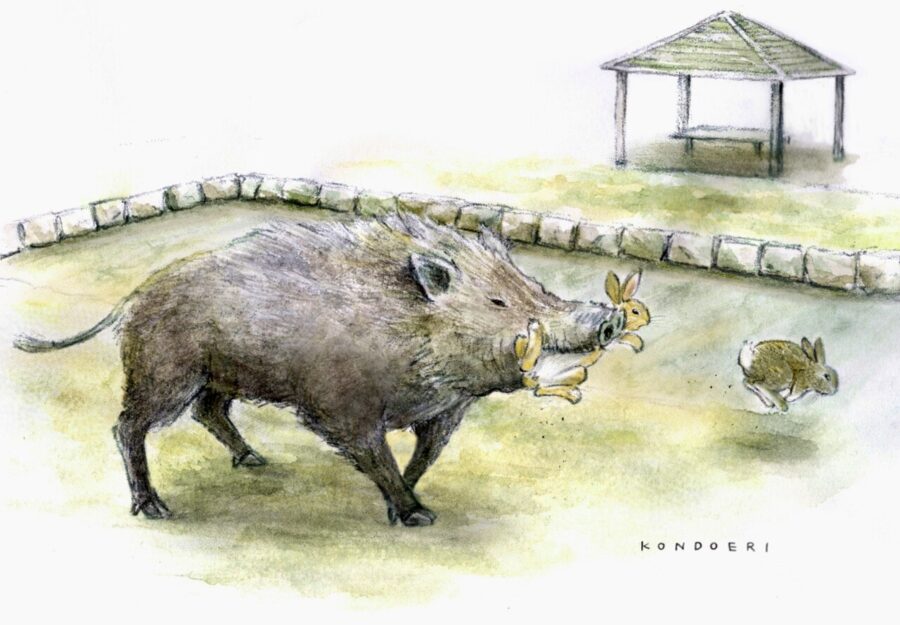
The researchers’ point is that the boars follow the food. Leftover feed and the bodies of rabbits that die draw them in, and the rabbits, too many for the island’s plants, have eaten the low branches bare to the height they can reach and have been gnawing oleander, which is poisonous. The leftover rule is the one that matters most.
When they are out
Rabbits are most active at dawn and dusk. In summer they spend the middle of the day flat out in the shade. Young rabbits appear from spring into summer, though around the births the mothers keep to the hills; if you find a young one, leave it alone, since a kit that smells of people can be attacked.
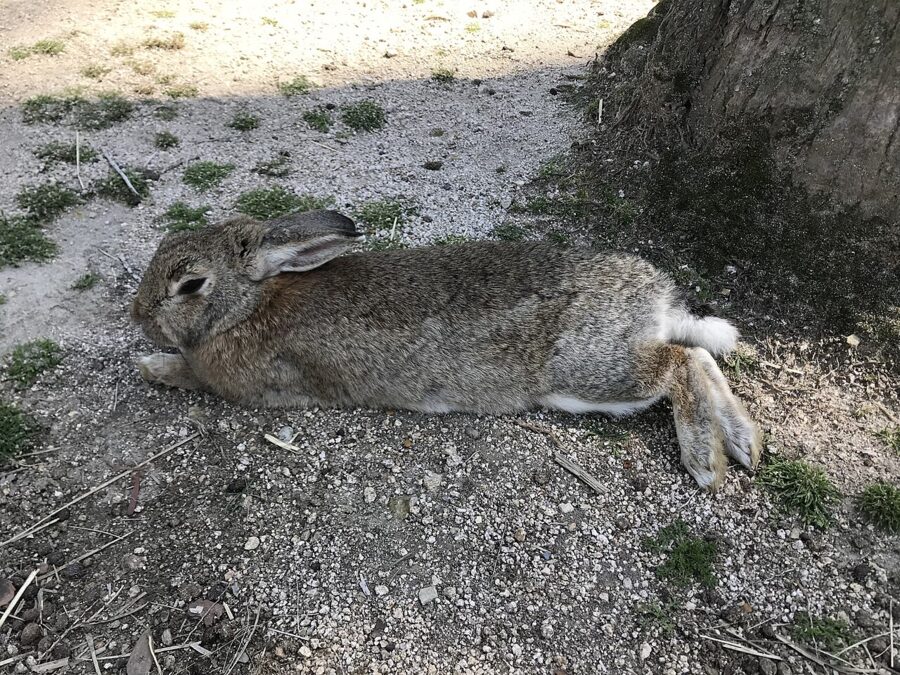
The most rabbits gather on the lawns in front of the hotel, where they are fed all day. For rabbits that run about rather than rabbits that have eaten their fill, come early, or stay the night and walk out at dusk.
The poison gas works, 1929 to 1945
In 1929 the Imperial Japanese Army opened a chemical weapons plant on Okunoshima, a branch of its Tokyo arsenal, and for sixteen years the island made gas. The farmers who lived there were moved off. The factories made mustard gas and lewisite, which blister skin and lungs, a sneezing agent, hydrogen cyanide and tear gas, and late in the war the paper balloons for the fugo balloon bombs meant to drift on the jet stream to North America.
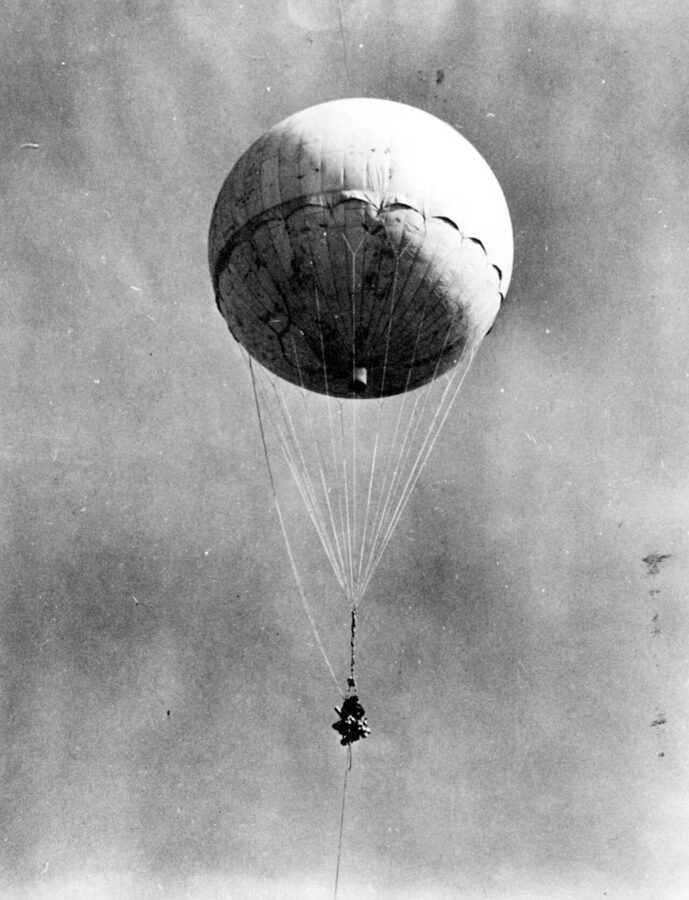
The work was secret, and workers were not allowed to tell even their families what they did. Their rubber suits, masks and gloves were not airtight, the gas got in, and many of them suffered damage to their skin, eyes and throats. The island is often called the island erased from the map, and it was left blank on maps of the time; maps of these waters had in fact been censored since the fortress was built, and the gas works kept them that way.
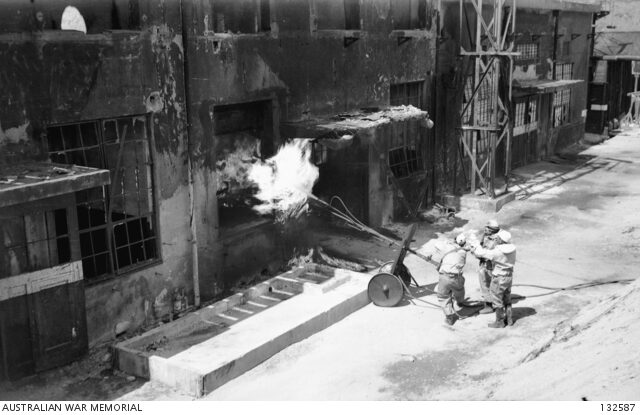
After 1945 the Occupation took the island over. In 1946 and 1947, under the British Commonwealth forces, the gas was shipped out and dumped in the Pacific off Tosa in Shikoku, burned or buried, and the buildings were burned out with flame-throwers. During the Korean War the US forces used the island as an ammunition store, from 1950 to 1955.
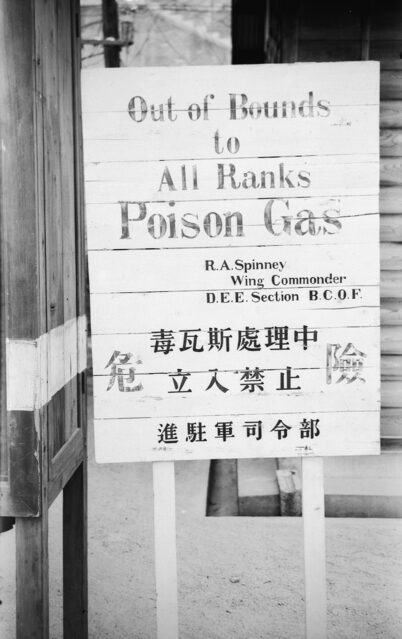
The clean-up was not complete. Gas was still turning up when the holiday village was built in the early 1960s, and in 1996 arsenic from burned lewisite tanks was found in the soil at the North Battery, which was washed clean in 1999. Kyukamura opened in 1963, and since then the island has been for holidays.
The Poison Gas Museum
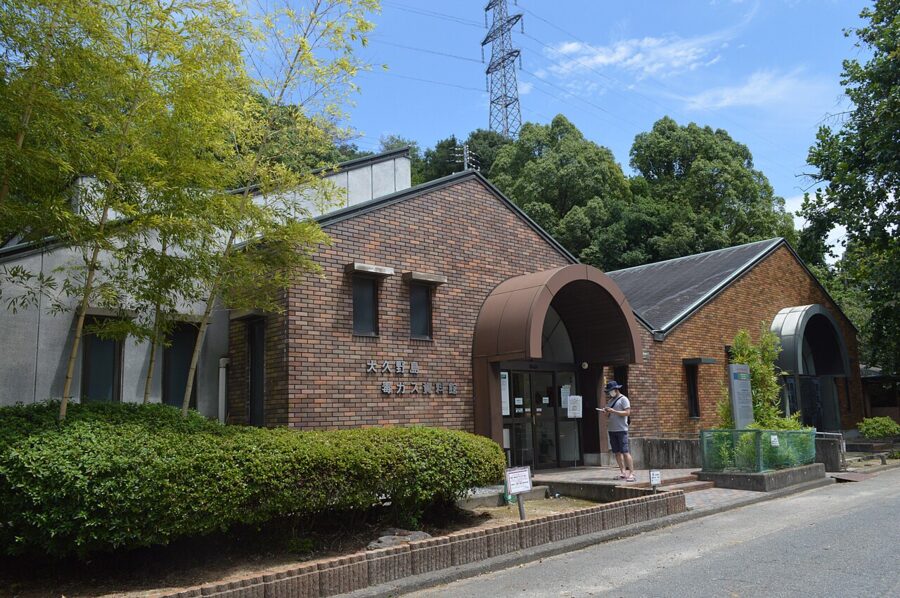
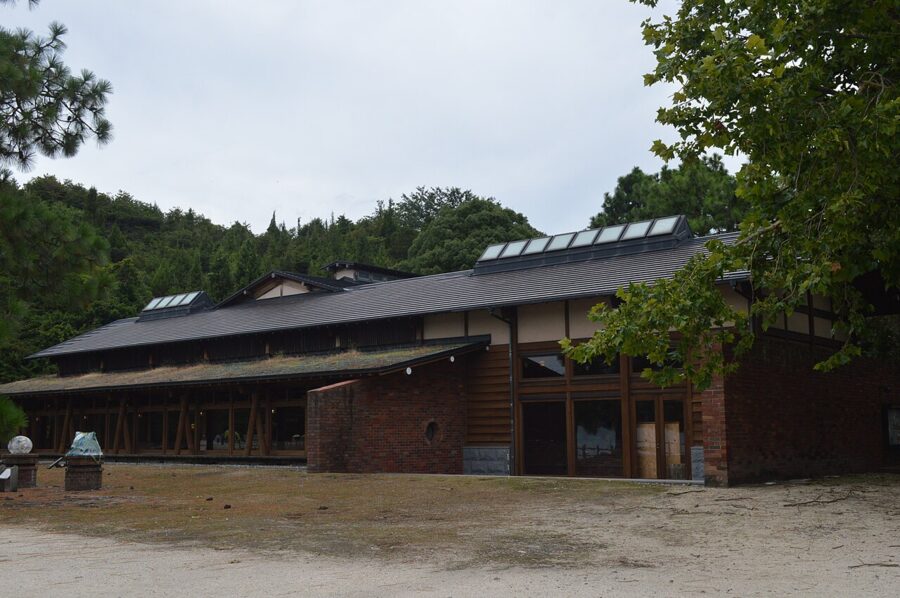
The Okunoshima Poison Gas Museum (大久野島毒ガス資料館) opened in 1988, built by Takehara with groups representing the people the gas works harmed. It is a small brick building a few minutes’ walk from the hotel, with two rooms. The first is about the factory: the leaking rubber suits, the masks, the equipment for making and storing gas, and the notebooks and training manuals of the workers. The second, set out like a classroom, shows what gas does to the body, with photographs from the Iran-Iraq war beside the island’s own record.
| Open | 09:00 to 16:00, last entry 15:40 |
|---|---|
| Closed | 29 December to 3 January, and on occasional extra days |
| Entry | ¥150 (about US$1) for anyone 19 or over; free under 19 (as of 2026) |
| Where | Near the hotel, about 15 minutes’ walk from Pier No.2 |
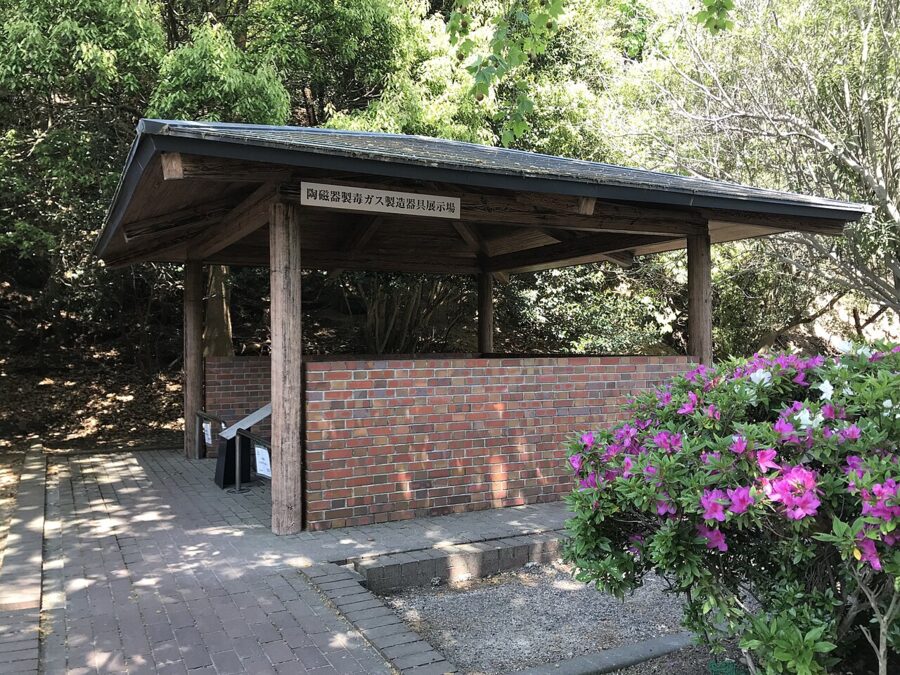
I would see the museum before the ruins, not after. A concrete shell in the woods is just a ruin until you know it held 100 tonnes of poison gas.
Walking the ruins
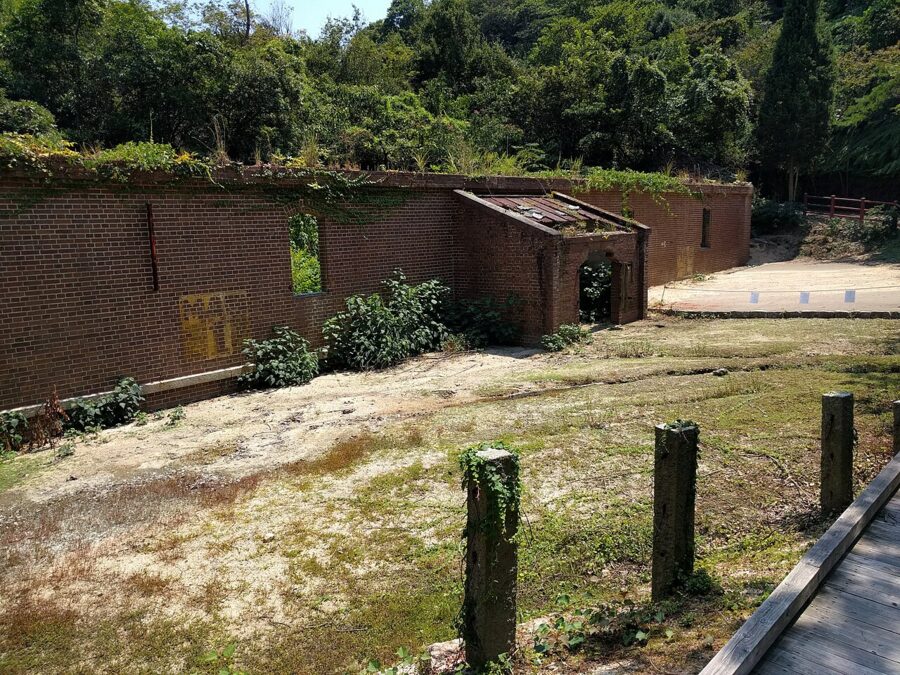
The gas-works ruins are scattered round the island, mostly fenced, and the ones you cannot enter are signed. Takehara’s list of the war remains runs to more than a dozen; these are the ones worth the walk.
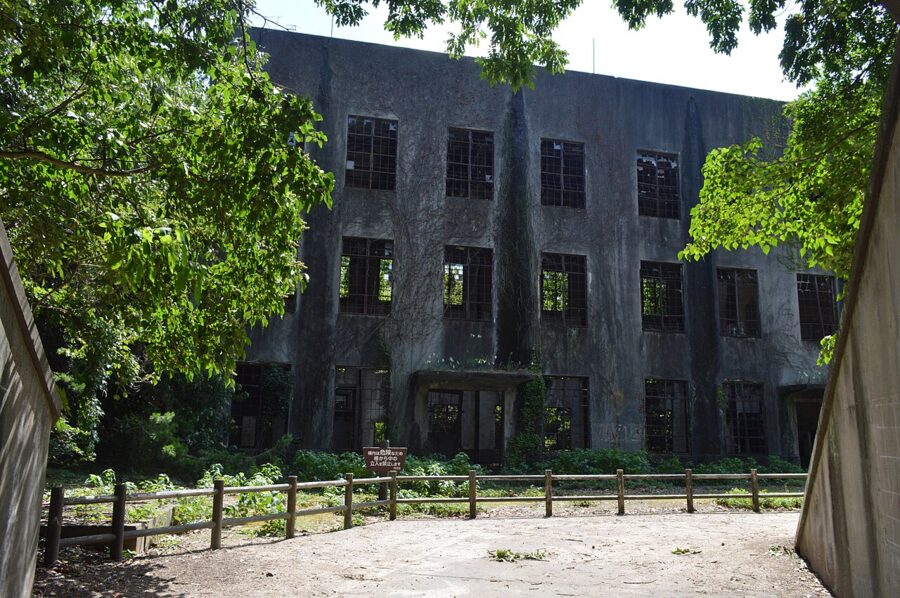
The power station is the big concrete block a short walk from Pier No.2. Its diesel generators powered the factories, an undersea cable from Tadanoumi added mainland power in 1941, and near the end of the war mobilised schoolgirls tested balloon bombs inside. It is closed for safety.
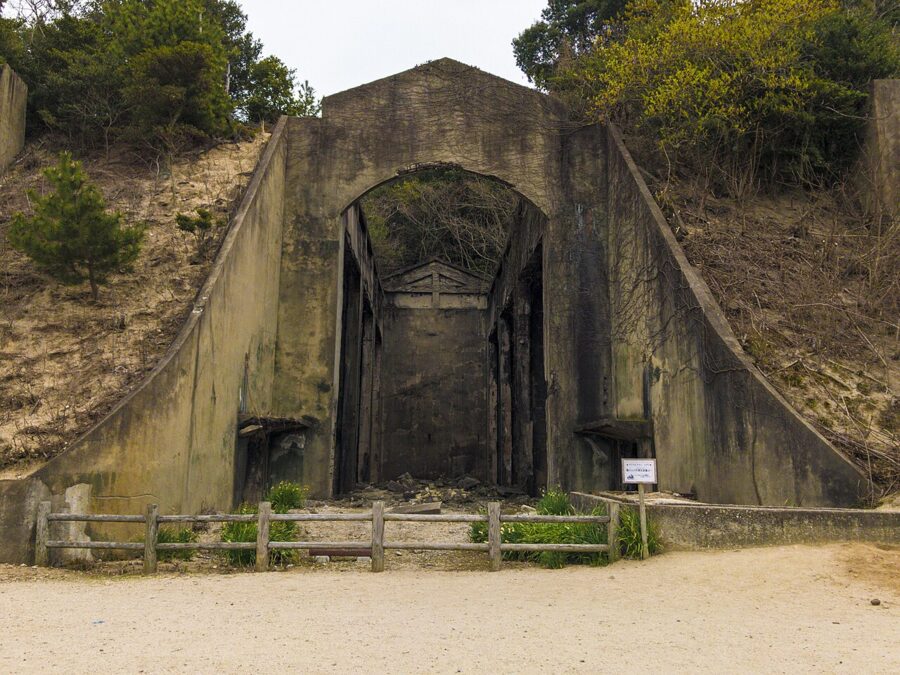
The Nagaura poison gas storehouse was the largest on the island, with six tanks of about 100 tonnes each. The walls are still black from the flame-throwers of 1946 and 1947. Elsewhere, in what is now woodland, is the open-air tank yard, where 32 concrete bases held more tanks under a simple wooden roof.
The laboratory and the testing building stand side by side, the white one where gases were developed and the grey one where they were tested; both are closed. The Sangenya works, where the main factories stood, is now an open field.
The telephone exchange bunker was built to survive air raids and still has its patches of yellow and green camouflage. Round the island are the stone-lined mouths of some of the 50 or so air-raid shelters dug for gas and supplies.
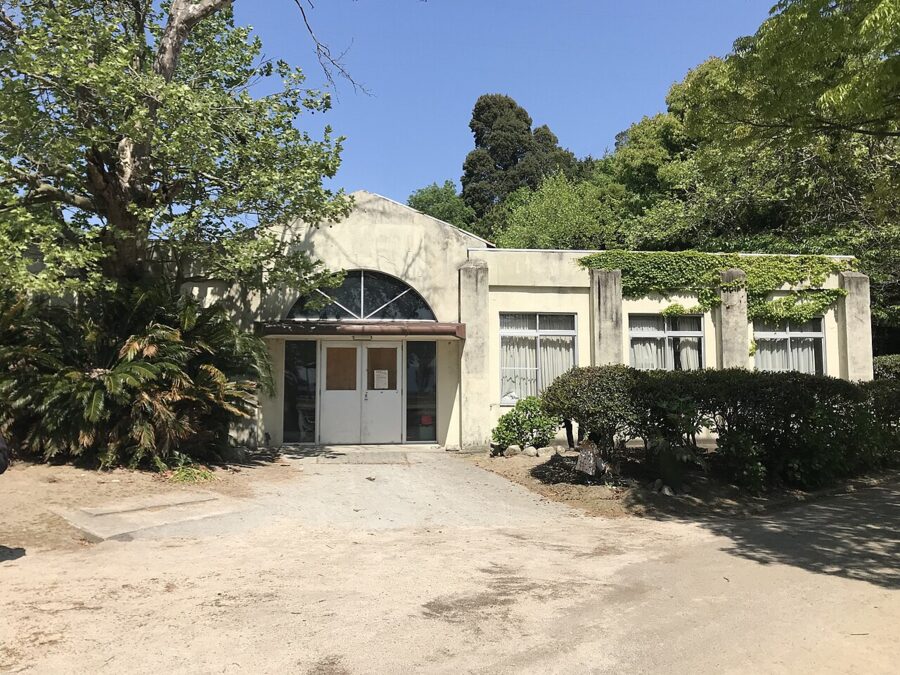
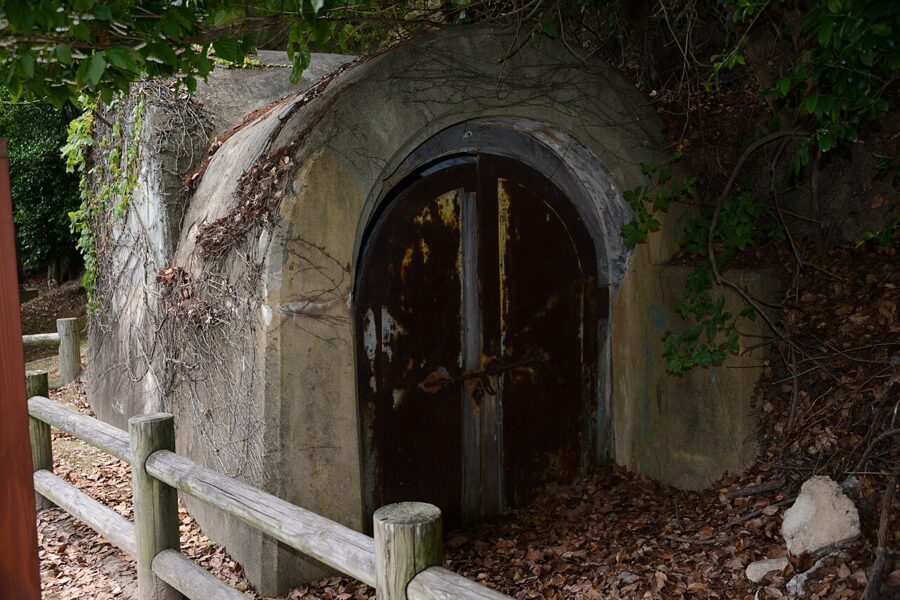
The memorial to those who died of the gas holds the names of people who worked in its making or disposal, and a ceremony is held there every October. Okunoshima Shrine, which the workers rebuilt when the factory opened, has a 1937 memorial to those killed on the job; the shrine itself is closed for safety.
Before the gas: the Geiyo Fortress
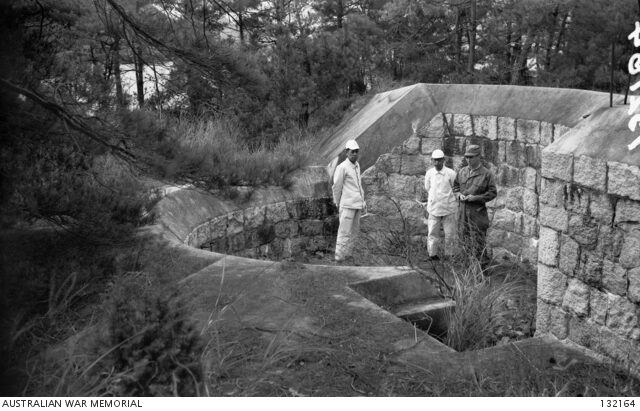
In 1902, before the war with Russia, Okunoshima was made part of the Geiyo Fortress, the guns that guarded the channels of the central Inland Sea. Three batteries, North, Middle and South, held 22 guns between them.
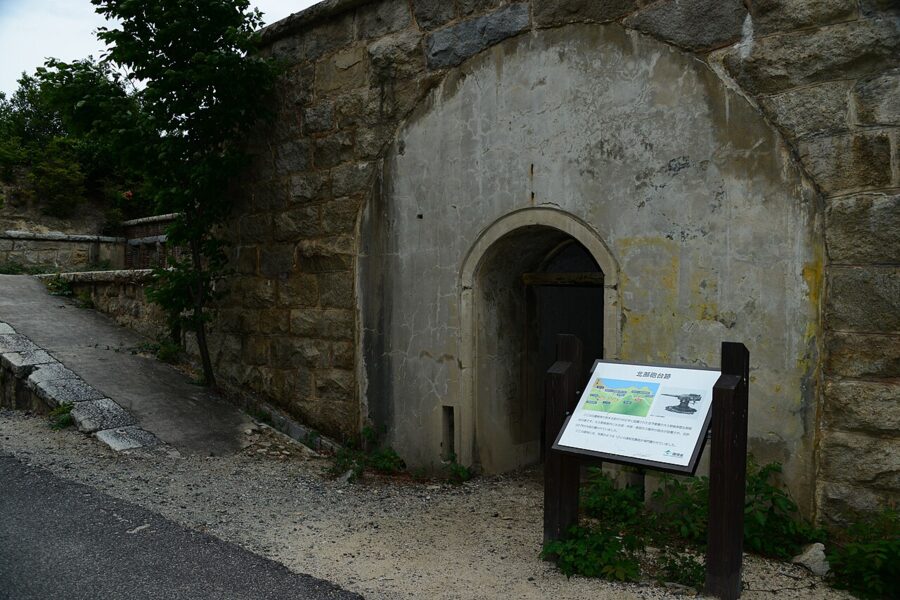
The North Battery is the most complete, with gun pits, magazines and an underground barracks along the ridge above the north shore. In the gas years it held a large tank of lewisite, and the arsenic from burning it is what was found here in 1996. The Middle Battery had six 28 cm howitzers, two of which were shipped to the siege of Port Arthur during the Russo-Japanese War; its gun pits and barracks still stand. The fortress never fired a shot in anger and was closed in 1924.
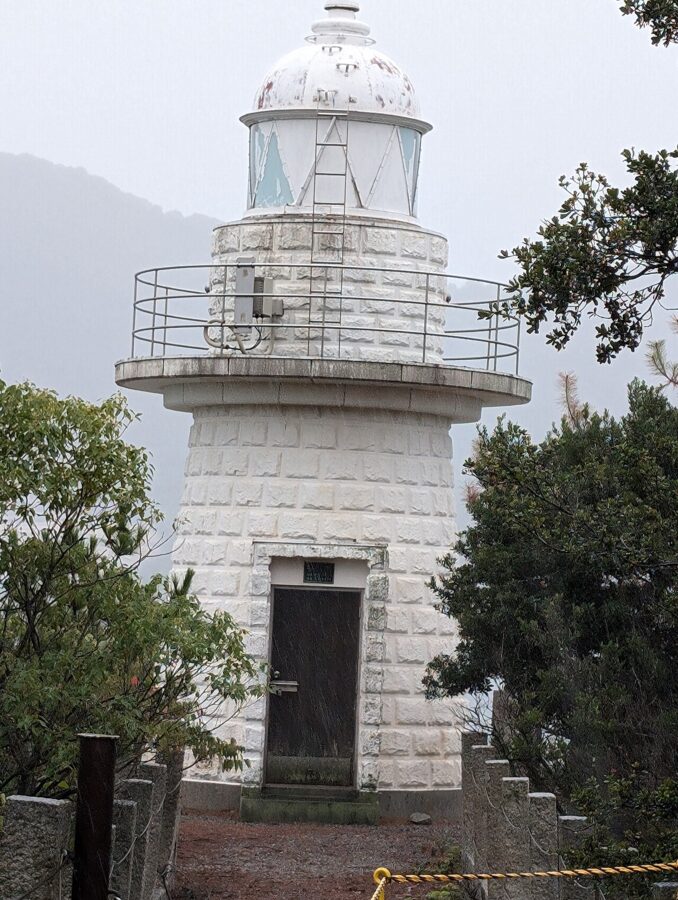
At the island’s southern tip is the Okunoshima Lighthouse, first lit in 1894, before any of the guns. It was one of a chain of lights on the Mihara Seto passage, the route ships took to avoid the Kurushima Strait. By the steps up to it stands an old army boundary post marking where the military land began. Near the south end, too, is the site of a searchlight from the fortress years, used to sweep the water at night.
Round the island on foot or by bike
A road runs right round the island, about 4 km (2.5 miles) with a few short rises, and walking it takes about an hour with stops. From Pier No.2 you can go either way; the hotel, the museum, the beach and Pier No.1 are on the far side. The paths up the hill are steeper.
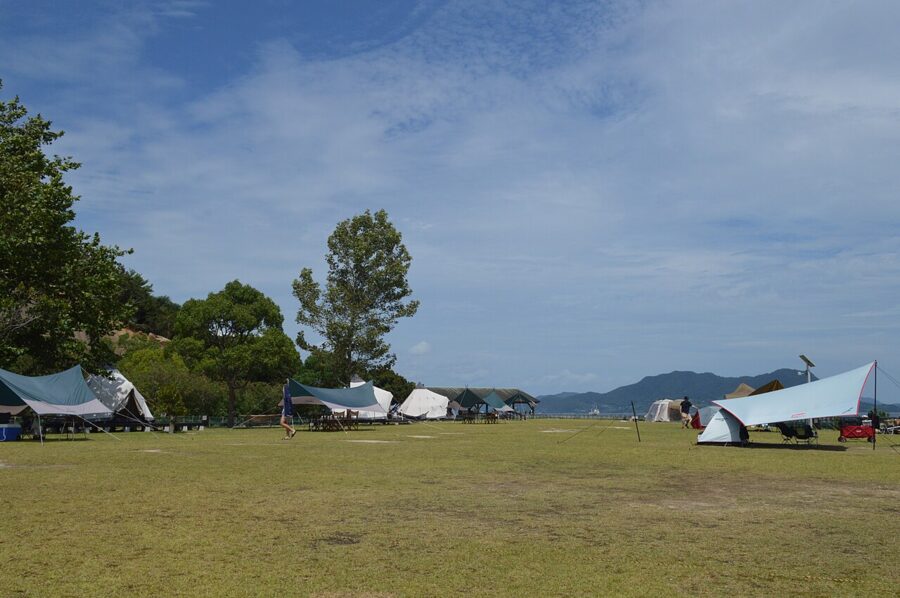
The Hyokkori observation deck sits on the island’s high point, about 100 m up, with a view of the islands all round; the climb takes about 30 minutes from the path between the campsite and the Visitor Centre. Two steel pylons carry power lines over from Tadanoumi, and at 226 m they are the tallest electricity pylons in Japan. You see them from everywhere.
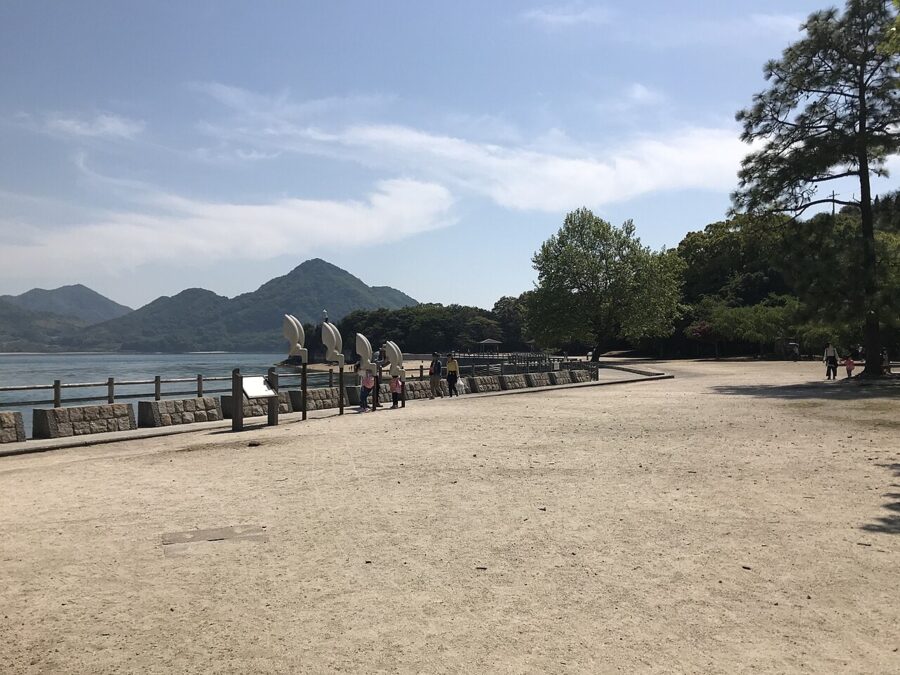
Bikes for hire come from the hotel’s front desk, with child sizes and electric ones, in two-hour slots; reports from 2026 give ¥600 (about US$4) for a standard bike and ¥900 (about US$6) for an electric one for day visitors, with a ¥1,000 (about US$6) cash deposit, and no booking. Your own bike from Sakari is fine. Ride slowly: the rabbits run across without looking, and a rabbit eating in the road will not move for you.
For the history explained as you go, Takehara’s guided cycling tour runs in Japanese or English at 10:20 and 13:20 and costs ¥9,000 (about US$60) for adults and ¥4,500 (about US$30) for under-16s; book through the Takehara tourism office, not the hotel.
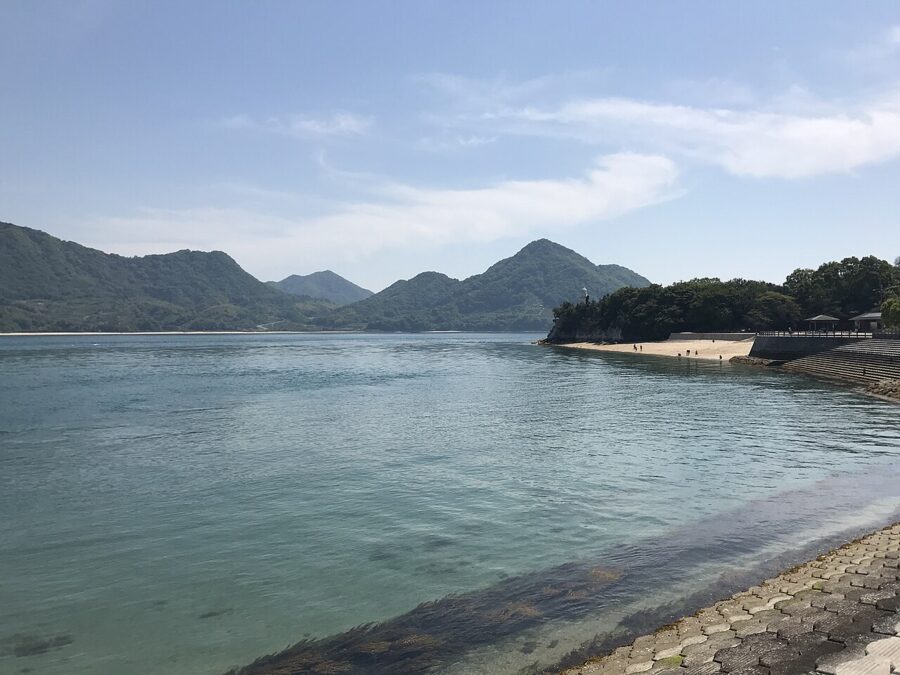
The beach is five minutes from the hotel: sand, clear water and Omishima across the channel. In the summer holidays it has toilets, changing rooms and a kiosk, and showers at ¥300 (about US$2) for three minutes. The hotel’s outdoor pool opened from 18 July to 30 August in 2026, at ¥400 (about US$3) for adults.
Kyukamura Okunoshima: a bed, a bath and lunch
Kyukamura Okunoshima is the only place to stay on the island, a large resort hotel facing the sea and the rabbit lawns. It belongs to the Kyukamura chain of national park resorts and opened in 1963. Check-in is from 15:00, and it is open all year apart from short maintenance closures.
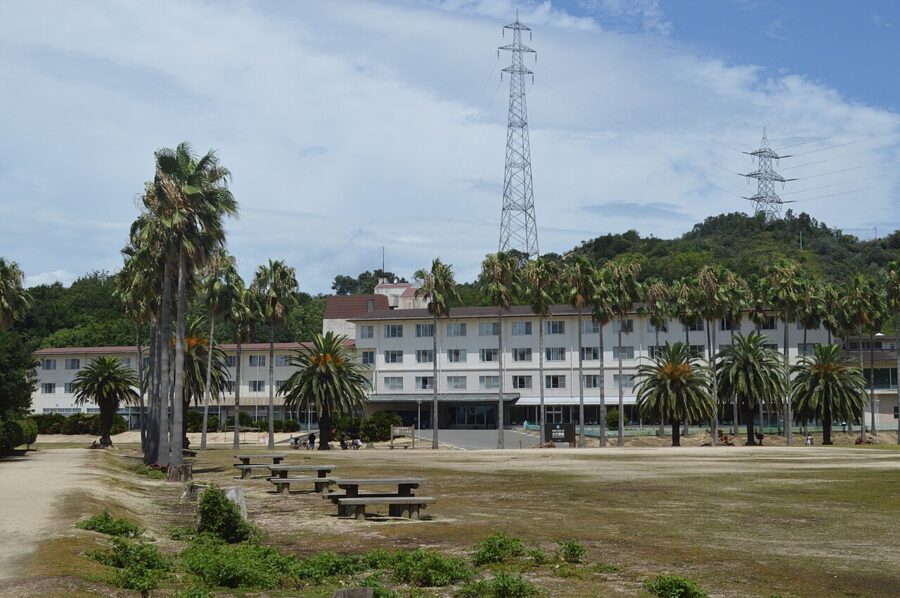
Staying the night is the way to see the island at its best. The day visitors leave on the evening boats, and the rabbits come out at dusk and again at first light, when they are most active. For a Shimanami rider it also solves the timetable: the 08:45 from Pier No.2 lands you at Sakari at 09:00 with the whole day to ride.
The hotel has a hot spring, a radon spring said to help with tiredness and cold hands and feet, in baths with a view over the sea. Day visitors can use it too: ¥550 (about US$4) for adults in 2026, from 11:30, with last entry at 16:30 on weekdays and 14:30 at weekends and on holidays.
Eating
Restaurant Usanchu, on the hotel’s ground floor, is the only restaurant on the island. Lunch is 11:30 to 13:30 (last orders 13:00), and the menu runs to an octopus set meal at ¥1,700 (about US$11), seafood curry at ¥1,050 (about US$7) and Takehara’s local fish rice, uomeshi, limited to ten servings a day, at ¥1,550 (about US$10). Dinner is a buffet of Inland Sea food from 17:30, with last entry at 19:00, and must be booked.
Next door, Usanchu Cafe is open 10:00 to 18:00, with light meals until 16:30. It does coffee from ¥450 (about US$3) and a vanilla soft-serve topped with cocoa peanuts at ¥550. The cafe and the restaurant are the only places on the island to buy food and drink, so carry water on the walk round.
Fitting it into a Shimanami Kaido ride
Okunoshima is in Hiroshima Prefecture and Omishima is in Ehime, but on the water they are neighbours. Which of three plans suits you depends on where you are sleeping.
As a detour from Omishima. Cross the Tatara Bridge from Ikuchijima, turn north-west at Tatara Shimanami Park and ride the 5.5 km to Sakari for the 11:25. You land at 11:40 with time for lunch at the hotel, the museum and a walk to the ruins, then take the 14:19 or the 15:29 back to Sakari and ride on to Oyamazumi Shrine or to wherever you are staying on Omishima. It adds about 11 km (7 miles) of riding and three to four hours to the day.
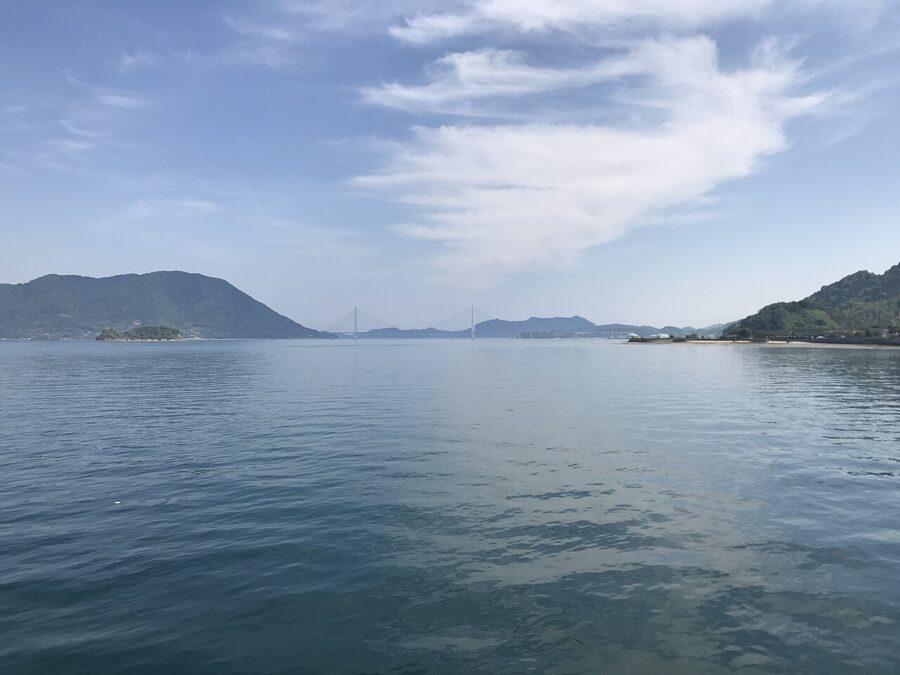
As the start of the ride. Come from Onomichi or Hiroshima by train to Tadanoumi, cross to the island in the morning, and take the Omishima Ferry on to Sakari to join the route on Omishima with your own bike. From Sakari it is three more bridges south to Imabari. It suits riders coming from the Hiroshima side.
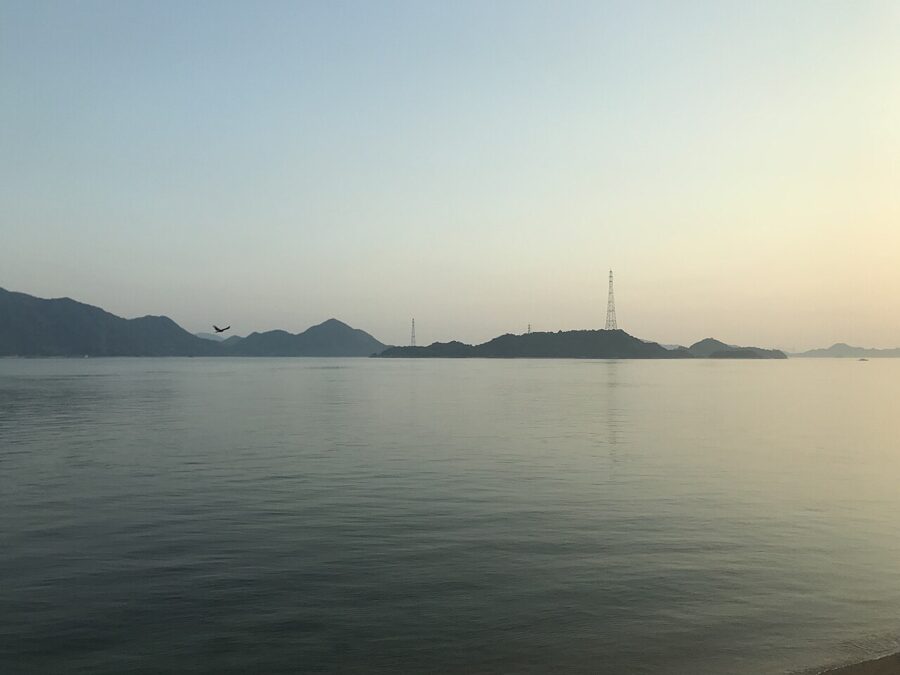
As a night off the route. Ride to Omishima, take the 15:50 from Sakari to the island, stay at Kyukamura, and catch the 08:45 back to Sakari in the morning. You see the rabbits at their best, the bath is yours after the day visitors go, and you lose no riding time at all.
For bags, there are coin lockers at Tadanoumi; on the route itself, the bag services in Shimanami Kaido luggage and ferries can send yours ahead. Okunoshima is one of several ferry islands off the Shimanami Kaido, and the Kure Line trains to Mihara tie it into getting to the Shimanami Kaido from the Shinkansen.
When to go, and when it is crowded
The island is busiest at weekends, during Golden Week at the start of May, in the school summer holidays and on three-day weekends. On those days the Tadanoumi car park is full by mid-morning, the boats are crowded and the rabbits are full by lunchtime. The car park tends to free up after three in the afternoon.
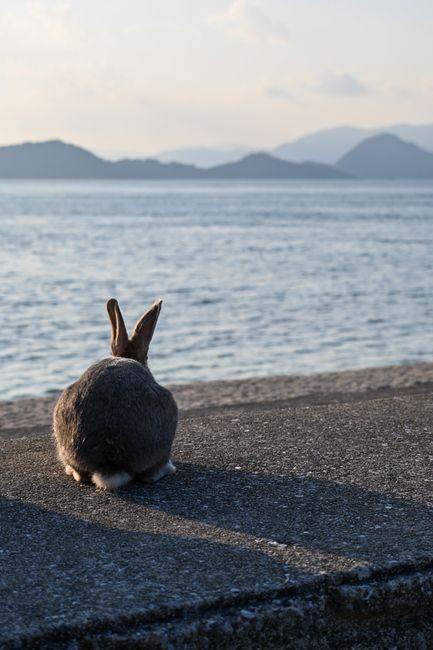
Spring and autumn are the best seasons: mild days, active rabbits, young ones in spring. Summer is hot, the rabbits hide at midday, and the beach and pool are the draw. Winter is the quietest time, but the 17:00 from Sakari does not call at the island from November to January, and the days are short. Spring and autumn are also the best time to ride the Shimanami Kaido, so the two fit together; remember the museum’s New Year closure from 29 December to 3 January.
Whenever you go, the rules are the same: food on the ground, not on the road, no touching, leftovers home.
And look at your watch at four. Pier No.2 is on the east side, the hotel and the museum are on the west, and the 16:39 does not wait for anyone still feeding rabbits on the hotel lawn.